
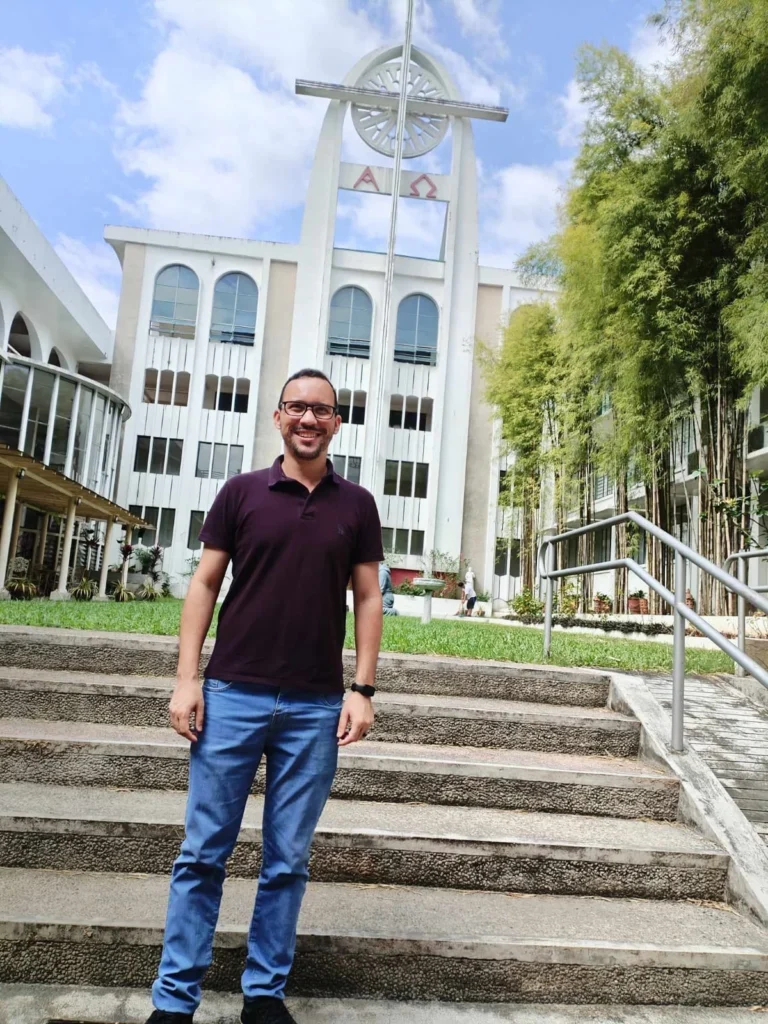
When I first got to the Philippines and started my intersection classes in June and July 2023, I had to deal with a lot of changes beyond just school stuff. I had to get used to a new rhythm of life, adjust to new cultural codes, learn new ways of communicating, improve my English, and figure out how I could fit into a new setting. Even simple things became part of a process of learning and becoming more integrated.
During this time, two questions kept coming back to me amid all these changes I was going through: How can I live my vocation as a Brazilian Jesuit in this new reality? And in this new setting, how can I faithfully pursue my academic mission?
Something was unsettling about these questions, and they continued to disquiet me for a while back then: Am I to lose my Brazilian self in the universal? Was my Brazilian identity something to be temporarily set aside, or was it a richness to be offered, even at the risk of misunderstanding? The former at the expense of the latter? The latter at the expense of the former? In other words, should I dissolve myself into the universal, or consciously affirm myself in the particular?
As I started my first year of theological studies at Loyola School of Theology, I brought these questions with me. They became more than abstract reflections. They affected my expectations, my relationships, and how I interacted with both academics and the community as I went into my first semester. I gradually worked through it through my studies, interactions, and everyday experiences.
As time passed, LST helped me not only find answers but also reformulate the questions themselves, precisely because of its deeply universal identity, firmly grounded in its character as a Jesuit, Filipino, and ecclesiastical institution. In this context, I discovered that it is not about deciding between being universal and rooted in my own culture, but rather about understanding how my cultural identity opens doors to the universal and how the universal, in turn, deepens that identity.
This growing understanding did not emerge from abstract reflection alone, but from concrete life within the LST community. From my very first days at LST, I was warmly welcomed with open arms by a community that reflects the universality of the Church and the Society of Jesus. This experience of being welcomed created an immediate sense of belonging, easing my transition into this new environment. At LST, diversity is not merely an abstract concept. It manifests concretely in the faces, accents, stories, and ecclesial backgrounds of colleagues from all over Asia and other parts of the world.
In this environment, I also learned that studying and doing theology are not just intellectual exercises. It is primarily about relationships: with God, with people, and with the Church. It is about a real call to respect each other, to respect cultural particularities while building bridges of mutual understanding. This theological and multicultural experience has meaningfully marked my sense of identity and belonging.
Going back to the initial questions, I am becoming more aware that interactions with others enhance rather than diminish my own identity. The particular and the universal are not opposing forces but complementary dimensions of the same reality, a calling to the same vocation. I should emphasize that such an experience strengthens my sense of belonging to a global apostolic body, united in diversity. Beyond theological learning, LST has been a very good school for experiences of respect, friendship, and genuine hospitality.
All this portrait of growth and enrichment, however, would be incomplete without acknowledging the challenges that come with this journey. In this context, the challenges are not merely obstacles to be overcome, but formative experiences that, within a multicultural community like LST, become genuine theological data and privileged spaces where the Spirit of God acts, educates, and leads each one of us. Language barriers, different pedagogical approaches, and the demands of academic life, and so on, tested my resilience and pushed me to grow in ways I had not anticipated.
However, what made every challenge manageable and meaningful is another dimension that has become central to my experience at LST: the friendships built along the way. Here, bonds are created that go far beyond the classroom. Daily life together, group work, liturgical celebrations, theological hours, various events, batch gatherings, and even shared difficulties created deep ties that sustained and encouraged me. These friendships became a concrete expression of the communion that theology speaks about: a lived reality of mutual support, honest conversation, and shared hope for the Church’s mission in the world.
As I reflect on all these aspects—the questions, the challenges, the community that welcomed me, and the friends who sustain me—I have to say one word describes my LST experience: gratitude. Gratitude, for the diversity that challenges and enriches, for the welcome that makes me feel at home, for the dialogue that enriches me, for the theological formation, for the friends who sustain me in good times and in bad, and for the confirmation of my vocation as a Jesuit sent to the frontiers. LST has not only formed me intellectually. I have not only earned credits in many subjects. LST has formed me to become a better Christian and a better Jesuit. My time in the Philippines at LST has given me a lens for seeing the world, the Church, and mission with greater depth, humility, and hope. This is a real gift from God. Here, my faith found new language to express itself, my Jesuit vocation gained broader horizons, and my understanding of the Church’s mission became more inclusive and dialogical. I learned to appreciate the richness of Asian theological perspectives, the vitality of Filipino popular religiosity, and the prophetic witness of a Church that serves people in so many different settings with creativity and compassion.
I was the first from the Province of Brazil and the Conference of Jesuits of Latin America and the Caribbean to be sent to study theology at this “Areopagus,” which is LST. I am grateful not to be the last, since every good experience deserves to be shared, promoted, and celebrated. I hope that future students from many parts of the world can also find here a place of intellectual growth, spiritual depth, and genuine fraternity, so they also can carry this experience back to their own contexts, enriched by the encounter with diverse cultures and theological traditions, better prepared to serve the mission of the Church in our complex and interconnected world.
—–
Carlos Cesar Barbosa, SJ, is a Jesuit scholastic of the Jesuit Province of Brazil. He holds a degree in International Relations and, before entering the Society of Jesus, worked with migrants and refugees. He is currently in his third year of theological studies at the Loyola School of Theology. His academic interests focus on pastoral theology, ecclesiology, migration and refugee studies, and the interaction between Catholicism, politics, and society in Latin America and Brazil, and now also Asia.