
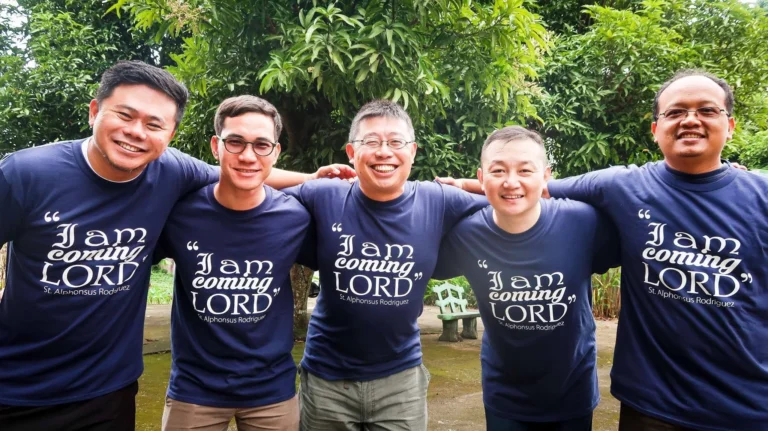
In an age dominated by performative success, personal branding, and the relentless pursuit of social status, young men across the world are quietly wrestling with a fundamental question: Where can I live a life of profound, authentic impact without losing my soul to the ladder of ambition?
In a world that constantly asks, “What title do you hold?” or “What position have you achieved?”, the vocation of the Jesuit brother offers a radical, liberating alternative. It is a call not to climb, but to descend into true companionship; not to govern from an elevated platform, but to walk side-by-side with humanity.
As an educator, formator, photographer, and former Convener of Jesuit Brothers for the Asia Pacific region, my answer to life’s deepest longing did not begin with a grand public gesture or a desire for clerical authority. It began in the quietest, most intimate corners of the human heart, where God speaks in a whisper.
An Encounter in the Silence
Looking back on the moments that reshaped the trajectory of my life, I can say my vocation started with an encounter. It was an encounter with God in its most intimate moment—meeting Christ in the silence of my heart during retreats and recollections when I was in college.
Before any formal discernment, before any understanding of religious vows or apostolic orders, I was simply a young man allowing himself to be loved by God. In those sacred spaces of silent recollection, the noise of the world faded, leaving behind an inescapable reality: Christ was real, personal, and calling me by name.
That interior, contemplative encounter quickly overflowed into active service. As a college student at Ateneo, I joined the Ateneo Catechetical Instruction League (ACIL) and began teaching catechism to young children in Camino Nuevo. In those humble classrooms, amidst the energy, laughter, and wide-eyed curiosity of youth, something profound shifted within me. Faith ceased to be an abstract set of doctrines taught in textbooks; it became a living, breathing reality.
I began seeing Christ in everything I did. It wasn’t just about learning theology; it was about encountering a living Person in the faces of those kids.
The defining turning point came during his ordinary, everyday duties as a student custodian. Part of my routine was hauling broken wooden desks to the campus woodwork shop for repair. It was there that I crossed paths with Br. Griffin, SJ—a veteran Jesuit Brother whose life was defined by the quiet rhythm of labor and hospitality. Br. Griffin’s days were spent shaping wood with calloused hands, but his workshop was far more than a carpentry room. It was a sanctuary. Students, faculty, and workers drifted in and out, drawn by the Brother’s quiet warmth, listening ear, and unpretentious wisdom.
Watching Br. Griffin, I realized you could preach the Gospel without ever stepping into a pulpit or wearing clerical robes. His holiness, faithfulness, and humility were contagious. That’s where my vocation took firm root—not in an abstract idea, but in an authentic human encounter.
A Gift of the Spirit: The Fundamental Identity of the Jesuit Brother
Throughout the history of the Catholic Church, the vocation of the religious brother has sometimes been misunderstood. Well-meaning people often ask, “Why didn’t you become a priest?” or assume that a brother is simply a priest “in training” or someone who “didn’t finish theology.”
Nothing could be further from the truth.
The Society of Jesus—founded by St. Ignatius of Loyola in 1540—has always recognized that the Jesuit brother is not a diminished version of a priest, but a full, vibrant, and essential expression of religious life. In official Church documents, the Society frames the brother’s life not as a compromise or a backup plan, but as a special grace given to the Church.
As General Congregation 34 (Decree 6) explicitly states:
“The vocation of the brother is a gift of the Spirit to the Society, by which he participates fully in its life and mission… He expresses in a unique way the religious character of the Society, reminding all of the fundamental identity of Jesuits as brothers in Christ.”
Because Jesuit Brothers and Jesuit priests pronounce the exact same religious vows—poverty, chastity, and obedience—they share an identical Jesuit identity. They are bound together as companions in one single apostolic body. However, while the priest exercises a sacramental and liturgical ministry, the brother expresses his consecrated life directly through lay apostolic action, professional skill, and everyday fraternity.
Working silently behind the scenes or at the very frontlines of secular culture, the brother’s fundamental identity is rooted in being a companion. He preaches not through formal sermons from an altar, but through the daily, tangible practice of Gospel values. He works alongside men and women in schools, laboratories, refugee camps, art studios, and community centers, demonstrating that the sacred is found squarely in the secular.
As General Congregation 31 (Decree 7) reminds us:
“Brothers, through their religious consecration, give witness to a life directly devoted to God in apostolic service, showing forth the Gospel value of simple, loving brotherhood.”
In a world fractured by division and hierarchy, the brother’s very self becomes the homily—a living witness to God’s non-judgmental love and a visible image of Christ walking as a friend among His people.
The Freedom to “Waste” Quality Time
Because Jesuit brothers do not have sacramental duties such as hearing confessions or celebrating daily public masses, they possess a unique, holy freedom: the time to simply be present where people live, struggle, and grow.
My mission as a Jesuit brother is wasting quality time with the young and bringing them closer to Christ.
In a modern productivity-obsessed society that measures every minute by output and financial return, the idea of “wasting time” sounds counter-cultural. But in the grammar of the Gospel, “wasting time” with someone is the highest expression of love. It means giving another person your unhurried, undivided attention without an agenda.
This holy ministry of presence has taken shape across classrooms, formation houses, and mission territories: in the classroom, in formation and accompaniment, and in the frontiers.
In the Classroom as an Educator
Whether teaching Senior High School students in Timor-Leste or guiding students at Ateneo de Davao Junior High School, my approach to education extends far beyond academic syllabi. Teaching is never just about delivering content. It is about entering into the lives of young people, teaching them about life in general, and helping them navigate their struggles. Guiding them and bringing them closer to their God is deeply consoling. In the classroom, a Jesuit brother shows students that they are valued not for their grades, but for who they are as children of God.
In Formation and Accompaniment
As a formator accompanying young men discerning their future, I enter into the messy, beautiful reality of youth culture. Sitting down over coffee, sharing meals, talking about anime, movies, sports, or life’s big questions, I create a safe space where young people can drop their masks. It is in those unassuming conversations—listening to what makes them happy and what makes them sad—that real ministry happens. By listening to their stories, I can guide them toward spiritual discernment, teaching them how to make good, prayerful decisions rooted in God.
A Call to the Frontiers: Listening, Healing, and Reconciliation
From its origin, the Society of Jesus has been sent to the “frontiers”—those geographic, cultural, and spiritual edges where the Church meets the secular world, where marginalization occurs, and where healing is most urgently needed.
In General Congregation 36, the Society renewed this focus, calling all Jesuits to be:
“Companions in a mission of reconciliation and justice… sharing one identical Jesuit identity through different ministries—whether priestly or lay.”
On these frontiers, the Jesuit brother fulfills a vital role: he is called above all to be a good listener.
In a noisy world where everyone is shouting to be heard, the brother offers the rare gift of quiet, compassionate listening. To be a brother is to listen to the world with empathy, to listen to the silent suffering of the marginalized, and to listen so intently that your presence becomes an avenue for healing.
Jesuit Brothers are called to be bridges. We are called to bring people closer together, to stand beside those who are hurting, to fight courageously for what is right and good, and to help heal the wounds of our broken world.
The Adventure of a Lifetime: Seeing God in All Things
The Society of Jesus does not offer a comfortable career, a guaranteed income, or performative honors. It offers an adventure of the heart—one in which a man’s unique personality, passion, and artistic gifts are not discarded, but fully consecrated for a higher purpose.
Being a Jesuit brother doesn’t strip you of your identity, talent, and desire. It actually makes use of all that you have for the greater glory of God.
This principle is vividly expressed in my passion for photography. Through my camera lens, I practice a uniquely Ignatian way of praying: finding God in all things.
As a photographer, I travel to rural villages, schoolyards, and quiet natural landscapes, seeking out moments of grace that often pass unnoticed. I capture images of quiet joy, spiritual consolation, raw human dignity, and subtle beauty—freezing those fleeting moments in time. I capture those moments hoping that people who look at the photos can resonate with what I felt in that exact instant. There is beauty in everything, even in the simplest and most ordinary things. My hope is that through a photo, someone might pause, catch their breath, and realize that God is right there with them.
This way, the camera becomes an instrument of evangelization. It invites the viewer to adopt a contemplative gaze—to stop rushing, to look deeper, and to discover the divine presence shining through the fabric of daily life.
Will You Answer the Call?
This is what happens when a young man surrenders his talents, fears, and ambitions to God. My life as a Jesuit brother demonstrates that true greatness is not found in titles, status, or public acclaim, but in the quiet, transformative power of authentic presence.
Fr. Arturo Sosa, SJ, Superior General of the Society of Jesus, captured this truth when he wrote:
“The brother’s call is a call to prophetic witnessing… Our vocation is not about what we do or the things that we cannot do. Our vocation is all about who we are as Jesuits—a bridge of reconciliation and love.”
The Church and the world today do not suffer from a lack of managers, executives, or celebrities. They suffer from a shortage of true brothers—men who know how to listen, how to heal, how to “waste time” with those who are lonely, and how to reveal the beauty of God in a darkened world.
If you feel an inner fire to live for something far larger than yourself; if you long to use your unique gifts as a teacher, artist, builder, scientist, or advocate; if you are called to stand at the frontiers of healing and be an authentic witness of God’s love through your very life—the Jesuit Brotherhood may be the radical adventure you have been searching for.
Christ is still walking along the shores of our modern world, looking for men willing to leave their nets behind. The question is: Will you have the courage to listen, to step out, and to become a brother to the world?
—–
Br. Jeffrey U. Pioquinto, SJ is a Jesuit Brother and the Director of the Global Paths: Internationalization Office (GPIO) of Ateneo de Zamboanga University. He leads the University’s internationalization initiatives by fostering global partnerships, promoting international mobility, and creating opportunities for students, faculty, and staff to engage in transformative intercultural learning experiences.
Before assuming his current role, Br. Jeff served as the Principal of the Ateneo de Zamboanga University Senior High School, where he championed academic excellence, Ignatian formation, and quality assurance, leading the school toward successful PAASCU Level I Accreditation. He has been actively involved in educational leadership, formation, and institutional development, with particular interests in international education, global citizenship, and the formation of persons for and with others.