
Interaction with Chinese culture is a part of the history of the Society of Jesus. From St. Francis Xavier to Matteo Ricci up to the present day Jesuits, they and their lay collaborators have been taking great interest in the evangelization of and dialogue with the Chinese.
This brief history of the Jesuits in the Chinese-Filipino apostolate in Cebu [Chinese-Filipino is used interchangeably with ‘Chinese’ with reference to the apostolate] modestly intends to give us a glimpse of the people involved and the institutions that continue to represent their sustained ministries. It must be emphasized this early that what is currently referred to as the Jesuit Filipino-Chinese apostolate in Cebu refers to the mission and ministry that’s traceable to the time when Miguel Pardinas, SJ came to Cebu in 1952. Although the first Jesuits arrived in Cebu in 1595 and “briefly assumed missionary responsibilities over Cebu’s sizeable Chinese community” (to borrow the words of Michael Cullinane), the suppression of the Order in 1773 and its consequent expulsion from the islands, removed them from Cebuano ecclesiastical history.
At present, two institutions stand out as representatives of the Jesuit Chinese-Filipino apostolate in Cebu: Sacred Heart Parish and Sacred Heart School–Ateneo de Cebu (may be referred henceforth as parish and school respectively). They share not only the same origin but also emerge from the same zeal and spirit that inspired the Chinese Catholics in Cebu to ask the Jesuits to minister their spiritual needs. There is a third institution, which is no longer under the Jesuits, but who share a history and heritage with the parish and school, i.e. Sacred Heart School – Hijas de Jesus (formerly SHS for Girls) which is now run by the Hijas de Jesus Sisters (FI). Sacred Heart School-Hijas also honors Francisco Heras, SJ, as its founder.
Sacred Heart Parish and the Beginning of Contemporary Jesuit Filipino-Chinese Apostolate in Cebu (1952 onwards)
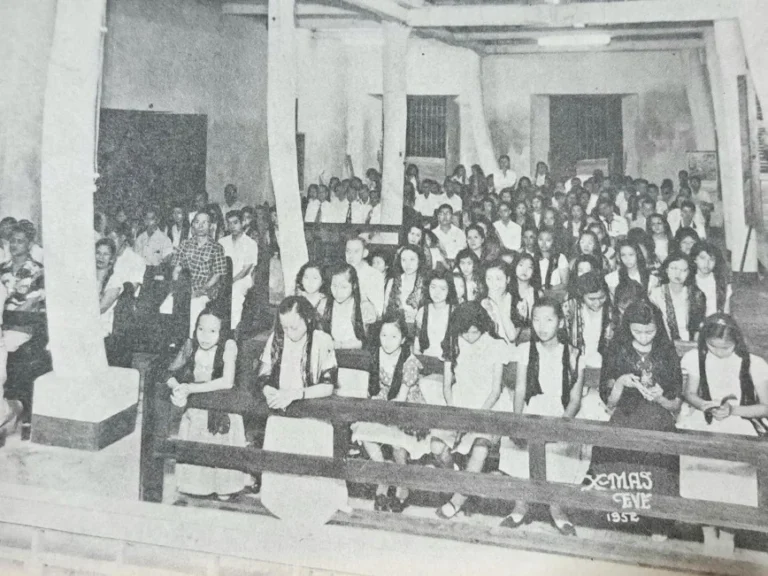
The story of Sacred Heart Parish started during the Holy Week of 1952 with the arrival of the Mexican Jesuit Miguel Pardinas. Assigned as the first parish priest, he organized the Chinese Catholics of what was then called the Parish of Our Lady Queen of China. This small community would later grow into the Sacred Heart Parish community. Before its current location in D. Jakosalem Street, the nascent community of believers was given space on the ground floor of the convent of the Cebu Metropolitan Cathedral. It was through the efforts of the Cebu Chinese Catholic Association (CCCA) with Mr. Francis Lim as its first president that the said area of the Cathedral’s convent would be renovated into a chapel.
Pardinas was an answer to people’s prayers. For a long time, the needs of the Chinese Catholics in Cebu became more felt and expressed. Practically a year before Pardinas arrived (1951), Francis Lim of the CCCA was delegated to seek permission from Julio Cardinal Rosales, then Archbishop of Cebu, to ask Paul O’Brien, SJ, the Jesuit Superior of the China missions to ‘assign a Jesuit’ and ‘take care of the needs’ of the Chinese Catholic community in Cebu. Eugene Lauzon, SJ, was sent to assist Pardinas in 1953. With him were scholastics like Paul Yang, SJ, Peter Tsao, SJ, Joseph Chi, SJ, and Joseph Shih, SJ. It was in 1956 under the pastorship of Fr. Arthur Baur, SJ, the second parish priest, that the land of the current structure of the parish (in D. Jakosalem Street), was bought.
A significant phenomenon from the beginning up to the current state of the parish is the role of lay people. In fact, it is notable to emphasize that the creation of Sacred Heart Parish both as a community of believers and as a structure, was an initiative of the lay faithful. In the words of Ismael Zoluaga, SJ, the delegate of the Provincial for the 27th anniversary of Sacred Heart Parish, “[t]hey, the people, the Christians, asked for the parish [and the school]. The Chinese community put them up, continue to make them alive and grow.” In 1977, five members of the Chinese-Filipino community, and also parishioners of Sacred Heart, were honored with the conferment of the Knights of the Pontifical Order of St. Sylvester. They were Paterno Luym Sr., Santiago Tanchan, Sr., Esteban Antonio Go Sing King, Victoriano Tiotong Cuenco, Sr., and Juanito Y. King. With them were four other lay awarded with the Pro Ecclesia et Pontifice: Maria Francisca vda. de Go Chong Kang, Norma Lim Liu, Francisca Kimseng, and Augusto Go.
Originally a personal parish for the Chinese Catholics in Cebu, it was later declared a territorial parish in 1983 by then Cebu Archbishop Ricardo J. Cardinal Vidal. The parish continues to serve as the most immediate link between the Jesuits and the Archdiocese of Cebu. It was actively involved in the milestones of the local Church such as the celebration of its Quadricentennial (1995), the International Eucharistic Congress (2016), and the Quincentennial of Philippine Christianity (2021). 2012 was a year of grace when the parish was elevated to the status of Archdiocesan Shrine. Now called Archdiocesan Shrine of the Most Sacred Heart of Jesus, it continues to expand its pastoral embrace in the wider Cebuano society.
Sacred Heart School: A School Born from the Parish
Sacred Heart School-Ateneo de Cebu has a shared history with Sacred Heart Parish. Currently located in Canduman, Mandaue City, it makes the Jesuit presence in Cebu concrete and visible. The significant personalities behind the start of the parish (Francis Lim, Andrew Gutianun, and Jose Yap Bioshe) were the same individuals who initiated a school for the children of the Chinese Catholics in Cebu.
Pardinas, the first parish priest of the Sacred Heart Church, suggested to O’Brien that Francisco Heras, SJ be assigned in Cebu to start the school. Heras had just ended his rectorship in Anking in 1951 after being expelled from China. He arrived in Cebu towards the end of 1953. Heras’s mission was to open the school that was requested by CCCA. History tells us that he succeeded even though he started with only P300 and “loads of good will, obedience to his superiors, and trust in God” (in the words of his confrere Julian Hernando, SJ).
Another challenge that confronted Heras was the need to acquire government recognition for Sacred Heart through the Ministry of Education. The school could not operate independently as it needed time to complete the government’s requirements. So it had to be annexed to an existing school. Heras and Pardinas approached Fray Martin Legarra, OAR, the Rector of then Colegio de San Jose – Recoletos (now the University of San Jose-Recoletos). Legarra not only agreed to the request but also gave his full support. Thus, Sacred Heart School opened in 1954 with the name Sacred Heart Chinese Academy – Colegio de San Jose-Recoletos Annex. The very first campus of the school was at Mabini corner Martires Streets and enrolled both boys and girls (this was the set-up in the first few years of Sacred Heart School).
In June 1955, the school on Mabini Street reopened as an independent school, no longer an annex of CSJ-R. A month earlier, the official recognition had been granted by the Bureau of Private Schools. Prior to that and as a prerequisite, the school had been registered with the Securities and Exchange Commission as a separate corporation under the name Sacred Heart School of the Society of Jesus Inc.
The land in Mango Avenue (now General Maxilom) was acquired in 1955; the construction of the building started in the same year. In 1956, Sacred Heart School transferred from Mabini to Mango Avenue. That same year, the Hijas de Jesus Sisters arrived, led by Reverend Mother Alonzo. They assisted the Jesuits by managing the Girls Section of the School. It was in 1957 that the girls separated from the boys. This would lead to the creation of a separate Sacred Heart School for Girls now known as Sacred Heart School – Hijas de Jesus, located in Don Jose Avila Street.
Other Jesuits arrived in Cebu after Heras. They reinforced the school’s teaching and formation staff. Arsenio Nuñez, SJ and Emiliano Martin, SJ came in 1955. Nuñez would serve as Director for two separate terms, first in 1981-1985, and then in 1989-1991.
Up until the late ‘90s, Sacred Heart School was more popularly known as Sacred Heart School for Boys. With the re-admission of female students in 1998, the school had to consequently use its original or corporate name Sacred Heart School of the Society of Jesus or Sacred Heart School – Jesuit. The current name of the school, Sacred Heart School – Ateneo de Cebu, was approved by the Board of Trustees in 2010 during the term of Manuel A. Uy, Jr., SJ as president.
The transfer from the General Maxilom (Mango Avenue) campus to Canduman was in 2007. The plan to have an expanded campus was contemplated by the administration for more than a decade before the transfer, but it was under the Directorship of Ernesto Javier, SJ with the able assistance of Julian Hernando, SJ, that the plan was fulfilled.
In an account as short as this, it is both a desire and challenge to include as many names of people, places, and events of such historical and significant institutions as Sacred Heart Parish and Sacred Heart School – Ateneo de Cebu, but the most that can be done is to express deep gratitude to everyone who labored and continues to labor in the Lord’s vineyard.
—
Rhoderick John S. Abellanosa has been with Sacred Heart School – Ateneo de Cebu for almost 20 years. He has served the institution in various capacities, from classroom teacher to Social Involvement Coordinator to Director of Human Resource and FSD Officer, and currently as Coordinator of the Research Office. He wrote the short biography of Fr. Francisco Heras, SJ “Founder of the Sacred Heart School – Ateneo de Cebu: Francisco Heras, SJ (1911-1991)”, in Sons of Cor Iesu (Cebu City: SHS-AdC, 2022).