
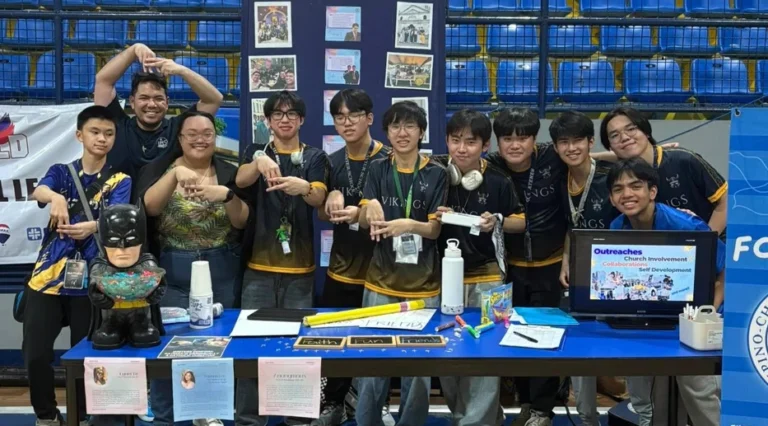
My uncle is Monsignor Gerardo Santos, DD, and for many years, he wanted me to become a priest. When he would introduce me to the seminarians he was mentoring and teaching, he would say, “This is my nephew, Juano, sana Diocesan pero kinuha siya ni San Ignacio!” Though he was a diocesan priest, he did not even mind if I became a Jesuit as long as I was a priest. However, I did promise him when I was a child that I will serve the church somehow, and that actually brings me to where I am right now, being the Youth Ministry Head/Coordinator of Mary the Queen Parish (MTQ) in San Juan City.
Mary the Queen Parish, on its 70th anniversary back in 2024, celebrated its long-lasting legacy of being not just a Jesuit parish but also a Filipino-Chinese parish and community. Though I have been a parishioner since I was born, it was only in the last half-decade that I got to see and learn the ins and outs of the church from our culture, the communities that are present, how the church works, how we serve, the history, the legacy, the festivities, and even what lies beyond with the vicariate, the archdiocese, and the Filipino-Chinese apostolate.
PRE-PANDEMIC AND THE PANDEMIC
If someone were to ask you what the Youth Ministry was like pre-pandemic, during the pandemic, and post-pandemic, everyone can say that all three eras were drastically different from one another.
Pre-pandemic, the Youth Ministry of MTQ was incredibly active with many avenues to bond and make the parish their home and, at the same time, contribute to the culture of the parish by having various activities such as salu-salo, acoustic night, and youth masses.
When the pandemic hit, the youth struggled as the lockdowns took a toll on their mental health, spirituality, and socialization. Around this time also, some youth orgs, traditions, or practices started to fade away as everyone was mostly stuck at home and did not participate in religious or spiritual life.
Aside from the cultures and practices, a lot of youth also left the church as some saw the pandemic as an opportunity to leave quietly, as many youths in MTQ experienced church trauma, lack of a safe space in the church, a lot of misunderstandings in the faith, and a lack of youth leaders stepping up to provide opportunities of youth-led activities because of the tough culture MTQ sometimes holds.
ENTERING THE YOUTH MINISTRY
I entered the youth ministry during the pandemic as a youth mentor, hearing the many stories of the youth about how they feel and, at the same time, providing them insight about the faith through meaningful conversations and connections to their personal life.
It was definitely an eye-opener because these stories would serve to help me post-pandemic when I became the new head of the Youth Ministry.
The current Youth Ministry is still ongoing, but what we see now is vastly different from the last two years when the pandemic ended. I became the new head of the youth ministry by the time our newly appointed parish priest, Fr. Bogs Tapiador, SJ, arrived in MTQ.
For the past two years, the Youth Ministry was quiet and conducted few activities throughout the year. That was simply because, as its new head, I first wanted to observe, experience, immerse, and converse with the many different youths of the parish, their youth orgs as well, and also the different parish ministries and members of MTQ.
I knew that MTQ could sometimes be considered a tough parish as many of the members are much older and are strict with traditions. This has led to some youths experiencing church trauma and also being discouraged to share their ideas or talents to help in the parish.
So for many months, I observed and discerned how to approach the youth, to be able to help them develop their character and faith where they are in their lives.
Luckily, our Youth Ministry is blessed to have some older parish members who understand the youth and know how to approach them. One of the older parish members ended up becoming one of my personal mentors, and one thing he always advocated and shared with all members of the parish for many years is, “We do not follow the youth, we do not lead the youth, we walk with the youth.”
These are words I live with day by day, serving the parish and advocating for the youth in the faith.
A MINISTRY REBORN
After a couple of years observing and immersing myself in parish work, I decided to revamp and create a reform in our youth ministry. I took a chance on a new direction while respecting traditions that were lost through the pandemic.
It also helped that when creating this new vision, Grade 9 students from Xavier School were conducting their project-based learning by interviewing several ministries in different parishes. Their questions would serve as reflection questions and a guide to what I wanted to address. They also provided unique projects as part of their requirement to help out ministries in addressing the issues.
This would be the layer of foundation of the reform and rebirth of the youth ministry of Mary the Queen.
I started first by creating the youth ministry’s new vision and mission inspired by my alma mater, Xavier School, and the school I teach in, Keys School Manila. A vision and mission that also celebrates the Jesuit legacy of being people for others, magis, and caring for others through cura personalis.
We envisioned a ministry that grows in the faith by developing character through service in the church and our communities, providing opportunities for the youth to develop their skills in multiple projects, and to continue building bridges within our community.
As a Filipino-Chinese community, we show so much diversity, yet we are united by one faith, sharing the same love we have for the Lord.
For years, the youth has been like scattered islands because of their diversity, and this was one thing Father Bogs and I wanted to change. We should be united as one youth ministry.
The theme of building bridges is something I highlighted to the youth leaders of each youth org, as it was also our way of paying tribute to the late Pope Francis. It is through the dialogues we all shared that we can see we are not so different, and we help each other through our own stories, seeing a bigger community out there.
We also take that theme of building bridges beyond our parish through our communities like Little Baguio, our vicariate, and even people of different faiths.
HOPE AND BRIDGES
Being a youth ministry in a Filipino-Chinese community can be challenging, but our ministry is built on hope and bridges.
To show a path to the youth, to walk with them in the journey, for many of us youth ministers and mentors, it is such a fulfilling task that it gives us hope for the future of the church and the future of its people.
As for building bridges and walking on these bridges, I always highlight in my interfaith dialogue with other religions the beauty of how faith and culture intertwine to make something beautiful.
I use my community, MTQ, together with Xavier and ICA, as a great example because, as someone who has no Chinese blood but lived with the Filipino-Chinese community for almost 30 years, I found God in this community and it showed me the power of what building bridges can do with His love and mercy.
_____
Juan Genaro Santos, or better known as “Juano” to his friends and family, is the current Parish Youth Ministry Coordinator of Mary the Queen Parish in San Juan City. He is a MAGIS awardee, Honorary St. Ignatius awardee, Brother Richie Fernando Service awardee, and an alumnus of Xavier School. He is a kindergarten and Grade 1 teacher in Keys School Manila and a part-time psychology teacher for Grades 9 and 10 in Xavier School. He is also part of multiple NGOs such as Kits for PH, Dalúman Initiatives, Haraya Foundation, and Teach Peace Build Peace Movement that focuses on advocacies in peace education, quality education, environmental education, leadership, and youth empowerment. Aside from a lot of service work, Juano is an avid comic book, movie, and video game fan and occasionally cosplays as Batman or a Jedi as a hobby or even for his NGOs.