
I had forgotten my name. The cold realization hit me one morning in third grade as I hurriedly searched for a piece of paper, struggling to remember the third and final character that I had written so many times before—“黄本…”. My father’s face furrowed in masked disappointment as he finished my trail of thought: “…源. 黄本源. (Huáng běnyuán). In most Filipino-Chinese households I know of, the Chinese name is rarely ever used. It’s odd to think about, given that names are labels representing who we are, a daily reminder of our identity. As cultures mix and interact, some aspects are passed down while others are left behind. Some are well-practiced while others are relegated to symbols and stories rather than applied tradition. So, as I sat down with my piece of paper, embarrassed at forgetting the most essential three words of my native language, I couldn’t help but wonder which of my names was really “mine.”
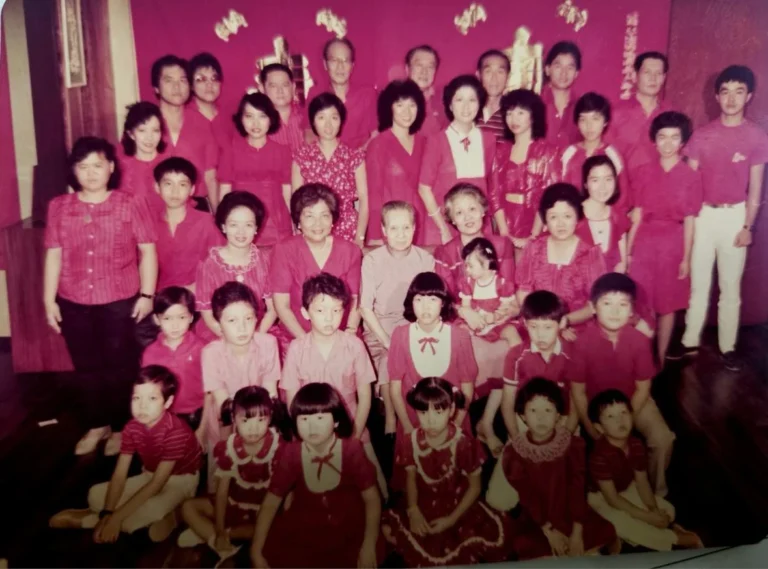
It’s a thought that creeps up on me every now and then, but the truth is that there’s a lot more overlap than most people realize. It’s sometimes difficult for me to tell which tradition comes from which culture, as it’s all already so deeply ingrained in my daily life. In both Chinese and Filipino culture, one of the most important things that you will ever have in life is family. As a Filipino, it’s common to not only celebrate occasions with immediate family, but even with first, second, and third cousins—sometimes even from both paternal and maternal sides. As someone Chinese, this is taken a step further, having entire associations dedicated to extremely distant relatives with the same Chinese surname. Even similar honorifics are used in both cultures: “ate” or “manang” would be “姐姐” or “atsi” and “kuya” or “manong” would be “哥哥” or “ahia.” I don’t know if it came from my Filipino or Chinese side, but my parents would always tell me: “no matter what, you should never forget your family, because in this whole wide world, you only have one.”
The similarities don’t end there either, as the cultures intersect and connect in many different ways. Superstitions, too, have a surprising amount of convergence in both cultures, with a great example being Feng Shui. Filipinos have the “Oro, Plata, Mata” chant meaning “Gold, Silver, Death.” This directly parallels the Chinese way of counting which has many different readings, but generally goes “good, good, bad, bad.” Although these small beliefs seem inconsequential at first, they add up to create a picture of two cultures that believe in something greater than can be understood. That is why to most within the Chinese circle, it’s unsurprising to know that China is one of the fastest growing Christian countries in the world. The superstitious and religious beliefs of both countries are so intertwined that national organizations such as the Filipino-Chinese Catholic Youth thrive in our country. In Iloilo alone, the Santa Maria parish church has “Our Lady of China,” where gongs are used and Chinese characters are written in the mosaic glass beside the crucifixion.
Despite this, for each great similarity that seems to bridge both worlds comes an equally great disparity in beliefs. Eventually, every Filipino-Chinese gets defined not by how similar they are to their fellow countrymen, but by the few differences that do stick out. For many parents, this leads to difficult choices that inevitably shape their children’s future. Some teach their child the local Filipino dialect while others stick to their roots and teach them Mandarin or Fukkien (Hokkien). More often than not though, you’ll find the child speaking English as a compromise between both worlds, risking being in neither. Even within Filipino-Chinese families, mutual understanding is very rarely achieved. Many people asked me why I spent so long studying Chinese even when it was no longer required of me. Commonly, I’d answer for college, but the truth was that I felt disconnected. How else would I understand my own heritage fully? How else would I contextualize the values I’ve spent my upbringing following? How else would I have a real conversation with my Chinese-speaking grandfather? My own “angkong,” and I struggle to connect with him. Plus, he’s only getting older.
It is undeniable that a Filipino-Chinese family will raise their children distinctly from others, with their own set of unique values and struggles to deal with. Especially in school, these similarities and differences are what often define student life. I will never forget explaining to my classmates why they should never stick their chopsticks into rice, and nor will I forget struggling to understand why dropping my spoon meant that a visitor was coming. I knew just enough of both cultures to be different, but not enough to completely fit into either. Yet, not once did I ever feel isolated in my school community. Even though there will always be others who choose to focus on dissimilarities, the mutual value of “family” managed to extend itself to wider society. More and more are both cultures accepting each other and finding middle ground, promoting mutual learning and a healthy environment for education. Ateneo in particular advocates the mantra of “one big family,” striving to create a community that acts as “instruments of sincere dialogue with other cultures.” The cultural gap is always going to be difficult, but jumping over it is a lot easier when there’s people cheering you on.
For these reasons and so many more, the average Filipino-Chinese family is not a perfect tapestry of meticulously interwoven traditions, it’s much closer to a hodgepodge of both cultures. It’s a spicy hotpot, where each random ingredient is tossed into the soup, a rich and unique blend that warms you inside like the warmth of a foreign relative’s long-forgotten hug. It’s a Santa Maria mass where different stray beliefs come together and find a common home under the same God’s roof, amidst the same waft of incense, listening to the same familiar gong. Experience and practicality, familiarity and strict order, hierarchy and freedom, each of these concepts contradict, and yet it’s difficult for me to imagine one existing without the other. That is exactly why I had such a hard time deciding which name fit me more. The Filipino-Chinese family is not a 50-50 combination of both worlds, it is a single shared heart created from cultural love, beating to the rhythm of two songs at once. The melodies may be different, but equally as important, both sides’ values equally as pronounced, each language’s name equally as valid. I am not just Lance Kenzo Ho Posadas nor 黄本源, I am both—100% Filipino and 100% Chinese.
—–
Lance Kenzo Ho Posadas is a senior high school student from Ateneo de Iloilo – Santa Maria Catholic School. He is a life-long Catholic from a Filipino-Chinese family in Iloilo city. Coming from a Jesuit school, he has always held education and spiritual well-being in high regard, journeying in reflection and prayer through participation in organizations like FCCY. His dream is to become a mechanical engineer in hopes to contribute to the Philippines’ SDGs.