
From its beginnings, the Society of Jesus has had a special interest in China. One of the Founding Fathers, St. Francis Xavier, brought Christianity to significant parts of Asia and died off the coast of Mainland China in 1552, his dream of evangelizing China left unfulfilled. In October of that same year, Matteo Ricci was born in Macerata, Italy, and thirty years later, he would lead the first group of Jesuits to successfully enter China.
Over a period of more than ten years, they made their way from Macau in the south to Beijing in the north, establishing footholds, learning the Chinese language, and studying the classics of Chinese civilization to better understand how Jesus Christ could be introduced to the Chinese people. In a mutual exchange, Ricci and his companions introduced European science and mathematics to the Chinese literati, including the reigning emperor. It was East-West dialogue at its best, notwithstanding later cultural clashes that led to heated disagreements in the Church, foremost of which was the Chinese Rites Controversy over translation issues and the meaning behind Chinese beliefs and customs in regard to elders and ancestors. Those issues took centuries to resolve, in favor of the Jesuit position. Today, Ricci and his companions are held up as paragons of inculturation, where the Gospel is allowed to take root in particular cultures, as it has from the time of the Early Church.
This broad history of Christianity in China forms the backdrop for the three Chinese-Filipino Jesuit schools in the Philippines that are marking their 70th anniversaries– Sacred Heart School-Ateneo de Cebu (1955), Xavier School (1956), and Ateneo de Iloilo-Santa Maria Catholic School (1958). Founded by Jesuit missionaries who left China around the time of the Chinese Revolution of 1949, these schools were founded at the invitation of local Chinese Catholics who had been lamenting the lack of Chinese Catholic education in the country. The missionaries, all fluent in Chinese and realizing that they would not be able to return to their work in China, accepted the invitations and founded the schools and their neighboring parishes (Mary the Queen, Sacred Heart, Santa Maria), all dedicated to evangelizing the local Chinese, the majority of whom were not Christians at the time.
The Jesuits from China saw the schools in the Philippines as extensions of their mission to evangelize the Chinese people. After seven decades, the majority of Chinese Filipinos are now Christians, well-placed to serve as bridges between the Chinese and Filipino cultures. Current students, whether they are ethnically Chinese or not, still receive a holistic education that encourages the preservation of Chinese cultural identity through various programs. This is important for all, especially at a time when geopolitics has put the relationship between the Philippines and China in a precarious state.
Historically, trading between China and what we now know as the Philippine islands has been going on for more than ten centuries. These are documented in Chinese sources dating back to the 10th century. Trading led to intermarriage, which in turn created a large mestizo culture that is distinct from the families that have retained predominantly Chinese customs and traditions. These days, the Chinese-Filipino or Chinoy community, while clear and confident in their Filipino identity, plays an important role in bridging the gaps in Philippines-China relations, and in Filipino and Chinese cultures. The three schools, with the systematic approach that is unique to educational institutions, serve as bridges in particular ways.
By running excellent schools that have a special mission in the Chinese community, the Jesuits hope that its students and graduates will be equipped to continue engaging China by knowing its language and its people. Mandarin Chinese is now taught as a foreign language, in recognition of the fact that Generation Alpha students are not growing up in an environment where Chinese, including the Hokkien dialect, is widely spoken. Language is an important window into culture, so all students are invited to learn it. The rise of China on the world stage is another important reason for learning the language, giving graduates a unique opportunity to engage China and all things Chinese.
The celebration of Chinese festivals in the school setting, the most important of which are the Lunar New Year and the Moon Festival, are important moments in the institutional life of the school to affirm their special identity and mission. Inculturated liturgies, ancestral veneration rites, and cultural performances highlight the observance of these festivals.
The Jesuit missionaries had to leave China, but the school communities now have opportunities to contribute a Christian presence in China through its programs, always working within the possibilities opened up by the modern development of the country.
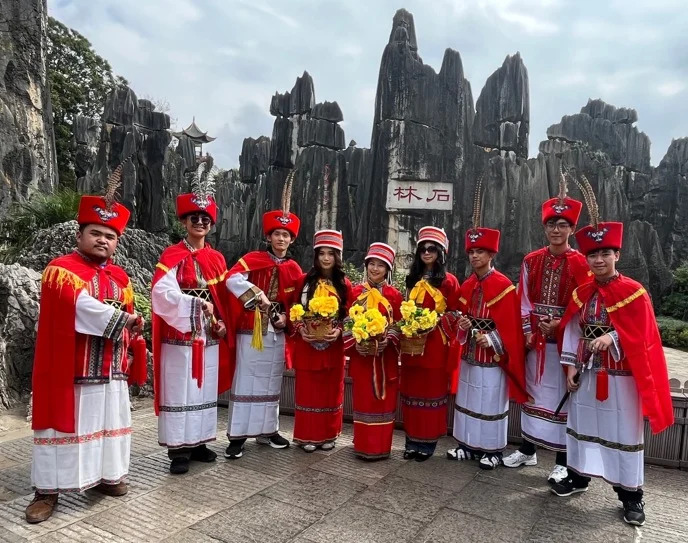
Xavier School has its XCE (Xavier China Experience) and Ateneo de Cebu has its iC2E (International College and Career Exposure), which brings students to China for study and cultural immersion. Ateneo de Iloilo participates in summer programs for students to visit China. For the students who participate, these are productive ways to be immersed in a Chinese-speaking environment and have ample opportunities to practice speaking the language. Classes in language and culture are balanced with field trips and other cultural activities.
Visits to Catholic churches are part of the itinerary, to show the students that the Catholic Church is alive and functioning in China, notwithstanding the complexities of Catholicism in the country and the relationship between the Vatican and the Chinese government. Students and faculty alike have been inspired by the piety and deep devotion of Chinese Catholics in the churches they have visited.
In the last fifteen years, as the maritime disputes between China and the Philippines have escalated, there have been suggestions to suspend the China trips out of fear that the students will be mistreated in China. Nothing of the sort has ever happened. The schools have been careful to distinguish between disputes involving the two country’s governments, and people to people exchanges. The latter need to continue precisely when political tensions are high, to present another face to the relationship between the two countries, whose historical ties run very deep.
During one of the XCE field trips, some elderly local Chinese people noticed the big group of Xavier students wearing identical shirts and speaking English or Filipino, and asked where they were from. After exchanging pleasantries, one of the Chinese remarked, “How wonderful that you continue to come to China even if our governments are quarreling!”
The students from the Chinoy Jesuit schools are told to be on their best behavior because they represent not only their country and their school, but their Catholic faith as well. By giving them an experience of China, the schools hope that they will continue to engage China and quietly present a Christian way of being in the world. This may sound like a romantic idea, but as far as the schools are concerned, it is the hope and vision behind the China programs.
The engagement with China goes both ways. While the schools bring big numbers of students to China, they also make an effort to look after the Mainland Chinese who come to our schools, inspired by the desire of Francis Xavier to evangelize the Chinese. Every year, numerous teachers come from China to teach the language courses in the schools. They are quite young and grew up without being part of any official religion. Local Filipino teachers are invited to look after their Chinese counterparts by orienting them about local life, helping them settle in, and bringing them to some places of interest. Whenever possible, formation sessions are conducted in Chinese for the China teachers, focusing on social and cultural values rather than explicit Christian content. This is an attempt to introduce values education and to help the Chinese understand the Christian ethos of the schools.
For the students from China who attend our schools, there are optional programs where they are invited to learn more about the Catholic faith. This has resulted in some baptisms.
St. Francis Xavier’s “China dream” to evangelize the Chinese people motivated generations of Jesuits to serve in China, and when that was no longer possible, many of them turned their attention to overseas Chinese communities. This is the founding story of the Jesuit Chinoy schools in the Philippines, and today the mission of evangelization continues in a different way.
By continuously engaging China, the school communities have a perspective that can be helpful in light of current geopolitics. The maritime dispute in the West Philippine Sea is a complex matter, but the school communities have the opportunity to broaden the discussion and to support diplomatic initiatives.
From 2023 onwards, there have been numerous clashes between Chinese and Philippine maritime forces. Both sides are unwilling to give up their positions, and in the international press, China is often presented as a bully that uses force to intimidate her smaller neighbors. This is the popular narrative in the Philippines as well, while in China, the Philippines is seen as a willing vassal of the United States. Under such circumstances, civil society groups are lonely voices calling for sobriety and continuous dialogue. The Jesuit schools, with their long engagement with China inspired by the life of Francis Xavier, Matteo Ricci, and their successors, view themselves as moderate voices trying to take the long view. China’s government cannot be equated with the Chinese encountered in various ways by Filipinos who visit China, and these encounters serve to humanize Philippine views of China.
If the dream of Xavier has been kept alive for close to five centuries, then no matter how difficult Philippines-China relations are at the moment, relations with Chinese people can be sustained so that under friendlier circumstances in the future, the world can learn to understand and engage a China that does not fit neatly into established categories of international relations.
—–
Fr. Ari C. Dy, SJ was president of Xavier School from 2013 to 2024 and is presently the President of Ateneo de Naga University. He is the Jesuit Provincial’s Assistant for Education, and has also served as National Executive Secretary of the Chinese-Filipino Apostolate, and Chair of the Jesuit Chinese-Filipino Apostolate (JCFA).