
When friends and colleagues learn that I’m taking China Studies, I’m often asked, “Are you Huaren (华人)? Lannang (咱人)?” When I say no, the question usually follows: “You’re Filipino, so why China? Why study it?”
It’s also a question I ask myself. I can offer several reasons: China’s relevance today, opportunities in business and technology, or my long-standing fascination with Chinese history and culture. But after all the explanations, I often arrive at a more straightforward answer: basta, I like it. I enjoy it. I was drawn to it, and I kept coming back.
This pull became clearer as I reflected on my personal history. My formation took place in spaces shaped by diversity and Ignatian values. It began in a Catholic Filipino-Chinese high school, continued through engagement with the Christian Life Community in college, and deepened during years of Jesuit formation, marked by early dreams of being missioned to China, work in campus ministry, friendships with Chinese peers, and solo backpacking trips around China. It took on new depth through postgraduate study and lived experience in Mainland China. Looking back, I see not a single decision, but a pattern of encounters that quietly led me here.
Matteo Ricci, Xu Guangqi, and the Spirit of Encounter
When I look back on these experiences, I often find myself returning to Venerable Matteo Ricci, not yet a saint, but almost there. Over time, he has become more than a historical figure to me; he has become a Jesuit spiritual companion who shapes my understanding of faith, mission, and encounter across cultures. What draws me to Ricci is not only what he accomplished, but how he chose to enter another world, not as a bearer of superiority, but as a learner who patiently studied the language, adapted to local customs, and formed genuine friendships with Confucian scholars.
I was struck by this again after the pandemic, when a student retreat for senior high school students I was facilitating unexpectedly found its home in the Matteo Ricci Hall. This ordinary moment felt quietly fitting.
Ricci is best known for his scholarly work, particularly The True Meaning of the Lord of Heaven (天主實義). Less known is that the first book he chose to write in Chinese was On Friendship (交友論), a short treatise offered as a gift to a Ming prince. Drawing on classical Western sources and reframing them in ways resonant with Confucian values, Ricci began not with theology or science, but with relationship. This choice reveals how he understood encounter: friendship before instruction, dialogue before assertion. Pope Francis’s recognition of Ricci as Venerable affirms this way of proceeding, describing him as “a man of encounters” who went beyond being a foreigner to become a “citizen of the world,” building bridges of friendship between China and the West.
Ricci’s story also reminds me that an encounter is never solitary. His openness found depth through friendship with Xu Guangqi. Xu did not abandon his Chinese Confucian identity through this relationship. Instead, it was deepened through dialogue. Together, they show that a genuine encounter requires two movements: the courage to offer oneself and the humility to receive the other.
It is this spirit of encounter—patient, relational, and mutual— that I recognize not only in Ricci’s story, but also in my own lived experiences in China and in Jesuit spaces that continue to foster engagement across cultures.
Language, Heritage, and Identity as Encounter
Language plays a central role in encounters. Yet I have learned that language is not primarily about grammar or fluency. It shapes how one feels included or excluded, confident or hesitant. For two years in China, I struggled with the language. I managed daily life with the help of translation apps, AI tools, and the patience of people around me. These made survival possible, but these also forced me to reflect more deeply on what language is and what it is not.
Language matters deeply. It is perhaps the most direct way of entering another world. Yet its ultimate purpose is not mastery for its own sake, but encounter. Because my Mandarin proficiency remained limited, I learned to rely on other ways of connecting. English sometimes became a bridge, though often with irony, my Chinese friends were practicing their English with me as much as I was learning from them. In many ways, I was at a disadvantage, yet the exchange remained mutual. What mattered more than vocabulary was sincerity: the willingness to listen, to accompany, and to stay present despite limitations.
Living in a university dorm further shaped this experience. Campus life felt sheltered. I was part of an international program where all my classmates were non-Chinese students studying about China in English. While this created its own kind of community, it also meant that my immersion in local life beyond the university gates was limited. Aware of this, I made a conscious effort to step outside and explore. It was there that I befriended local ayi and shushu. Once a week, I would go early in the morning to a nearby market, where produce from the surrounding mountains was sold in small stalls. My Mandarin was minimal, often limited to food-related words learned out of necessity, and perhaps affection. Still, I was often given small freebies: an extra vegetable, a piece of fruit slipped into my bag, a smile that lingered. In those moments, a nod or shared laughter bridged what language could not. The encounter happened not because I spoke well, but because I showed up with attentiveness and respect.
Matteo Ricci’s life reminds us that deep language learning matters, and that mastery itself can be an act of respect. My experience does not stand in contrast to his, but alongside it. Where Ricci’s mastery enabled encounter, my limitations taught me that encounter can begin even before mastery is reached.
This same tension is visible across Jesuit Filipino-Chinese spaces. In some Jesuit Filipino-Chinese schools, Mandarin is part of the formal curriculum, complete with classes and proficiency exams. For some students, this becomes a meaningful connection to heritage; for others, it feels burdensome. I have heard students say they have already given up on learning Chinese because it is too difficult or because it negatively impacts their grades. Yet similar frustrations are often voiced about Filipino as a subject, another language whose value is questioned precisely because it resists effortless mastery. The struggle itself becomes revealing.
In contrast, some Jesuit schools do not have a formal Chinese language program. Yet even there, I have encountered students: Chinese enthusiasts, Lannang, Huaren, and curious non-Chinese students, who choose to learn Mandarin through student-led organizations and informal study groups. The difference is telling: when language is imposed, it can feel heavy; when it is chosen, it becomes meaningful. In both cases, the effort required forms something deeper than linguistic competence.
Heritage, in these spaces, is therefore not simply about bloodline or ethnicity. It is something inherited, both consciously and unconsciously, questioned, and carried forward with both pride and tension. In Jesuit Filipino-Chinese schools, this heritage is shaped by history. Many were founded by Jesuit missionaries who had once served in China and later found refuge in the Philippines. What they brought with them was not only language or custom, but a way of holding faith and culture together.
I have witnessed this heritage lived out quietly in daily school life: Chinese festivals are celebrated alongside the liturgical calendar, ancestral remembrance is observed with respect, and masses are adapted in ways that feel familiar rather than forced. In some schools, students are even given the chance to spend time in China, not as tourists, but as learners who discover culture through ordinary routines and encounters. In these moments, heritage becomes less about labels and more about the relationships they represent. It remains alive, shaped not only by preservation but also by lived experience.
Identity, then, is not a fixed label but a lived question. Jesuit education does not rush people toward a single answer to “where do I belong?” Instead, it forms individuals who learn to live between worlds and are aware that identity shifts with context and grows through relationships. I recognize this in my own life: as a Filipino, a China scholar, and a person formed in Ignatian spirituality, I have learned to live between worlds. Over time, I have grown more comfortable with hybridity than with purity.
In this sense, identity is not only about being Filipino or Filipino-Chinese, but about becoming a person open to encounter, a citizen of the world. Language becomes a doorway, but not the only one. Heritage becomes meaningful not when it is preserved unchanged, but when it is lived and shared. Identity is not inherited whole; it is formed and reshaped through relationships. This, I believe, is what Jesuit Filipino-Chinese spaces quietly form: people ready to meet the world with humility, patience, and hope.
Spaces of Encounter Today
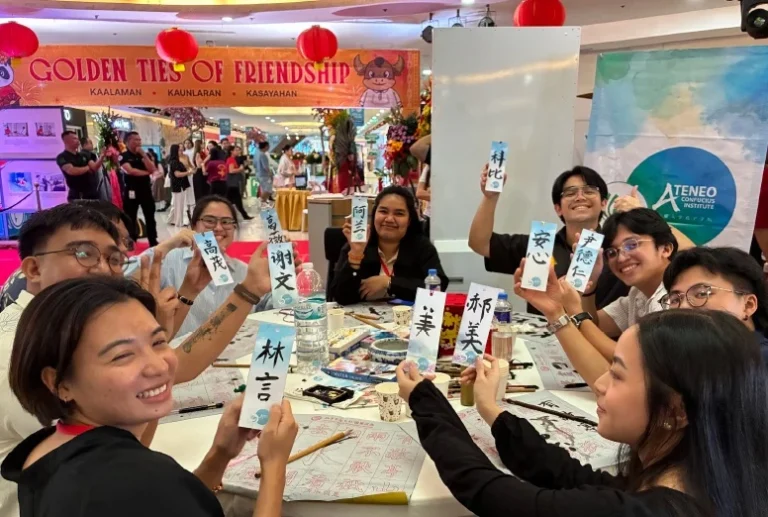
This understanding deepened when I returned to Manila after completing my master’s degree in China and began working with the Confucius Institute at Ateneo de Manila University. What initially felt like an unplanned detour soon revealed itself as an extension of my China experience. While language instruction and culture remain central to the Institute’s work, I came to see that their deeper value lies in the encounters they make possible. Working with the Confucius Institute at this moment, nearly twenty years since its opening in 2006, has made me more aware of how cultural encounters unfold slowly, through sustained presence over time rather than quick outcomes.
I met learners from many backgrounds, professionals, students, Filipino-Chinese families seeking to reconnect with their roots, and Filipinos encountering Chinese culture for the first time. People arrived not as experts, but as beginners. Many struggled with tones, characters, and unfamiliar sounds. This shared difficulty created a connection. Language learning produced a common vulnerability.
Equally formative were the volunteer teachers from China. Many arrived eager to teach, but soon found themselves learning about Filipino culture, daily life, humor, faith, and food as well. In classrooms and informal conversations, I watched roles shift. Teachers became learners; learners became guides. These exchanges reminded me that cultural encounters do not flow in only one direction. Just as Ricci’s work depended on Xu Guangqi’s openness, today’s encounters rely on the willingness of all involved to be changed by what they meet.
One moment stays with me. During a Mandarin teacher training program, I was tasked with accompanying visiting professors from China around Manila. As part of my role, I was responsible for introducing them to Filipino culture, including local cuisine. I assumed they might prefer familiar flavors or request Chinese restaurants. Instead, they insisted, gently but firmly, that we eat Filipino food at every meal. They wanted to try everything, even dishes they could not pronounce. What struck me was their openness. In those shared meals, roles quietly shifted. I was not simply hosting, and they were not merely guests. We were learning from one another.
At that moment, I saw again what Ricci and Xu Guangqi embodied centuries ago. The encounter was happening in both directions. Culture was not being explained or performed; it was being received. Their willingness to taste unfamiliar flavors reminded me that dialogue depends as much on receptivity as it does on generosity. Friendship, once again, became the medium through which understanding grew.
Beyond classrooms and shared meals, cultural activities, such as Chinese painting classes, often grew into communities rather than remaining one-time events. Students returned not only to learn techniques but to see one another, to talk, and to share stories. Learning continued, but friendship quietly took root.
My graduate research on Filipinos living and working in China has further confirmed this. Many navigate daily life with limited language proficiency, relying instead on adaptability, patience, and the support of friends. Most do not have access to formal language instruction, nor the time or resources to enroll in classes, due to the demands of their work. Language is often acquired through daily interactions and ordinary encounters. Some develop fluency within months; others remain in China for decades and still struggle. What this reveals is that the encounter is rarely idealized. It is slow, uneven, and sometimes uncomfortable. Yet it is precisely through these everyday interactions that mutual understanding quietly grows.
The World as Our Home
Jesuit education has long carried the conviction that the world is our home. This does not mean belonging everywhere in the same way, but being oriented beyond one’s comfort or culture. Jesuit spaces, such as schools, institutes, and programs, that foster engagement with China and the Chinese diaspora participate in this vision by forming individuals who are globally attentive, culturally open, and willing to encounter differences without fear.
I have also become aware of how easily distance shapes perception. Despite geographic closeness, we often remain strangers, relying on assumptions formed without real encounter. Yet even small moments, such as shared meals, travel, and conversation, soften fear and open up space for understanding.
So why China? For me, it is not solely due to ethnicity, strategy, or academic specialization. It is because engaging with China has been life-giving, shaped by experiences, relationships, and encounters that I have come to enjoy and return to. Over time, China became the place where questions of language, heritage, and identity were brought into sharper focus.
Language is a doorway, but not the only one. Heritage is not fixed or inherited whole; it is lived, negotiated, and shared across cultures and generations. Identity, finally, is not something that is simply possessed, but instead formed through relationships and shared experiences. In Jesuit Filipino-Chinese spaces, the invitation to live as a person of the world is not to abandon one’s roots, but to carry them lightly and preserve openness while continuing the patient work of encounter.
As Matteo Ricci and Xu Guangqi remind us, learning about another culture is ultimately an act of respect. In a world tempted by division, choosing “encounter” remains both a challenge and a quiet calling.
—–
Irvin Jezz Lambojon is a China Studies scholar formed in Ignatian spirituality. He holds a master’s degree in Contemporary China Studies from Shandong University and has lived and studied in Mainland China. He currently works at the Confucius Institute at the Ateneo de Manila University, where he is engaged in language education, cultural exchange, and people-to-people encounters between China and the Philippines.