
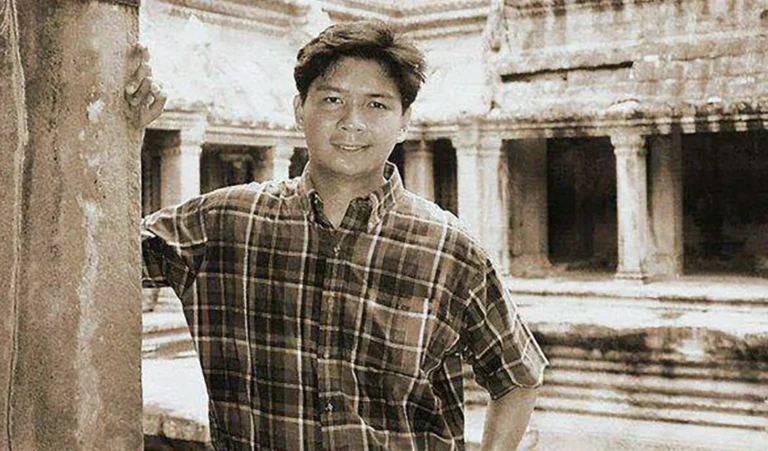
The postulation on the cause works for the petitioner, the Philippine Province of the Society of Jesus, represented by the Provincial Superior. The postulation is headed by Rev. Pascual Cebollada, S.J., Postulator General of the Society of Jesus in Rome, who has delegated Rev. Jose Quilongquilong, S.J., as Vice-Postulator (appointed on December 1, 2017) and representative of Fr. Cebollada in the Philippines.
In 2017, Fr. Cebollada consulted with the Congregation for the Causes of Saints (now Dicastery for the Causes of Saints) and presented the initial findings on the death of Richie Fernando, based on the archival records deposited at the Archives of the Philippine Province of the Society of Jesus. Among those records are the police report, the autopsy and the death certificate of Richie all done on the same day of the death, 17 October 1996 or the day after. Also included was the result of a formal inquiry on the death done on 23 October 1996 and collated by Sr. Denis Coghlan and certified by Eve Lester, the lawyer for the Center of the Dove. The examination of the cause also followed the procedures and guidelines as enunciated by the following church documents:
- John Paul II’s Apostolic Constitution Divinus Perfectionis Magister (25 January 1983),
- Sanctorum Mater (2007) from the Congregation for the Causes of Saints and
- the Apostolic Letter Maiorem hac dilectionem (No greater love than this, 11 July 2017), issued by Pope Francis on the category of oblatio vitae or offering of life.
The norms of the Congregation clarified that the facts and documents presented do not indicate that Richie’s cause falls directly under the title or category of martyr. The term “martyr” has a technical meaning and has two characteristics or requirements:
- On the part of the person, who died: It must be established that the person died in defense of the Christian Faith.
- On the part of the cause of death: It must be established that there was “odium fidei” (hatred of the faith).
With Richie, it is quite clear that at least one of the characteristics was absent. On the part of the cause of death, the perpetrator Pim Sarom, 29 years old, orphan, ex-soldier and student at Banteay Prieb, did not intend to harm Richie. In fact, he was immediately remorseful for having killed a “friend” with whom he “ate rice.” Pim Sarom’s escape from the center and his immediate surrender to the police was his way of assuring that others in the center would not harm him once they learned of Richie’s death. Thus, this case does not involve any hatred of the faith.
However, the subsequent norms of the Congregation have opened another possibility for the cause of Ritchie through “oblatio vitae,” the offering of life, a new path opened by Pope Francis in 2017. The following requirements have to be met under this category:
- The untimely death must be freely chosen and despite the possible danger to life, the person deliberately chooses to be placed in harm’s way in defense of another. The number of persons saved and protected by the offering of life need not be many, one is sufficient. Nor is it necessary that the person being protected should be unharmed. What is crucial is the motivation of the person being placed in harm’s way. Deliberation and choice are needed, this implies that the death was:
- not accidental or
- caused by impulsive behaviour or
- done in pursuit of duty as might happen to soldiers in battle who die as collateral damage.
- A connection or nexus between the self-offering and a premature death.
- The offering of life is seen not as a one-shot happening but as the culmination of a number of instances of a person’s self-offerings, like acts of generosity and charity, and a life of ordinary virtue. Therefore, a thorough investigation of the life, character and actions of a person must be made.In the case of one who is within living memory, as many of those who have known and interacted with the person must be interviewed. All who have a negative opinion of the person and those who may know of some negative things must be called to testify. The Congregation does not look favorably on causes that present a too glossy and sanitized picture as this may present a lop-sided and false picture of a person.
The false projection of a person that leads to some form of veneration is called in Church parlance as “undue cult.” The Church is especially averse to “undue cult,” esp. in this age of virality, false news and alternative truths.
- The existence of fama sanctitatis, a reputation for holiness, and such public signs, at least after death.
The postulation has been tasked to establish that Richie’s death was not an accident, the result of miscalculation, impulsive behaviour or other reason. It must be able to erase the dubium or doubt that the death was not an accident but a true and deliberate offering of life. Only when sufficient evidence is assembled and doubt removed can the diocesan tribunal be convoked.
Beatification means that a person is being proposed for emulation and honour for the Church. Because this is so, the person being proposed must be a clear witness of faith and a model of sanctity, at least of the “ordinary” kind. Doubts or qualifications have to be all erased. This doesn’t deny that the person may be treated as a hero which strengthens the fama sanctitatis (fame of holiness) of a person, but that alone is not sufficient to move a cause.
In his letter (dated 11 November 2019 to Fr. Jose V.C. Quilongquilong, S.J., Fr. Cebollada, S.J, noted that after a careful review of the cause “it cannot be established with certainty that the circumstances of the action of the murderer and the response of Richie happened as the motu proprio (offering of life) indicates.”
In this regard, the Postulation has decided to discontinue the process of the cause of Richie Fernando. But Fr. Cebollada added in his letter to Fr. Quilongquilong that “this doesn’t mean that Richie was not a great man, with plenty of generosity, giving his life to save others’ lives. In this sense he continues to be a model for all of us, especially for educators and for the youth.”