
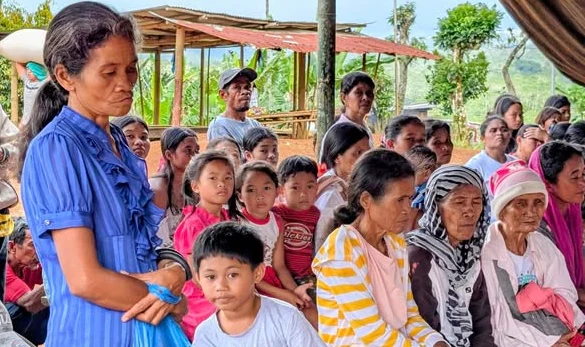
On the 25th of May, 2025, a quiet upland community in Talakag, Bukidnon, once again became a place of Jesuit mission. Bishop Noel Pedregosa of the Diocese of Malaybalay formally elevated the San Francisco Javier Chapel in Tikalaan into a mission station, entrusting its care to the Society of Jesus. In the presence of the Bishop, the decree of elevation was read by outgoing Bukidnon District Superior Fr. Ambrosio Flores, SJ, who was part of the discernment process of the new mission. On behalf of Father Provincial Xavier Olin, SJ, Fr. John Lester Tajon, SJ, incoming district superior, gestured the Society’s acceptance of the mission.
However, its quiet and beautiful rural landscape is far from idyllic. The mission is part of the 42,265-hectare Kibaritan military reservation of the Philippine Army, where training is regularly conducted.
A Call from the Bishop
The journey began in 2023, when Bishop Pedregosa invited the Jesuits to discern the possibility of returning to Tikalaan. Its home ecclesial community, St. Joseph Parish of Talakag, had grown so vast that its priests could no longer adequately accompany its many chapels. The bishop saw in the Jesuits a fitting partner, particularly in their charism of serving those in the peripheries and walking with Indigenous Peoples. The good bishop, an alumnus of Jesuit institutions, knew that the Society could resonate deeply with the pastoral needs of Tikalaan.
After months of discernment, pastoral visits and dialogue, Father Olin finally accepted the invitation. Within the context of the prevailing Universal Apostolic Preferences of the Society, the Jesuits did not return to Tikalaan merely to “supply priests,” but to walk with the people, especially the Indigenous, in faith, justice, and hope.
The Return of the Jesuits in Tikalaan
Tikalaan is no stranger to the Jesuits. Archival records show that the San Francisco Javier Chapel was among the first chapels the Jesuits opened in the 1940s when they began their mission in Talakag. For many years, Jesuits administered the parish and its chapels until the ministry was later entrusted to the diocesan clergy. The last Jesuit assigned in Talakag Parish was Fr. Robert Dy, SJ, who ministered for 19 years until 1992.
Located in the uplands of Bukidnon, Tikalaan is home to the Higaonon people, one of the major Indigenous groups of Mindanao. Farming has sustained them for generations. Alongside them are settler families who have also made their home in the community. However, the community’s peace situation suffered from a history of land disputes and rebel encounters. Aside from the military camp at Kibaritan, some checkpoints are spread around the area.
Despite having a larger percentage of minority Protestant sects compared to other places in Bukidnon, the Catholic faith of the people is strong. Families walk for kilometers to attend Mass. Children and youth crowd the small chapel on Sundays. Elders faithfully keep the chapels clean and simple, knowing that these are sacred spaces where God meets His people.
A Mission Station for Many
The newly established mission station, dedicated to San Francisco Javier, is based in Barangay Tikalaan. It also serves 18 other chapels spread across nearby sitios and barangays. The Catholic Higaonon communities generously donated the lands for church purposes. Scattered across hills, rivers, and rugged roads, these communities reflect both the vastness of the mission’s challenges and the depth of the people’s faith. The following chapels are under the mission station: Tagbak, Gahiton, Salucot, Overlooking, San Fermin, Intalwas, San Miguel, San Rafael, Sta. Victoria, Indulang, Colawingon, San Mateo, San Dionisio, Mamaon, Lantud, Migpait, Km. 26, and Km. 28.
Some of these communities are only beginning to experience the first stirrings of faith. Among them are Sitio Malantao and Sitio Patpat. In Sitio Malantao, the people joyfully welcomed the first celebration of the Eucharist. A simple makeshift stage served as the altar, and the community itself built a temporary tent to shelter those who gathered. At first, the people hesitated to proceed, fearing that no one would come since Mass had never been celebrated there before. To their surprise, many came, elders, parents, and children alike, filling the open space with song and gratitude. In Sitio Patpat, distance has long made participation in the sacraments difficult, and some residents have since joined other faith communities. The first Eucharistic celebration was held in a garage generously opened by its owner for the occasion. The Mass was well attended by both young and old. Afterward, an elderly woman expressed her joy that, after so many years, a Mass had finally been celebrated in their place. Though there are no concrete plans yet to establish a chapel, she promised to look for a site where one could someday be built. The community also expressed, though shyly, their hope for a regular monthly Mass.
In Overlooking, one of the most difficult communities to reach because of its distance and rugged terrain, another moving celebration of the Mass took place. Despite the steep climb, river crossings, slippery paths, and leeches, laughter and song filled the journey and the celebration. These moments reveal the remarkable faith of people who, even amid the harshest conditions, gather to encounter the Lord in the Eucharist.
The celebrations of the Mass in schools have also marked our Jesuit presence in the mission and have become occasions of grace. For many children and young people, these celebrations are their first real encounter with the sacraments in their own community. Teachers and students alike welcome the presence of the missionary, seeing in him both pastoral accompaniment and encouragement in their daily struggles. By serving beyond the chapels, the next generation is assured of faith and values formation through access to the sacraments in their schools.
Words of Shepherds
During the elevation rites, Bishop Pedregosa reminded the faithful that the mission station is the fruit of listening to the Spirit and responding to the cries of God’s people in the peripheries.
Father Olin likewise emphasized that the mission is not simply about administering sacraments but about planting ourselves in the life of the people, walking with them, and helping them see how God is already at work in their midst. These words resonated deeply with the Higaonon community. The establishment of a resident mission was an answered prayer. For them, the creation of a mission station means that their struggles, dreams, and faith are recognized as part of the wider Church, a sign of God’s nearness, and likewise gives the Jesuits a chance to walk with them for the long haul.
Challenges
Every mission has its share of difficulties, and Tikalaan is no exception. One of the most pressing challenges is the need for sturdier infrastructure. At present, the Jesuits are renting an old house across the church, in-between a basketball court and the barangay hall, that serves both as a residence and a temporary office. There is no convent or permanent office yet. Since the elevation of the chapel into a mission station last May, baptisms to funerals were conducted, and there is a growing need for a proper office where these records can be safely stored and administrative work can be done efficiently. Almost everything started from scratch, especially the necessary mass kits for chapel masses—thanks to a few surpluses from Miarayon Parish and the generosity of friends and benefactors.
The immediate priority now, however, is the construction of the office, which will serve as the mission’s heart, a place for pastoral planning, community meetings, and coordination. The place of formation of the people shall come first. The construction of the convent and a larger church will follow in the next phases. These are not simply buildings but symbols of stability and presence, signs that the Church truly walks with the people of Tikalaan. For this reason, the mission has begun a fundraising initiative to help make these dreams possible.
Another challenge lies in the formation of volunteers. While there are already active ministries like the alagads, catechists, lectors, and altar servers, there remains a need to form more lay leaders, especially among the youth, who can help sustain the growing mission. The area is vast, and many chapels can only be reached after long travels. The presence of several evangelical sects around also poses a challenge to better form the existing volunteers. Building a network of trained and committed lay leaders is essential if all 19 chapels are to be accompanied with consistency and care.
Because of the lack of trained catechists and volunteers, many of the baptized have yet to receive their First Communion and Confirmation. The distance of some chapels also makes it difficult for catechists to regularly provide catechesis. Still, these challenges have become moments of grace, occasions to strengthen collaboration with the diocese, with fellow Jesuits, and with lay partners who share the dream of a faith-filled, self-sustaining mission in Tikalaan.
Consolations
One of the greatest consolations in Tikalaan is the vibrant presence of people who willingly make themselves available for the mission. Despite their own daily struggles and limited means, many step forward to serve the Church in whatever way they can. Some dedicated volunteers go out of their way to prepare for Masses, accompany the priest, or assist in the liturgy and catechesis.
In every celebration, whether in the main chapel, in the far-flung sitios, or in schools, the priest is never alone. There is always someone present, someone sent by the community to help. Each time they arrive, sometimes on foot after a long walk, or riding a habal-habal or bao-bao, their presence becomes a visible sign of love for the Church and of deep faith in the mission.
Another source of great joy is the people’s spirit of faith. They welcome every Mass like a feast, every visit as a sign that God has not forgotten them. In some areas, people gather, whether under the heat or rain, transforming open spaces into holy ground when necessary. In schools, children and adults alike sing their hearts out during the Eucharist, their voices lifting prayers of gratitude. These are moments that remind everyone that God’s grace is alive and working quietly in the hearts of His people.
Amid the challenges of mountain life, these small but radiant signs of generosity and faith sustain the mission and give it meaning. They are reminders that the Gospel continues to take flesh in the lives of ordinary people who, despite poverty and distance, live their faith with joy and perseverance. Indeed, no one can be too poor to have faith. “Blessed are the poor, theirs is the kingdom of God.”
Mission: to help build a holistic Church for the future
At the heart of the mission is the San Francisco Javier Chapel, now serving as the central church of the station. The land on which it stands was generously offered by local benefactors, a reminder that this mission belongs not only to the Society or the Diocese but to the people themselves.
Yet the mission is young and fragile. Building a convent and office is the most immediate priority. A larger church is also needed to welcome the growing number of faithful. These material needs require collaboration with the Diocese, with Jesuits across the Province, with lay partners, and with benefactors who can share in the dream of building a home for the mission.
Above all, the future of the mission will depend on forming local leaders, catechists, and youth who will sustain the faith of the community. The hope is to accompany the Higaonon and settler families alike in living their faith, preserving their culture, and building communities marked by justice, reconciliation, and care for creation.
Conclusion: Our Desire for Tikalaan
As Jesuits return to Tikalaan, the deepest desire is not only to (re)start missions but to plant God in the lives, struggles, and hopes of the people. To walk with the Higaonon, to celebrate with the children, to share life with the farmers and families who make up this mission station: this is the dream.
St. Francis Xavier, our mission patron, wrote, “Many, many people hereabouts are not becoming Christians for one reason only: there is nobody to make them Christians.” Tikalaan reminds us that even today, in the hills of Bukidnon, the harvest remains plentiful, and the mission continues.
————–
Fr. Jereme Asunto, SJ has been missioned to the Bukidnon Mission District since his ordination in June 2018, serving in both parish and school ministries. He is currently assigned as the Mission Station Administrator of the newly established San Francisco Javier Mission Station in Tikalaan, Talakag, Bukidnon.