
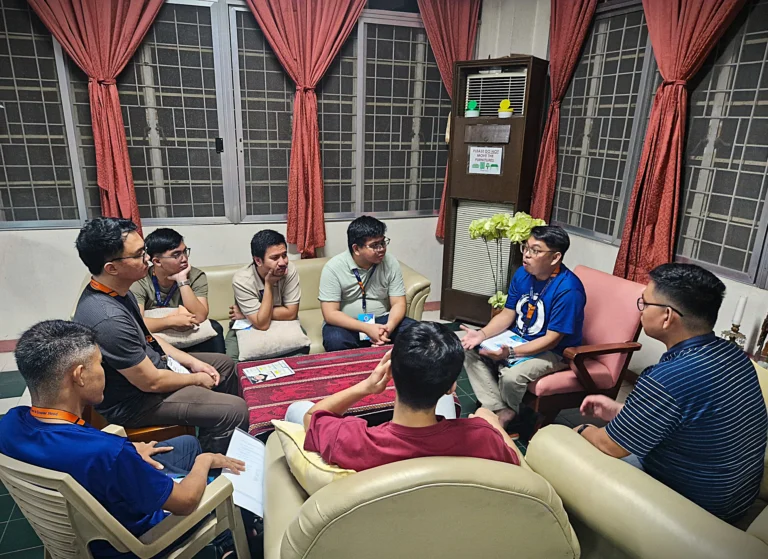
I entered Sacred Heart Novitiate in August 2025 with a heart confident of God’s unconditional love. However, I was still filled with anxiety and fear. I was afraid of various things. I feared the uncertainty inside the novitiate. I was afraid of rejection. I was anxious because of my sense of unworthiness and insecurity as to my formability.
Half a month in the novitiate, our house offices were announced, and my automatic reaction was wanting to do well in my assignment as a Kitchen Minister. I got triggered when things didn’t go as planned: menus not being followed, food not being enough, and cups being left around the corridor. Right off the bat, I went straight to “doing.” I realized that I was trying to earn my place in the community by being performative and proving that I can handle responsibilities.
However, my stay in the novitiate, contrary to my usual programming, has invited me not to rush in doing things, fixing things, or making things perfect. I am being invited, before anything else, to slow down and to stay in the moment, to relish, and to listen—to listen not merely with the ears or the intellect, but with the heart.
The novitiate, I am learning slowly, gently, and sometimes painfully, is not primarily about doing but about focusing on God’s movements, on one’s inner life, and on the quiet ways grace works beneath the surface. In this sense, my stay here in SHN has felt less like a program to complete and more like a long conversation—sometimes consoling, sometimes unsettling—between God and my deepest self.
Being Taught by God
St. Ignatius described his time in Manresa as a season when God dealt with him “as a schoolmaster deals with a child.” It is where St. Ignatius learned to listen with his heart: affective knowledge. Since entering the novitiate, I have come to realize that this same relationship is happening between me and God: I am a learner being patiently taught by God. Much of this learning has involved unlearning—letting go of compulsions toward control, achievement, and self-sufficiency that once defined my sense of worth.
Like St. Ignatius, who survived his scruples and grew beyond his extreme penances, I am slowly being taught by God that my worth does not depend on the things I have accomplished or can accomplish. My mistakes and sins do not define the amount of love God has for me. I am beloved by God in my wins and defeats. I am unconditionally loved.
Formation has gently but persistently drawn my attention to the inner movements that shape how I relate to God, to others, and to myself. Silence in prayer, the daily examen, spiritual conversations, and the structured pauses of community life have created a space for encounters with God that have allowed old fears, long-standing wounds, and familiar defenses to slowly surface—not to be condemned, but to be acknowledged and healed.
But God did not meet these revelations with urgency or judgment. Instead, God looks at me with patience, mercy, and love. Again and again, I have been invited to look at myself honestly but compassionately, trusting that nothing revealed is beyond the reach of grace.
Listening to One’s Humanity
One of the most formative invitations during my stay here in Sacred Heart has been to listen seriously to my own humanity. For the longest time, I felt the pressure to present myself as someone who has it all together. However, learning to listen with the heart has meant allowing myself to feel emotions and articulate needs that I had long learned to suppress.
St. Ignatius started his journey as a pilgrim to prove to himself that he could also do (and even more) what Sts. Dominic and Francis did. But eventually, God was able to purify his desires so that they led to the institution of the Society of Jesus. I was inspired to also accept my need for achievement. But like St. Ignatius, I was moved to redirect the focus of doing things from myself to God. I was reminded of Fr. Ogie Cabayao, SJ’s homily when I was about to leave Davao: “true greatness lies not in our capacity to do things, but in the greatness of what God can do in us and through us.”
Through the different formation activities in SHN, I have been provided a safe space to be more in touch with my humanity. I am able to confront my compulsions, needs, sexuality, strengths, limitations, brokenness, and historicity – my whole self. Leaving no stone unturned, I simply try to be open and honest with feelings that accompany each significant moment. I have been guided by the formators to articulate and own all these parts of me – for even the ones I hated about myself are indeed accepted and loved by God. Even these parts can be used by God for His greater Glory.
Here I have found a place where I can be truly honest with myself, others, and God. Slowly, I have come to understand that these parts of me are places where God is already present, waiting to be received.
From Doing to Being-With
A significant shift this year occurred in my understanding of mission and apostolate. Coming from years of development work, I was accustomed to measuring success in terms of outputs, outcomes, and impacts. In the novitiate apostolate, however, I have found myself repeatedly invited to slow down—to be with people.
In simple conversations, moments of laughter, and shared meals with the Kawan youth and elders, I have discovered a different kind of fruitfulness. God is present not only in planned activities but also in what feels like “wasted time.” These encounters remind me that mission begins with presence, and that listening is itself a form of service.
Here, the Jesuit call to spiritual conversation has become concrete. Ordinary conversations unexpectedly turn into moments of grace, where stories of struggle, hope, and faith are shared. I have begun to see how my own story, including my brokenness, can become a bridge rather than a barrier in encountering others.
From “I” to “We”
Community life has been a powerful teacher. Living closely with my brothers has confronted my tendencies toward self-sufficiency and control. Gradually, I have been learning to trust my companions—to ask for help, to share leadership, to receive feedback, and to allow others to contribute in their own way. God also works in the diversity of personalities, gifts, and eccentricities.
This movement from “I” to “we” mirrors Ignatius’s own journey. The realization that mission is never meant to be carried out alone has been both humbling and liberating. In community life, I am learning to give and receive from others—not just help, but also care and love. This process proves to be stretching—as you open yourself to loving and being loved, you also open yourself to the possibility of pain. But Jesus stayed on even after abandonment by the apostles. Jesus loves even in the face of man’s sinfulness. Here in the novitiate, I am being invited to do the same. In the stretching of my heart, I am discovering a deeper freedom and a more authentic sense of belonging because I am growing in love.
Trusting the Slow Work of God
As my first year of formation continues, I find myself returning often to simple but demanding graces: openness and trust. Openness to God’s presence, love, and invitation—to be vulnerable before God. Trust in the process of formation and God’s timing.
The novitiate has taught me that God does not rush the work of love. Here I feel like I’m being grasped by God—a God who labors patiently, shaping my heart through encounters in ordinary days of routine, prayer, and community life. My task is not to perfect myself, but to be at home in the humble acceptance of my humanity. Learning to listen with the heart has been, and continues to be, the quiet work of grace. And in that listening, I am slowly discovering a freedom rooted not in achievement and control, but in loving and being loved—exactly where I am, as I am.
All is gift. All is grace.
—–
Regin Oliveros, nSJ, is a Jesuit novice from Quezon Province. A graduate of the University of the Philippines Los Baños, where he earned a Bachelor of Science degree in Food Technology in 2012, Rui is currently undergoing formation at the Sacred Heart Novitiate.