
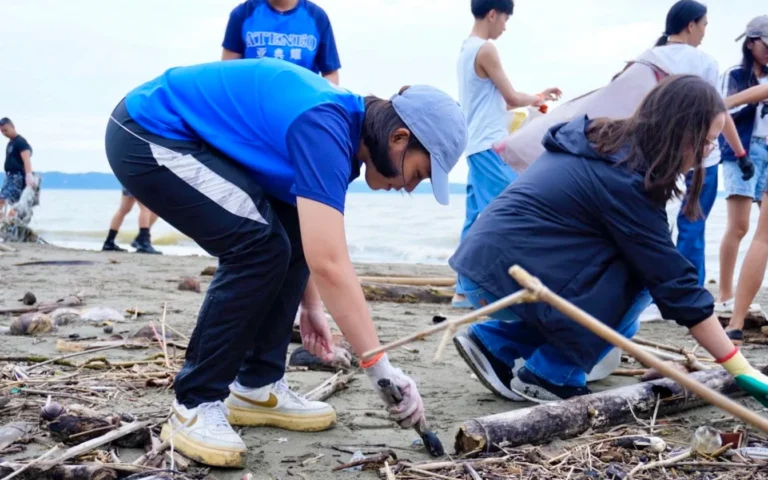
Mending what was Once Broken by John Philip W. Jancilan
The disasters that we face today are more than just forces of nature, but a painful reminder of the broken bond between humanity and the environment that we depend on. They remind us that when we continue to neglect the pleas of the environment, the consequences always find their way back to us. In fact, the recent flooding in Iloilo City has become so evident that it no longer feels like a rare calamity, but something we have learned to live with. On the other hand, the recent earthquake that hit near Bogo City in Cebu was also felt here in Iloilo, and even though we thought it would be quick, the shaking lasted longer than we could have ever imagined, making it clear that our safety depends on the balance of the environment we live in. In moments like these, we are reminded that our place is within nature, not above it.
With this in mind, integral ecology, as emphasized in Laudato Si’ teaches us that everything is intertwined by caring for our common home together. It is when we recognize that human beings, society, and even nature are all interconnected with each other. Our behavior and choices are never isolated, and we all have a shared responsibility in looking after the world around us. Reflecting on the natural calamities recently shows that ignoring the environment has consequences beyond nature itself where the devastating effects can ripple through society and people. Hence, these experiences illustrate that true harmony comes when we understand our place in nature, extending our care by looking out for both Mother Earth and the community around us.
Moving forward, these natural calamities that we face today emphasize that real change starts with small and consistent action. Every responsible action that we take sets an example for others to restore the balance that was once lost. That is the essence of integral ecology, which calls us to see the environment not as a separate entity, but as part of our integral life. It tells us that humanity cannot truly coexist with nature if we don’t first learn how to live within it and protect it. In the end, how can we hope for a better tomorrow if we leave the Earth broken and neglected?
—————————–
A Faith that Does Justice: Bridging Education and Ecological Responsibility by Annika Celestine C. Ong
Anyone can write about solutions such as planting trees, segregating waste, and promoting sustainability to solve global warming. But who can answer the question, “What comes next?”
Color-coded waste bins are useless if ignored. Planting tree saplings in the soil means nothing if done hastily. Turning off lights and air-conditioning in classrooms become a moral choice when no one is watching. Seeds cannot bloom without consistent care and maintenance, just as these solutions are not effective without everyday effort to see the projects through. Although the current curriculum provides students with environmental education and awareness, it falls short on challenging the human nature that gravitates towards convenience and a lack of moral discipline that comprises ecological irresponsibility. To truly embrace integral ecology, education must inspire not just informed minds, but committed hearts that transform their faith into justice in serving the environment.
While the school teachings of integrated science classes, such as Disaster Readiness and Risk Reduction (DRRR), provide students with ample education opportunities, the real challenge lies in addressing the root of the problem: the failed bridge between studies and application. Most settle for convenience and the easy way out: they have done their part by being aware. However, living out integral ecology requires the active commitment to our faith and responsibility as stewards of our common home. It is a holistic effort in tackling social, cultural, and spiritual issues through questioning mindsets and systems that normalize such wastefulness and consumerism—an overall disregard for the common good.
This is what sets the school initiative “CLAYGO” or Clean As You Go apart from other projects. The constant repetition of reminders from personnel is what built the habit among students to be responsible in clearing areas of trash and litter after use. Such is an example of how the mastery of a singular effective action triumphs over doing multiple yet shallow exertions.
Let us not waste the seeds of education sown, where, as proper caretakers of our common home, we are called to nurture these blooms into lasting habits and meaningful action. Real ecological conversion begins not with grand gestures but with small and consistent efforts rooted in the people’s belief in justice, compassion, and care for creation.
—————————–
The Age of Excess: Pursuit of ‘More’, Death of ‘Enough’? by
The Earth does not die in silence. It dies in the noise of our desires, in every purchase we call “self-care,” in every outfit we refuse to repeat, in every plastic dream we cradle as the world burns quietly beneath us.
A new Labubu drops, a limited-edition Sonny Angel is released, and suddenly, the world stops. Screens light up with unboxings, shelves fill with collectibles, and wallets empty in seconds. We chase the thrill of owning, of being first, of showing the world that we, too, can afford beauty wrapped in plastic. Yet behind every “add to cart” lies the quiet cry of a dying planet. The question is no longer what’s trending, but what’s left.
In a world that glorifies aesthetics, even the act of “outfit repeating” is mocked. We shame people for wearing the same clothes twice, as if value lies in novelty, not necessity. This obsession with constant change, with always having more, newer, and better, feeds a cycle of waste that the Earth can no longer sustain. Every item we buy carries an invisible cost: polluted rivers, exploited workers, and mountains of trash buried in silence.
Modern consumerism has become our most polished form of destruction. We call it lifestyle, but it is really addiction, one dressed in pretty packaging and pastel branding. We buy to belong, not realizing that the same culture that sells us happiness also sells us emptiness. As we decorate our lives with trinkets, we strip the planet of its life.
In his encyclical Laudato Si’, Pope Francis writes that “the earth herself, burdened and laid waste, is among the most abandoned and maltreated of our poor.” He calls for an ecological conversion, a change not just in habits, but in the heart. We must stop seeing the Earth as a storehouse of resources and begin treating it as a home. Yet this vision cannot thrive in a world ruled by the “throwaway culture” he condemns, where even human dignity is disposable, and worth is measured by consumption.
Consumerism blinds us to the beauty of simplicity. We chase possessions as if they define our worth, forgetting that “less is more.” Laudato Si’ challenges us to live with moderation, gratitude, and reverence for creation, to choose mindful living over mindless spending.
When the shelves are stripped bare and the skies fall silent, no brand, no beauty, no possession will matter. Only the Earth will remain—broken, waiting to see if we ever deserved it at all.