
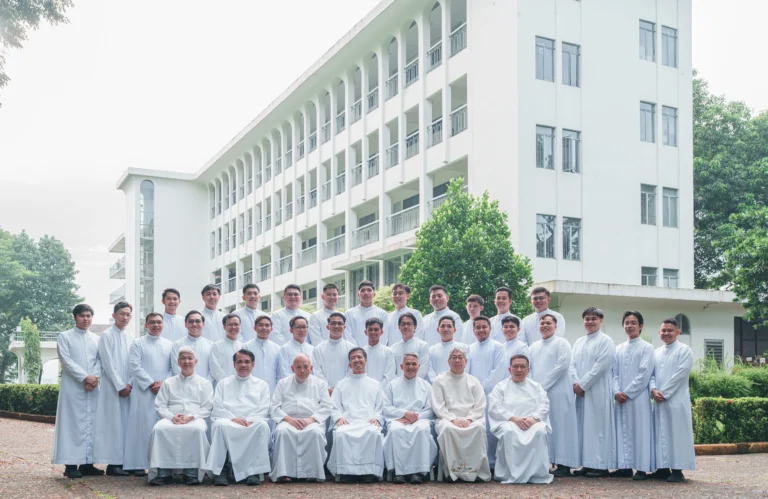
This year, 2026, San José Seminary marks the 425th year of the foundation of the institution from which it evolved, the Colegio de San Jose in 1601. It will be recalled that the Colegio de San Jose was originally a boarding school for boys who were studying at the College of Manila. In the history of the El Colegio de San Jose de Manila authored by William C. Repetti, SJ, we read thus:
On August 25, 1601, the Jesuits of Manila, on the initiative of Father Diego Garcia, inaugurated a seminary to which they gave the name “San Jose”. Its object was to foster vocations and give a training suitable for such a purpose, by providing of keeping the boys off the streets … From 1601 on, the students attended classes in the College of Manila, later the University of San Ignacio, when special teachers were not available, and received their degrees from that university.
The history of the Colegio de San Jose has been well-documented in articles written by historians such as Frs. Leo Cullum, SJ and Fr. Miguel Bernad, SJ. Fr. Rene Javellana, currently the Archivist of the Philippine Province, says that San José had an “itinerant life.” He notes how San Jose Seminary moved from Intramuros to Padre Faura in 1932 when a fire destroyed the Ateneo. Then, in 1936, San José moved to Balintawak in what is now the Manila Central University. Then again in 1941, when World War II broke out, San Jose returned to Padre Faura. Then, in 1943, when the Japanese took over Padre Faura, Josefinos and Jesuits studied with the Vincentians at San Marcelino until they were dispersed when the Japanese took over San Marcelino. After the war, San Jose re-opened in rented houses surrounding La Ignaciana in Sta. Ana. In 1951, San Jose moved to Highway 54 (now EDSA). In 1965, Fr. Rector Jesus Diaz spearheaded the transfer of San José Major Seminary to the Ateneo Campus. The major seminarians temporarily occupied a wing of Loyola House of Studies (LHS) while their building was being constructed. In 1966, the minor seminarians went to the Juniorate wing of Sacred Heart Novitiate. Then, in 1967, upon the completion of the new San José Seminary building, the seminarians moved in from LHS. The seminarians studied at Loyola School of Theology. The minor seminary was closed. With this, as Fr. Bernad writes, “San José Seminary has reverted to its original status of the Colegio de San Jose in Intramuros. It has once again become a residential college where the seminarians live a community life and undergo spiritual and pastoral formation, but they attend classes at the Ateneo de Manila University or at the Loyola School of Theology.”
As San José Seminary marks this milestone, the question is asked, “what has changed and what has remained constant through the centuries?” I believe our mission-vision statement illustrates the consistent thread through the centuries even as San Jose Seminary moved locations, as the high school and college departments were closed, as rectors and Jesuit formators came and went, and as seminarians graduated and moved on to become either ordained ministers or lay faithful in the Church. Our vision-mission statement states thus:
San José Seminary is
a nurturing home and a formative workshop
that molds Ignatian-inspired diocesan priests
who are configured to Jesus Christ, Prophet, Priest, Shepherd.
San José Seminary is
a safe and welcoming environment
where seminarians can nurture their God-given talents and potentials
through a holistic and dynamically integrated formation.
Through the years, San Jose Seminary has nurtured the vocation of hundreds of diocesan seminarians from various dioceses across the country and formed them in the workshop of Tata Jose, the carpenter of Nazareth. Some have become bishops, among whom four have become cardinals and are now known, not only in the Philippines, but on the global stage. However, many of our alumni are quietly working as dedicated parish priests in parishes big and small, in urban centers and rural areas. Some are doing crucial tasks entrusted to them by their bishops as diocesan chancellors, eoconomus, personal secretaries, vicar for the clergy. Besides the ordained alumni, we have as many lay alumni who bring to their respective families and professions in the secular world the Josefino values that have molded them whilst in the formative workshop of Tata Jose.
The Ignatian spirituality that has characterized the formation in San José Seminary binds Josefinos of various generations, especially those who have been privileged to make the full 30-day Spiritual Exercises. The Ignatian terms, such as magis, cura personalis, and discernment, are not only empty words for them. These truly serve as criteria for their decisions, big and small. In opus ministerii, the ultimate goal is the greater glory of God, ad maiorem Dei gloriam. For Josefinos of every generation, St. Ignatius of Loyola is not just one saint among many saints. If San Jose is their spiritual father; St. Ignatius is their spiritual master.
San José Seminary’s movement from one place to another certainly challenged it to adjust to the new location and to the new environment, and especially to the challenges in formation at that particular point in history. The move from Highway 54 to Loyola Heights happened in 1965, the year when the Second Vatican Council came to a close and ushered in major changes in the life of the Church. The new ecclesiology born of the Council found its way to the formation structures of San José Seminary specifically in the restructuring of the community into basic ecclesial communities (BEC). As Bishop Francisco Claver said, the BECs are the new way of being a Church. Through the BECs, the faithful truly feel they are members of the Church, actively participating in its life and mission. From the time it was created until today, the BECs have been a venue for lively conversations, a source of fraternal support and encouragement, and a concrete experience of the vibrant community life in San José Seminary.
More recently, especially with the inspiration and challenges that the late Pope Francis brought forward for the Church to confront, we have also emphasized key themes in the current formation program in San José Seminary, namely, safeguarding and ecological consciousness. We underlined the need for greater simplicity of lifestyle in order to meet the demands of safeguarding and ecological conversion. Hence, in the vision statement above, we explicitly stated that we envision a “safe and welcoming environment.” We have laid down Protocols for the Safeguarding of Minors and Vulnerable Adults. We emphasize boundaries in relationships, both inside and outside of the seminary community. We hope that this heightened focus on safeguarding will be carried out later on by our seminarians in their respective dioceses, parishes, and ministries. In addition, we have also continuously reminded the community of the need to care for our common home. We believe that small acts that manifest ecological consciousness, such as planting trees, tending plants, segregating and reducing waste, will go a long way towards instilling love for the earth in our seminarians’ consciousness.
The new Ratio Fundamentalis for Seminary Formation underlines the need for “a holistic and dynamically integrated formation.” In the spirit of ecclesia semper reformanda, a Church in need of constant renewal, we undertake a regular review of the formation program of San José Seminary. The recent Synod for Synodality with its emphasis on the participation of all members of the Church has affirmed the characteristic manner of proceeding in San José Seminary for decades now especially since the Second Vatican Council: constant consultation, respectful exchange of views, but in the end, serenely submitting to the decision of the superiors in humble obedience. We remind seminarians that authentic Ignatian discernment culminates in obedience, for St. Ignatius himself wanted Jesuits to excel in obedience as much as in poverty and chastity.
God willing, the next four decades will see San Jose Seminary where it is now, sitting on top of a hill, looking out into the East, where the sun rises each day. Here, every time a seminarian looks out into the sunrise, the ray of hope dawns for him and his diocese, ad maiorem Dei gloriam!
–
Fr. Norlan Julia is the present rector of San José.