
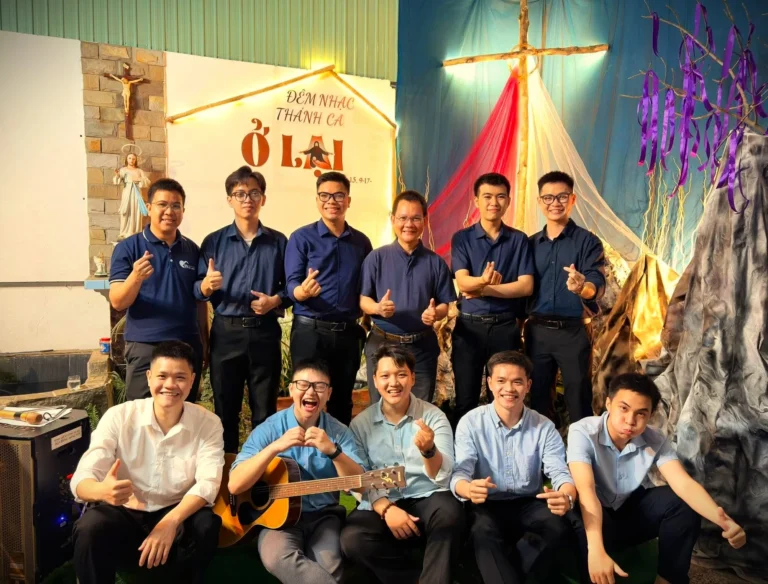
The desire to be a missionary has been with me since I entered the Society of Jesus in the Philippines in 2019. However, I never imagined I would be sent to a prenovitiate in a foreign country for my regency. I often associated foreign missionary work with direct service to the poor. This is why, as a young scholastic, I expressed my willingness to be sent to conflict-ridden Myanmar if the opportunity arose. I wanted to be in direct contact with the poor. Yet, the Spirit brought me to Vietnam, to teach English to prenovices and candidates and assist in their human formation.
“We’re also poor, Brother Jun,” one prenovice remarked after I shared my story during a table conversation. I simply smiled at his perceptive reply. It takes an honest look at oneself to arrive at such an insight into one’s condition. It requires courage to admit one’s poverty and articulate it. That prenovice’s honest and courageous confession had since challenged my initial, immature understanding of mission and my availability as a young Jesuit on mission.
As a novice, I was deeply moved by an excerpt printed on a large vocation promotion tarpaulin that once hung along the novitiate corridors: “A Jesuit, therefore, is essentially a man on a mission: a mission which he receives immediately from the Holy Father and from his own religious superiors, but ultimately from Christ himself, the one sent by the Father. It is by being sent that the Jesuit becomes a companion of Jesus” (GC 32, D.2, n.14). In other words, it is through mission—by being sent—that my desire to be Jesus’ companion finds its fulfillment.
As a young scholastic studying philosophy, I often looked forward to meeting Filipino Jesuit missionaries who stayed with us in the formation community. I cherished sitting with them during meals, listening to their stories about life in their mission. I noticed how their Jesuit lives became more defined as they endeavored to make themselves available for the greater needs of their mission assignments.
After spending two years as a missionary in Vietnam, I began to grasp what the excerpt I read as a novice and the mission stories I heard as a scholastic in First Studies truly mean. My desire to accompany Jesus in mission is fundamentally rooted in and sustained by the reality that Jesus has faithfully been my companion throughout these years. Jesus has accompanied me through the ebb and flow of responding to the Father’s call. This was most especially true during my regency in Vietnam. Young as I am in the Jesuit life, I can say that this phase of formation is thus far where I experienced most palpably Jesus’ company.
It is not unknown to all that I am the first Filipino Jesuit regent sent to Vietnam. The Vietnamese Provincial Superior even noted that I was ushering in the third wave of foreign missionaries to the Vietnamese Province, thus contributing to the call for greater interculturality. The first wave, of course, was the group led by Fr. Alexander de Rhodes in the 1620s, while the second wave arrived in the 1950s. The first group remained in Vietnam until the Society of Jesus was suppressed worldwide in 1773, and most of those who belonged to the second wave had to return to their homelands following Vietnam’s “reunification” in 1976. (Worthy of mention would be Fr. Roger Champoux, with whom I often corresponded, especially for perspective and encouragement. Not only fluent in Vietnamese, he is also deeply familiar with Vietnamese culture, as well as the Church and the Society in Vietnam.)
Before the seemingly historic nature of this mission in which I was privileged to partake, I found myself confronted with my growing edges. The words of Jeremiah resonated deeply with me: “Ah, Lord God! I do not know how to speak. I am too young!” (Jeremiah 1:6). I did not initially know how to speak Tiếng Việt. I felt I was too young to accompany the prenovices in their human formation. I had been missioned to teach English as a foreign language even when my own background was teaching English as a second language. (Well, of course, a foreign language is technically a second language, too!) These and other reservations I raised to God, who assured me: “Do not say, ‘I am too young.’ To whomever I send you, you shall go; whatever I command you, you shall speak. … Do not be afraid… I am with you…” (Jeremiah 1:7-8).
Beyond these initial reservations, however, there were tensions and difficulties I needed to come to terms with as I embraced the concrete circumstances of the people, places, and times to which I had been sent. Two major and interconnected tensions were those of being and doing, and of community and mission. Even as I was settling in, I found myself already engaged not only in prenovitiate-related work but also in parish assignments, since the apostolic community in which I lived carried both ministries. I was also invited to teach newly vowed Jesuit scholastics, men and women religious from other congregations, and a few lay students.
Furthermore, given the added layers of negotiation and adjustment involved in being inserted into a “foreign” apostolic community, it became very tempting to prioritize “mission” while overlooking the truth that community itself is mission. In this context, a line from De Statu Societatis 2023 served as a constant reminder to what was becoming my doing-centered, mission-disguised self: “What defines the Jesuit, or those who share in the apostolic activity of the Society, is their identity, not their activity.”
Very strikingly, my experiences of difficulty further solidified and grounded my identity in Jesus, my most intimate companion in mission. In my experience of poverty that went beyond the material and touched the existential, He was God’s Providence, rescuing me from being trapped in the whirlpool of my intensifying and disorienting needs. In my experience of humiliation, which deepened the darkness of disillusionment, He was God’s Strength, drawing me out of the pit of discouragement, helping me regain my bearings and move forward under the light of His radiant love. In my experience of loneliness, which seemed to overwhelm me even as I was surrounded by people who tried to show care in the ways they knew how, He was God’s Gladness, urging to be shared, especially with my brother-Jesuits in the apostolic community; with the prenovices and candidates I was entrusted to teach and accompany (and who taught and accompanied me, too); and with the international community of parishioners I was called to serve.
In other words, what began as difficulties became pathways toward a closer following of Jesus—poor, humiliated, and humble(d)—one key grace I had begged for when I first made the Spiritual Exercises as a novice. I could not help but proclaim, “God is faithful!”
As I move forward to the next phase of Jesuit formation, I carry with me the wounds created by these tensions and the aches left by these difficulties, for it is in and through them that I have been given the grace to experience the very wounds and aches of my crucified Lord. It is also through them that I have learned a way of loving and serving that is more humble and more freeing.
Contrary to what I had initially thought, mission—whether local or foreign—does not begin with immediately addressing needs, whether material, linguistic, psycho-emotional, or spiritual. It is not simply about doing something; it is about being someone—and being with someone. Thus, mission begins with and flows from a deep, personal relationship with Jesus. For St. Ignatius of Loyola, and for every Jesuit, this relationship is always with Jesus carrying the Cross. Only within the depth of this relationship can I freely and joyfully respond to wherever the need is greater.
—–
Sch. Rogelio R. Nato, Jr., S.J., hails from Tagkawayan, Quezon Province. Born on the Feast of Our Lady of Lourdes and baptized on the Solemnity of Saint Joseph, Husband of the Blessed Virgin Mary, he has long entrusted himself to Mary and Joseph, seeking their prayer and encouragement as he continues to respond to the call of Christ the King—his crucified and risen Lord—wherever it may lead him.