
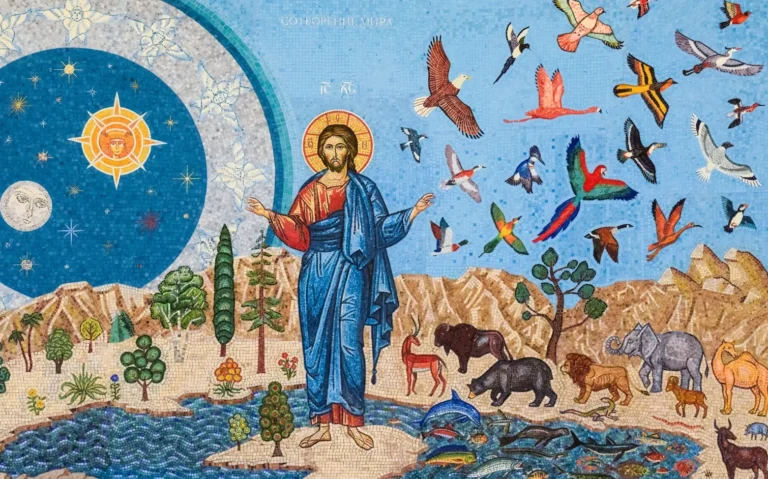
“The poor and the earth are crying out.
O Lord, seize us with your power and light,
help us to protect all life,
to prepare for a better future,
for the coming of your Kingdom
of justice, peace, love and beauty.
Praise be to you!
Amen.”
A Christian prayer in union with creation (Laudato Si’ no. 246)
Ten years ago, Pope Francis published his groundbreaking ecological encyclical titled Laudato Si‘. For the first time in Christian history, a full-length encyclical is dedicated to addressing the ecological devastation of our common home in the light of our Judeo-Christian faith. It is important to keep in mind that the encyclical is not confined to the ecological for it rightfully belongs to the rich body of Catholic social teaching. For Pope Francis, “a true ecological approach always becomes a social approach; it must integrate questions of justice in debates on the environment, so as to hear both the cry of the earth and the cry of the poor.” (LS n. 49) Ecological justice and social justice are inseparable insofar as our Christian faith encompasses the spiritual and material dimensions of created realities as exemplified by Jesus Christ, the Incarnate Word, through his words and deeds.
Unfortunately, despite its clear rootedness in the Judeo-Christian tradition this green encyclical is not immune from critics which include Catholics. Economist Steve Moore accused the Pope of using “the language of the radical green movement that is at its core anti-Christian, anti-people, and anti-progress” as if the subversive language of the biblical prophets and Catholic social teaching is not radical. Climate change skeptics and deniers are not happy with the Pope’s affirmation of the reality of climate change and its palpable impacts. Jeb Bush, formerly a Republican presidential candidate, was a bit dismissive of the Pope’s moral voice when he said: “I don’t get economic policy from my bishops or my cardinal or my pope.” Perhaps, the sharpest yet not really surprising public criticism from a high-ranking official in the Church comes from the German theologian Cardinal Gerhard Müller who ironically is a supporter of Latin American liberation theology. He commented in an interview with The Australian: “Environmental policy is nothing [sic] to do with faith and morals. Those issues are for politicians and for people to vote for the party they agree with.”
At the root of this negative and sometimes hostile attitude towards Christian engagement with pressing social and ecological problems is a pernicious “dualism.” This dualistic worldview is anti-body, anti-nature, and anti-world. The philosophers Plato and Rene Descartes are considered the brainchildren of this worldview; the former reduced the body into a prison for the soul, while the latter dichotomized the mind and body as separate entities. Gradually, this crept into Christianity resulting in overly spiritualized theologies and heaven-centered spiritualities devoid of worldly concerns. “Once Christian thought adopted a dualistic philosophy with the hierarchy of spirit over matter, it subordinated the religious importance of the natural world, accounting for the tenacious human-centeredness that pervades most theologies,” observes Elizabeth Johnson, CSJ. Notable figures in the history of spirituality who promoted a dualistic, heaven-centered spirituality are spiritual writers Thomas à Kempis and Adolphe Tanquerey. Sean McDonagh, SSC, explains that this anthropocentric dualism emphasizes “the salvation of one’s soul and future life in heaven rather than being involved in the affairs of the world,” thereby significantly shaping Christian discipleship. Sadly, dualism persists in the Christian religion up to this day as evidently shown in negative receptions of Laudato Si’ from certain groups of Christians. In the liturgy, the exhortation “to love the things of heaven and hold fast to what endures” is still prayed during the season of Advent, subtly exalting heavenly things over earthly things.
The holistic creation spirituality of Laudato Si‘ serves as an effective and powerful antidote against modern-day dualistic theologies and spiritualities that contribute to the distortion of our relationship with God and with the community of creation. Pope Francis acknowledges in the beginning of the encyclical that humans have the tendency to misinterpret the Bible to justify their dominion over an unbridled exploitation of the earth. An infamous example of this is God’s mandate to humans to fill and subdue the earth and have dominion over all created things (Genesis 1:28) taken literally and read dualistically. (LS n. 67) Humans forget that creation is a sacrament: “The universe unfolds in God, who fills it completely. Hence, there is a mystical meaning to be found in a leaf, in a mountain trail, in a dewdrop, in a poor person’s face.” (LS n. 233)
Another biblical misinterpretation and dualistic reading the Pope points out is depicting Jesus Christ as “an ascetic set apart from the world” and “an enemy to the pleasant things of life.” (LS n. 98) On the contrary, “Jesus lived in full harmony with creation… He was far removed from philosophies which despised the body, matter and the things of the world. Such unhealthy dualisms, nonetheless, left a mark on certain Christian thinkers in the course of history and disfigured the Gospel.” (LS n. 98) In addition, Jesus’ central proclamation of the Reign of God has ecological and cosmic dimensions. The great theologian Edward Schillebeeckx, OP, highlights these often-neglected dimensions: “Where human beings live and emerge, it must become clear to each of them that God will rule, that here the kingdom of God begins, that here peace and justice are beginning to reign among human beings and peoples within a sound natural environment.” The Reign of God is not “a sovereign realm above and beyond this world,” in the words of Schillebeeckx. Therefore, our care for our common home and for the oppressed are participation in the Reign of God among us. (Luke 17:21)
As long as the Church is infected by “unhealthy dualisms,” Laudato Si’ retains its ongoing relevance. Christianity which escapes from the world and earthly concern becomes an ideology. On the other hand, Christian social and ecological activism without the Reign of God can also become an ideology for “we are not God” (LS n. 67) and our collective human efforts will never be enough to transform our common home without God’s salvific grace. But this can never be an excuse to not conscientiously connect our faith convictions with our historical responsibility. “The church only has a future to the degree to which it lets go of all supernaturalism and dualism, and thus on the one hand does not reduce salvation to a purely spiritual kingdom or a simply heavenly future,” says Schillebeeckx. The lack of enthusiasm in heeding Pope Francis’ call for urgent ecological conversion impelled him to write a follow-up document wherein he lamented the world’s response: “Yet, with the passage of time, I have realized that our responses have not been adequate, while the world in which we live is collapsing and may be nearing the breaking point.” (Laudate Deum no. 2) We must not lose hope. We must continue to “come together to take charge of this home which has been entrusted to us, knowing that all the good which exists here will be taken up into the heavenly feast.” (LS n. 244) God is with us empowering us to heal our wounded world: “The Creator does not abandon us; he never forsakes his loving plan or repents of having created us. Humanity still has the ability to work together in building our common home.” (LS n. 13)
—–
Kevin Stephon R. Centeno, SJ is a Jesuit scholastic from the Philippine province. He currently resides in Loyola House of Studies, Ateneo de Manila University, studying philosophy, theology, and education.