
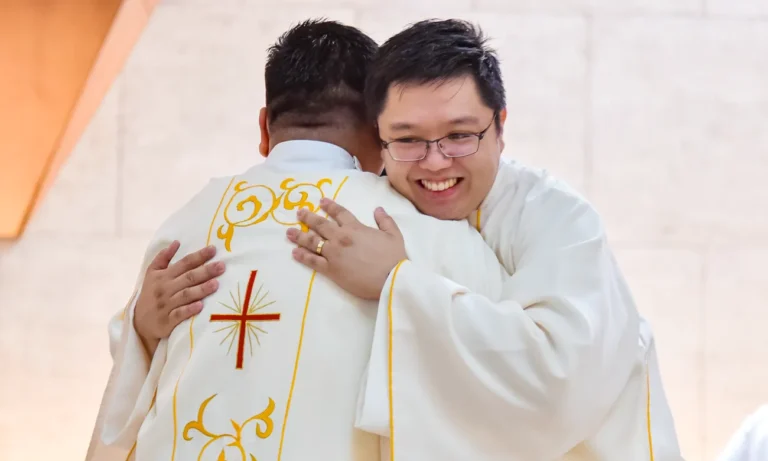
The ministry of the diaconate is more than doing things; it is also about being someone. It is not simply about performing duties or carrying out responsibilities, but about embodying a way of being that reflects Christ, who came not to be served but to serve. To be a deacon is to be configured to the self-emptying love of Jesus, to become a visible sign of His presence among the People of God. This ministry is not only about proclaiming the Word, baptizing, or assisting at the altar; it is also about being with people, walking with them in their joys and sorrows, their new beginnings and painful transitions. It is about standing at the intersection of heaven and earth, where God’s grace gently enters human experience.
The past months, I’ve been invited to preside over baptisms. I’ve been to many baptisms in the past, but it brings a different kind of consolation now that I am the one presiding. Meeting and talking with parents and godparents before the liturgy, seeing children’s confused stares as I pray, touch their heads, pour water, and anoint them with oil—these moments reveal the tenderness of God’s presence. There are the godparents who, with sincerity and hope, promise that from now on they will go to Mass every Sunday and strive to be good role models for their godchild. There are parents who, despite their limited means, still find creative ways to nurture their children’s faith and values. In their simple sincerity, I see what ministry truly means: to walk with ordinary people who love deeply, struggle daily, and keep believing even when faith seems fragile.
Maybe the sacraments are really like that. They draw us closer to people, to family life, to their joys and hopes, and most especially to the ordinary faith of ordinary individuals—each one struggling and trying, day by day, to become more Christlike. The sacraments open our eyes to how God is at work in hidden ways: in parents who persevere through difficulty, in godparents who rediscover faith through their promises, in the community that gathers to celebrate new life. The diaconate, then, becomes a call to share in this holy ordinariness, to make the Church’s care tangible in simple, human ways. It reminds me that we religious are no different from those we serve. We too depend on God’s mercy and are shaped by countless hands and hearts along the way.
The consecratory prayer of ordination expresses this mystery with great beauty. It recalls God as the giver of every grace, who “remains unchanged yet makes all things new,” ordering creation through His providence and wisdom. From the earliest days of the Church, the apostles, led by the Spirit, appointed seven men of good repute to assist in the daily ministry so that they might devote themselves more fully to prayer and the preaching of the Word. Through prayer and the laying on of hands, they entrusted to these chosen men the ministry of service. The same Spirit continues this work today, making deacons living instruments of Christ’s charity.
The prayer asks that every evangelical virtue may abound in those who are ordained: unfeigned love, concern for the sick and the poor, purity of innocence, unassuming authority, and spiritual discipline. These virtues are not lofty ideals but daily invitations to love sincerely, serve humbly, and lead gently. To be a deacon is to embody this way of love, to be the Church’s servant in a world that often forgets the language of service.
To be bound more closely to the altar means to be bound more closely to Christ Himself, who became the servant of all. The altar is not only the place where the Eucharist is celebrated but also the wellspring from which all Christian service flows. From the altar, we receive the Body of Christ, and from it we are sent to serve His Body in the world. Ministry, therefore, is not a ladder of honor but a descent into love, not an ascent to privilege but a deepening of presence. The deacon’s ministry is a daily return to the altar, where one learns again and again that every act of service, no matter how small, participates in Christ’s own self-giving.
As I reflect on this vocation within the Society of Jesus, I am reminded of the words of Pope Leo XIV: “Wherever in the Church, even in the most difficult and extreme fields, there have been, and there are, Jesuits. The Church needs you at the frontiers, whether they be geographical, cultural, intellectual, or spiritual. These are places of risk, where familiar maps are no longer sufficient.” The Pope’s words, spoken more than a century ago, still echo today. They challenge us to go to the frontiers, to discern boldly, to serve generously, and to practice what St. Ignatius called “holy indifference”—the readiness to let go of cherished roles or comforts when the Spirit leads us elsewhere for the greater good. The diaconate is precisely this kind of frontier: a ministry that bridges the sacred and the secular, the liturgical and the pastoral, the altar and the street.
Today, standing in this new role of ordained ministry, I feel immense gratitude. As the psalm in today’s liturgy in our ordination proclaims, “The Lord is kind and merciful, slow to anger and rich in compassion.” Indeed, He is. This journey has never been mine alone. It took a village, and so many hearts, to bring me to this moment.
I think of our families and loved ones, our first teachers in faith and love. They were our first companions in prayer, our first examples of service and generosity. They planted in us the seeds of vocation long before we even knew what it was. To our friends, teachers, and formators, we extend our deepest thank you for being instruments of God’s providence, for their encouragement, their patience, and their faith in us.
We also thank the many religious communities: the Society of Jesus, parishes, schools, and apostolates where we were welcomed and trusted. In your faith and devotion, we encountered the living God. In your struggles and joys, we discovered the heart of ministry. You taught us that service is not about efficiency but about accompaniment, not about success but about fidelity.
As ordained, I come to realize that indeed the Church is our home, and the People of God are our family. It is for them and with them that we take up this ministry of service.
Finally, this ministry is no other than a gift from the generous and merciful heart of the Lord, who is the giver of every good gift. This ordination is not an end but a beginning, another start to a new mission entrusted to fragile but hopeful hearts. May Christ, our Lord and friend, always find favor in these tender beginnings. May Mary, the Mother of Jesus and our Mother, teach us to say “yes” always to God with courage, humility, and joy.
In the end, the diaconate is a reminder that the Church’s mission is not sustained by great plans or perfect systems but by people who serve with love. It is a call to be with others, to listen, to bless, to forgive, and to lift up. It is a call to find Christ in the faces of those we meet, in the laughter of children, in the weariness of parents, and in the prayers of the faithful. It is a call to live the words of Jesus every day: not to be served, but to serve.
Pray for us.