
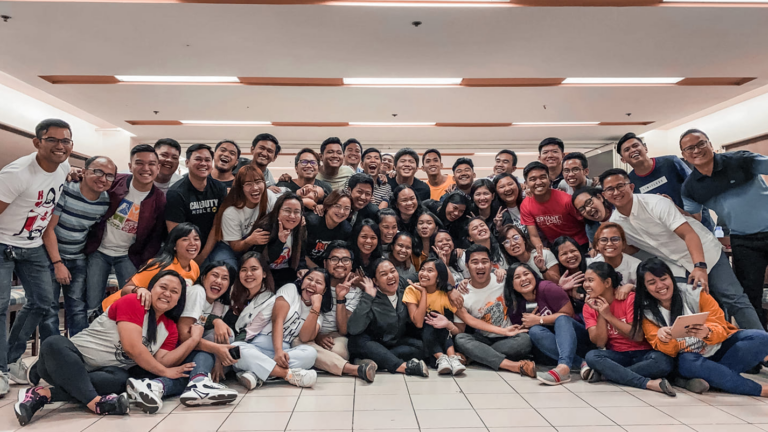
There is this particular scene in my memories—one that appears every time I want to recover the “why” that made me say “yes” to this path of being a youth minister. It was 2005. Twenty years ago. I was still in CFC Youth for Christ then. I was in the midst of around 10,000 young people like me all over the world. Then, in Subic, during our yearly conference that gathered young leaders all over the world, the speaker laid down a challenge for all of us to evangelize every young person we met. The ambitious vision was declared: “In ten years, the world will bow down to Christ.” As I stood in the rain and closed my eyes, I felt the warmth in my heart turn into something like an unquenchable fire. It was my earliest memory of wanting to be a missionary for God. Aware of my flaws and brokenness, of my traumas unresolved and the dark secrets I was ashamed to put into the light, I said “yes” to change my life and seriously make that vision my own too. Well ten years later, the world from a bird’s eye view did not change much. A year later, we’ll find the beginning of the bloodbath of the Duterte regime. But despite the mess, I knew that those present in that conference in Subic also took that vision seriously. Some I would meet later in different areas of service to the world and the Church. More than ten years later, I was still in youth ministry, having experienced serving in different settings: parish, diocese, campus, transparochial ministry, and within the Catholic Bishops’ Conference of the Philippines. Today, twenty years later, as I write this piece, I am still a youth minister serving with the Salesians of Don Bosco and the Diocese of Cubao, and a teacher of vocation in discernment at the Ateneo de Manila Higher Education unit. The vision from twenty years ago in Subic is still ablaze in my heart.
In more than twenty years of accompanying the youth, when I think of young people, I remember this quote attributed to the late Pope Benedict XVI: “The world offers you comfort. But you were not made for comfort. You were made for greatness.” I believe that in every young heart, there is this desire for greatness. Initially, this “greatness” may just be for one’s personal flourishing or to achieve personal glory or the fulfillment of one’s dreams. But when one digs deeper into their narratives, one will note that this desire for “greatness” is the desire for holiness; the desire to be free to love truly and to serve others. The desire to uplift the living conditions of their families and to change the world, too. This desire gets lost in their many and varied flurries of activity, but it is there like a still, small voice urging them to act. Only that, there should be someone who must help them listen to that desire buried and hidden. This is where I believe most of us, mentors, pastors, and youth ministers, should begin: knowing that every young person desires greatness/holiness but they are not just aware of it. They are not a “lost cause,” or what some adults say, sayang. It is not that they “do not care” about the world or the Church. They are just disappointed that the Church does not walk her talk. I would like to begin introducing the young this way because it is crucial to see them as Pope Francis said as the “now of God.” Without a positive view towards the young, youth ministry or pastoral care for young people will not bear fruit. From this point, let me share three other articulations from young people that will make us understand who they are. These three are both from what I have experienced on the ground and likewise a fruit of my research and doctoral studies in Loyola School of Theology. My paper was entitled, “The Via Pulchritudinis: An Essential Dimension in the Kerygmatic Formation of Filipino Catholic Youth Ministers.”
“We are called to act but we still need to be guided and formed”
If there is something that has been consistent in the articulations of Filipino Catholic youth, that would be the need for formation. The youth are hungry for formation. They know that they need to grow and mature as persons and in the faith. Some are very vocal about this but there are more young people who need other people to help them realize that they hunger and thirst for God. It has been consistent in sharings I have encountered with the youth all over the country (and even in a recent gathering of charismatic youth leaders I attended as part of the CBCP Episcopal Commission on Evangelization and Catechesis). One can also find this in published media and in national conferences. Last year, during the Philippine Conference on New Evangelization, the fruit of the synodal conversations produced these statements presented in the plenary: “Accompany and guide the youth to listen to the voice of God in silence and prayer. Nais naming mapalalim pa ang aming pananampalataya sa Diyos;” “Bring back formation.”
Particularly, young people today want to be formed in prayer and discernment. While they also need to know skills in community organizing, foremost in their appeals would be formation. In the many years of also giving them retreats and recollections, I learned that it is not so much teaching them what prayer is but how to pray. When questions such as “Paano ko ba malalaman na ako lang iyon or si God?” “Paano ba magsalita si God bukod sa Bibliya?” are addressed, one can notice the twinkle in their eyes from suddenly finding out that there have been many times “It is the Lord!” One time when I gave a session on Ignatian Contemplation to the kids in Payatas, most of them were in tears. Before I left, a young boy held my hand and said: “Ate, si Jesus ba Talaga iyong nagsabi sa akin na huwag ako matakot? Siya ba iyon?” He said this trying not to burst into tears. When I smiled and said, “Ano ang sa tingin mo?” He replied: “Bakit ako naiiyak, ate?” And he sat down crying audibly at the sudden realization. It is a memory I carry with me in this advocacy, to help the rest of those in positions of power in youth ministry to see this urgent imperative. It is a life mission I am willing to see through until my last breath. But let me factor in that formation should not be just a number of activities or events done just to say we have done our part. It should be close accompaniment. Accompaniment in prayer, in discernment, into the deep as Jesus told Peter. Not the breadth of activities but depth in every young person.
The Church should be an authentic, safe space for them to grow.
You must have heard of “safe spaces” countless times already from the youth. The Cambridge Dictionary defines it as “a place or situation in which you are protected from harm or danger.” In my research, I mentioned three spaces that the youth desire to be havens of belongingness and love. It is particular in their stage of development to belong and to be seen as someone who can tap into their capacity for greatness.
The family
In their open letter to the Church, Filipino Catholic youth ministers mentioned that in their desire to be “truly life-giving” to the Church and society, their families take the first place: “Our families will always be part of our hopes and aspirations.” For the Filipino Catholic youth, the family is still an important part of their lives as this is where they first experience love and belongingness and find their first guides in shaping their identity.
However, even with this acknowledgment of their rootedness in the family, the youth still find “a lack of testimony to faith lived out in the families and social groups from which they come.” In the 2021 Young Adult Fertility and Sexuality Study (YAFS5) of the University of the Philippines Population Institute, results show that 1 in 3 Filipino youth grew up without both parents. In the YAFS5 press release, it was stated that “the most common reasons for not being raised by both parents include any parent working away (45%), marital separation (38%), and the death of any parent (17%). According to the study, previous results (2013) led to studies finding that “not having been raised by both father and mother is linked to a higher likelihood of early school leaving, teenage pregnancy, and cohabitation. It was also found to be associated with lower self-esteem, life satisfaction, and happiness levels.”
The Digital environment
The youth find themselves today in a pervasive reality called the digital environment. The Synod on Youth Fathers said that this environment “is no longer merely about ‘using’ instruments of communication but living in a highly digitized culture.” The youth find in social networks a channel where they can forge friendships, connect with people globally, document their daily lives for everyone to see, and even engage in conversations that show their stand on socio-political issues concerning violation of human rights and protection of those who are vulnerable.
Despite the opportunities that this digital environment can provide us, it is also “one of loneliness, manipulation, exploitation, and violence” since people can become so engrossed in it at the expense of forming authentic interpersonal relationships. Mental health issues related to cyberbullying, sleep deprivation, or lack of physical activity have been associated with frequent social media use.
The Church
The 2024 PCNE (Philippine Conference on New Evangelization) generated a buzz when the youth pertained to the Church as a “hypocrite.” The articulations were: “The Church must be good witnesses. We must walk the talk”; “The Church is a hyprocrite. Kung magkakasama, bakit may naiiwan?”; “If the youth have dreams why don’t the adults guide us? We feel ghosted, iniiwan sa ere.” This was also something pointed out in the Open Letter of the Youth last 2018: “Our apparent distrust and doubt on the credibility of the Church, on the other hand, is but an expression of our burning desire to see her truly living the joy of the Gospel.”
With a generation keen in their observation of the sexual scandals that are plaguing the Church, we cannot blame them for demanding authenticity. They are not “disillusioned,” they just desire to see Jesus in a Church that should enflesh him today.
Include us in the decision-making processes of the Church. Emphasize works of mercy and justice. Form us in Catholic Socal Thought.
The PCNE results say much about this desire to be more involved: “Hopefully the Church will help us utilize our creativity and innovation for the service of God’s people”; “We can be agents of reconciliation. We can be bearers of the joy of the Gospel and we dream big.”
With the imperatives of synodality still to be realized, are we really involving and consulting the young? Or are they just valuable assets to the parish to animate events such as parish fiestas? Are they too young to discern what is best for the ministry? Or are we, as adults, confined to the idea that “marami pa kayong bigas na kakainin.” Are we forgetting that by virtue of their baptism, the young should not just be passive recipients of the Gospel but our collaborators in building a better world?
Another consideration to take note of is Pope Francis’ observation of the “activism of the young today.” They want to serve the Church and make the Reign of God apparent today. But some of them do not know how to begin. Our formation should not only focus on prayer but appeal to this generation that desires to offer their creativity to foster a world of kaginhawaan.
I could go on and on about young people but I hope to just communicate these crucial insights that often may be overlooked. I still believe in the vision God planted in my heart when I was an 18-year old leader seeking for meaning in life. Much of what I wrote here is coming from the reality that I met this merciful God who loved, healed, and transformed me in youth ministry. It takes a village to raise a young person. It took a village to raise me: the Salesian fathers who patiently walked with me, the counselors who helped me heal, the figures of faith that challenged me and honed my gifts, the young people who inspired and continue to inspire me. I believe that when we pay attention to young people and walk with them as they flourish, we will truly experience a Church alive with the “now of God.”
________________________
Lee-an has been a faculty member of the Ateneo Theology Department for the past 7 years, currently teaching DLQ10: Discerning Life’s Questions. She has been a youth minister for more than 20 years, having served in the parish, diocese, charismatic youth community, and campus ministry. She is affiliated with the Salesians of Don Bosco, currently helping as a formator of novices and migrant youth and heading the service formation arm of the north province’s Commission on Social Concerns. Her other affiliations are the following: CBCP Episocopal Commission on Evangelization and Catechesis and Commission on Youth. She was also appointed as a team ministry member of the Diocese of Cubao Ministry of Youth Affairs.