
Popular piety—undeniably one of the most important aspects of the Catholic faith—has always served as an enduring marker of a people’s devotion. In his apostolic exhortation Evangelii Gaudium, the late Pope Francis describes it as the “treasure of the people of God” and an “active evangelizing power which we must not underestimate.”
From the very young age of five, I was deeply interested in the many different devotions practiced not only in the Philippines, but around the world. Growing up, I found myself drawn to various devotional expressions—whether through processions, rosario cantada, pabasa, and more. This fascination led me to become a collector of ecclesiastical art, captivated by the transcendental beauty of sacred images and how they offer a glimpse of the glory that awaits us in heaven. Whenever I had the chance, I would organize pilgrimages for my parents, introducing them to devotions, Marian titles, shrines, and other treasured traditions.
During the uncertainty and isolation of the Covid-19 pandemic, many turned to their home altars for comfort and hope. I, too, rediscovered the power of prayer during this time and felt a renewed calling to revitalize our family altar. My life as a santero (caretaker of devotional images), after a long hiatus, suddenly returned with new fervor and purpose. With my eyes on social media, I realized I was not alone—many others my age were also reigniting their devotional lives, making sacred spaces within their homes feel as though we had never left our parishes. Once restrictions were lifted, these devotions reemerged in public with renewed energy, celebrated with great reverence and festivity. The Philippines, known as the Pueblo amante de María—a people in love with Mary—proved once again the depth of its Marian devotion, especially through the surge of events dedicated to the Blessed Virgin.
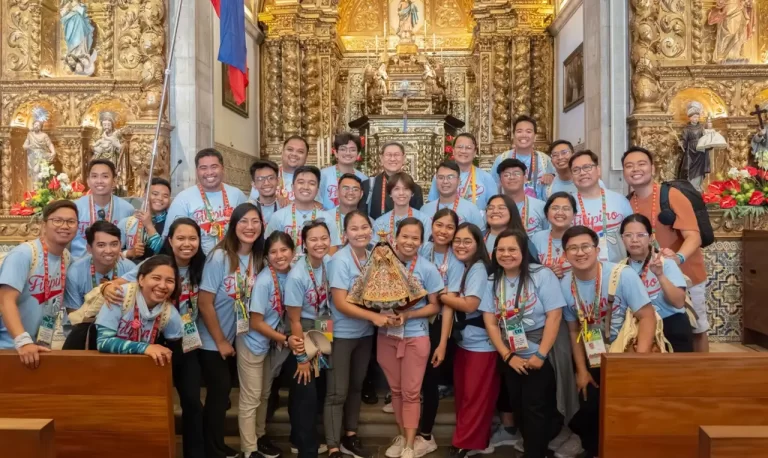
Some might argue that many young people today have drifted from the Church and its rich traditions. While there is truth in the concern that many still need encouragement to serve the Mother Church, I believe we have come a long way in keeping the faith alive for future generations. In 2023, I had the privilege of attending World Youth Day in Lisbon, Portugal, as part of the Philippine delegation of Regnum Christi under the Legionaries of Christ. Never did I imagine that I would witness over two million youth kneeling in adoration before the Blessed Sacrament during the grand vigil at Parque do Tejo. It was in that moment that I truly realized: the Church is alive—and young people are still inspired to bring the Good News to the world. During
On that pilgrimage, I brought with me a replica image of the Virgin of Antipolo—one of the most beloved Marian images in the Philippines. I was deeply moved to see people from across nations approach the image with such reverence, love, and devotion. It reminded me that while languages, cultures, and devotions may differ, our shared faith unites us in one Church—ever ancient, ever new.
Coming out of the pandemic, I served as a cantor and photographer for the recently declared International Shrine of Our Lady of Peace and Good Voyage. In my two years of being involved with its activities, I have come across new friends my age who have the same shared interest and passion for evangelization in today’s current media landscape. Many of us were involved through either helping with the social communications arm of the cathedral, its different charitable initiatives, and its efforts of spreading the devotion to the Virgin across the world. With such access to information, popular devotion has become all the more accessible, and it has dawned upon us that it is a great responsibility to carry, especially in a world where many voices influence many different directions and dispositions in life.
It begs the question: given our shared reality, how can we make the Catholic faith even more relevant to the signs of the times and the needs of today’s youth?
In my own personal context, photography has become my creative outlet—not only as a means of sharing my deep interest in popular piety and ecclesiastical art, but also as a way of capturing the divine in a manner that is accessible and translatable to the modern viewer. This goes the same for many other ecclesiastical photographers within my circle. The Via Pulchritudinis, or Way of Beauty, has only deepened that inspiration within me. God, as the source of all beauty, reveals Himself through creation, through art, through transcendence. This beauty, when encountered sincerely, speaks for itself.
In conversations with peers about our shared emotional reactions to ecclesiastical art and the devotional practices surrounding it, we came across a fascinating term: Stendhalazo—the overwhelming physical and emotional response to beauty, particularly in art. It is beauty that stirs us, even without words. It captures our attention, engages our senses, and gives us something to long for. In a world where young people increasingly rely on what they see—especially through the media we consume—I believe beauty is one of the most powerful ways to communicate the presence of the divine amid the noise of modern life.
However, encountering beauty also carries with it a great responsibility. We must not stop at superficial appreciation, nor allow ourselves to remain captivated merely by external splendor. True beauty should move us—compel us—to respond. It invites us into a deeper encounter with God and calls us to express our faith through authentic, lived action.
Sadly, many still fall into the trap of admiring beauty only on a surface level, missing the deeper call it offers. But when we truly encounter the divine through beauty, we are also called to reflect that beauty in the way we live and love. Our response must go beyond sentiment and translate into a life marked by humility, compassion, and charity. In doing so, we not only admire the beauty of Christ—we begin to embody it. We become living icons of His presence, reflecting the beauty of His life through our own.
Returning to my personal experience at World Youth Day, one moment that deeply struck me was the encounter with a peculiar Marian icon displayed during the opening Mass. She was given the title Nossa Senhora Apressada—Our Lady in a Hurry—a name bestowed by the late Pope Francis, inspired by the Gospel account of the Visitation. In that moment, Mary goes “in haste” to share the Good News with her cousin Elizabeth, that she has become the God-bearer. That image left a lasting impression on me.
As young people, we were not only moved by the beauty of the image of Our Lady, but also by the beauty of brotherhood, fellowship, and unity across nations. Yet, beyond the emotional and spiritual richness of that encounter, we also recognized the responsibility it placed upon us: to respond with urgency and love to the needs of the most vulnerable.
We, the youth, have been entrusted with gifts and talents that can bring about meaningful change in an ever-evolving world. These gifts have found powerful expressions in the forms of popular piety we see today—devotions that are deeply interwoven into the social and cultural fabric of our lives. Like Mary, we too are called to “go in haste,” with hearts full of fervor and hope, using the very traditions and devotions passed down to us as vehicles for renewal, compassion, and transformation.
Kris Gonzales graduated cum laude with a degree in AB Communication from Ateneo de Manila University. A collector of religious art, he is also an ecclesiastical photographer and blogger dedicated to documenting popular devotions and religious traditions in the Philippines and across Europe. Alongside his visual work, he is a professional classical singer specializing in liturgical and early music, with a focus on Renaissance and Baroque repertoire. Through these interdisciplinary pursuits, he seeks to preserve and interpret Catholic traditions by uniting the visual and musical arts.