
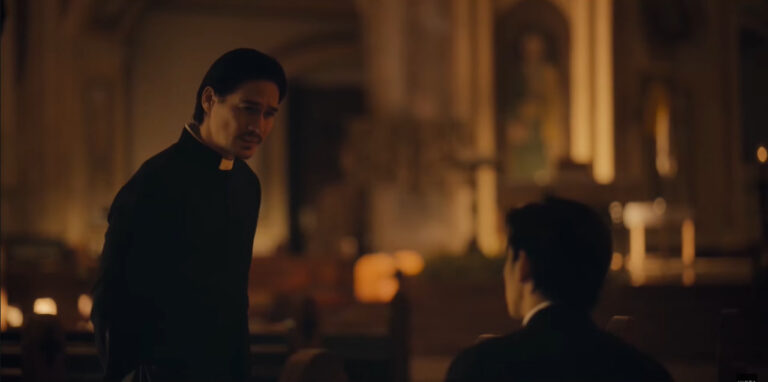
[ GomBurZa is a 2023 historical biographical film produced by Jesuit Communications, MQuest Ventures, and CMB Film Services that tells the story of three brave Filipino Catholic priests whose execution by Spanish colonial authorities figured prominently in the events leading to the Philippine Revolution of 1896. ]
GomBurZa accompanies the viewer through glimpses of the essential unfolding of language. It first allows the viewer to experience language as a tool.
In one scene, the viewer watches Padre Corominas strictly implement Latin as the medium of instruction. He forbids his students from shifting to any other language lest they be considered heretics. When Buencamino is called to recite and struggles to express his thought in Latin, the old friar bursts into exasperation as soon as the young student shifts to Spanish.
Then comes Padre Burgos who subtly rebels against such a policy and allows his students to recite in Spanish, a language more familiar to them. Buencamino even speaks (as portrayed in the scene) in what we now call Filipino. The discussions become livelier because expression is freed from the bonds of a “dead” language. What used to be flattened becomes round and rich again. Even Paciano picks up courage to confirm with Padre Burgos if he penned the manifesto that was simply signed “Los Filipinos”. Padre Burgos beautifully caps this crucial scene: “Lalabas pala ang mga galing ninyo kung nagkakaintindihan tayo.”
The scene appears to make a statement on what language to employ as the medium of instruction. Contemporary Philippine education can very well relate to this. Shall the learners’ first language be used to teach them in basic education? If so, until what level must this be done? The present K-12 curriculum, for instance, provides for a mother-tongue-based multilingual education until only the third grade. Will this establish enough educational foundation for shifting to a second language like English as the medium of instruction?
Insofar as the scene above is concerned, comprehension is better facilitated with the use of the first language than of any second or foreign language. In another scene, Buencamino claims how ideas are stunted by Latin, and thus argues that it is more fitting to teach him and his fellow students in Spanish.
Meanwhile, on the night before their execution, Padre Burgos and Padre Gomes engage in an intimate conversation about the predicament in which they find themselves, the apparent “bad luck” that has befallen the archipelago, and their resolve that their deaths will help illuminate the path to freedom for their fellow Filipinos. They warmly speak to each other in Filipino, a language most accessible to the Filipino viewer of the film, who need not check the English subtitles to follow the scene. Given the potential of GomBurZa as an educational film for Filipinos, rendering such a poignant scene between Padre Burgos and Padre Gomes in the vernacular is well advised and worthy of praise.
During the trial, after Padre Zamora exits the frame desperately struggling to explain himself, and while Padre Burgos argues in Spanish to defend themselves against false accusations, Padre Gomes sits quietly and pays close attention to how the proceedings are being conducted. When Padre Burgos is dragged back to the cell, Padre Gomes surprises the viewer as he stands up to the jury and boldly questions, “Ito ba ang hustisya ng Espanya?” Once again, his character delivers his line in Filipino.
Language is a tool which can achieve control over others. This is why, as mentioned in the film, the Spanish friars continue to refuse teaching Spanish to the indios or learning for themselves the first language of the indios. To learn the language of the other is to enter into their worldview and to risk being affected. Padre Pelaez asserts before the court that the parishioners of Antipolo are closer to the secular priests; so why are local priests being replaced by friars? The viewer can guess that one reason for this closeness is that secular priests speak the language of the people.
At the same time, language can be employed as a tool for liberation. This is exemplified by the statement drafted by Padre Pelaez, shown to the hierarchy for approval and endorsement, and sent to Spain in the hope of obtaining a just intervention on the transfer of parish administration. This is precisely the point of Padre Burgos’ manifesto, which he writes upon reading the newspaper report that tarnishes the reputation of the secular priests and of Padre Pelaez. Of course, this is most creatively illustrated in Jose Rizal’s novels, especially the El Filibusterismo, which he dedicates to the three garroted secular priests.
But the viewer must not stop at understanding language as a tool, whether for control or for liberation. One must listen more carefully to how language essentially unfolds in the film, or rather, how the film brings forth the essential unfolding of language.
When Padre Burgos shows to Padre Gomes the newspaper report containing the friars’ take on the administration of parishes, the latter becomes annoyed and almost curses, then turns to the former and asks him, “Anong binabalak mo, Pepe?” Padre Burgos responds with silence. The next scene portrays him writing the manifesto.
When Paciano and Buencamino excitedly approach Padre Burgos to inform him of the youth movement they have established, Padre Burgos turns to them and asks a similar question, “Anong binabalak n’yong gawin?” The two young students respond with silence. Subsequent scenes show them being arrested and maltreated.
When Padre Zamora is arrested and incarcerated, he repeatedly asks what they must do and turns to Padre Burgos to make use of the latter’s degree in civil law to defend all three of them. Then he goes to a corner and sulks in confusion and despair. Padre Zamora becomes completely absorbed in helplessness when he receives the death sentence. He speaks no more. Even as Padre Burgos and Padre Gomes converse inside the cell, Padre Zamora remains totally silent, utterly troubled at the condition he never imagined for himself, parched from shedding one loaded tear after another, terribly desolate. He has become so lifeless that he has to be dragged up to the garroting machine. Silence has permeated his being. It has overcome him.
When it is Padre Gomes’ turn to be executed, he turns to Padre Burgos and keenly looks at him before going up to meet death. No word is exchanged between them. One last look is enough to communicate what needs to be said. Padre Gomes then turns to the people and delivers a courageous speech that centers on offering all up to God.
When it is Padre Burgos’ turn, he musters overflowing audacity to forgive the man in charge of the garroting machine and to assert innocence, his own and his brother-priests’. He even asks why they must die that way. To which a friar insensitively responds by saying that Jesus himself was innocent at death. Padre Burgos does not reply any further. Instead, as he is being garroted, he raises his fists, even with his wrists tied up; he raises them high to proclaim his utmost resistance. He ultimately surrenders to silence.
German philosopher Martin Heidegger posits that language is the house of being. All that is there resides in the word. What is not there is yet to be revealed. And this revelation is in language. He quotes the poet Stefan George to illustrate his point further: “So I renounced and sadly see: / Where word breaks off no thing may be.” Then he provides a counterpart to the second line: “An ‘is’ arises where the word breaks up.”
Padre Gomes, Padre Burgos, and Padre Zamora have each come face-to-face with the nothing that is no longer being that is in language. They have each renounced their way with words that they formerly employed as tools for expression, evangelization, and liberation. And they gladly see. Their very renunciation becomes now the paragon of listening well to and speaking out for that which unconceals itself. The language of GomBurZa breaks up today. Let it arouse every viewer to rise as a Filipino now and forever.