Philippine Jesuits
Apostolic Plan 2026-2031
0. INTRODUCTION
0.1. The mission of the Society of Jesus in the Philippines (PHI) drives us forward as ever. As Pope Leo XIV summed up his address to the participants of the Meeting of Major Superiors (MMS) in Rome on 24 Oct 2025: “The urgency to proclaim the Gospel today is as great as in the time of Saint Ignatius. The Lord says through the prophet Isaiah: ‘I am doing a new thing; now it springs forth, do you not see it?’ (Is 43:19) Your mission, dear brothers, is to help the world perceive this newness—to sow hope where despair seems dominant, to bring light where darkness reigns. To accomplish this, I encourage you to remain close to Jesus…. No frontier will be beyond your reach if you walk with Christ.”
0.2. Sharing the fruits of the MMS in his letter of 3 Jan 2026 to the whole Society, Father General Arturo Sosa recalled the Pope’s directive: “Familiarity with the person of Jesus, poor and humble, and His Gospel—the Pope emphasized—is the source of the courage we need as religious not to fear detachment, a condition for Ignatian indifference and for the freedom to see frontiers as places to develop the prophetic and missionary dimension of our consecrated life.” It is a familiarity we treasure and deepen in our experience of the Spiritual Exercises, the shared gift entrusted to us which undergirds our apostolic identity, zeal, and works.
0.3. Speaking through the Vicar of Christ and Father General, the Spirit sharpens the focus of our mission today. With the conclusion of the Renewed Province Plan (RPP, 2021-2024), the Philippine Province engaged in a process of articulating its subsequent apostolic plan. The evaluation of the RPP was presented at the Meeting of Superiors and Directors of Work (MSDW) in Aug 2024. MSDW Jan 2025 was dedicated to initial discussions which led to the formation of the PHI Apostolic Planning Committee and set the tone for the Province-wide series of spiritual conversations toward crafting an apostolic plan. The fruits of all these conversations formed the basis of further conversations at MSDW Oct 2025, out of which emerged some broad strokes of the plan. Based on these, the committee formulated an initial draft and presented it at MSDW Jan 2026. After soliciting more comments from the Province in Mar 2026, a draft was finalized and submitted to Fr General, who on 26 May 2026 approved it and declared, “It is a powerful instrument that I laud with much enthusiasm.”
0.4. Unmistakably palpable in the genesis of the apostolic plan was the “finger of God” throughout the numerous spiritual conversations, which have inspired hope and zeal among participants. Particularly providential in the process was the timely release of Pope Leo’s apostolic exhortation, Dilexi Te, on the first day of MSDW Oct 2025 and the impetus of MMS in Rome later that month. Altogether, these reassure us of God’s abiding presence as we strive to fulfill the mission of the Church entrusted to the Society in the Philippines.
0.5. “The Church, through Pope Leo XIV, confirms that we have been sent with others to contribute to the reconciliation of all things in Christ, serving the faith in the struggle for the justice of the Gospel, inspired by the Universal Apostolic Preferences [UAPs] taken as a whole. Through them we continue to receive the fresh air of the Spirit of the Risen One that allows us to grow in the inner freedom needed to read the signs of the times and respond to them with the boldness and generosity of people called to be companions of Jesus” (Fr Sosa, “Confirmed in the charism, sent on a mission of reconciliation and justice,” 3 Jan 2026). The present PHI apostolic plan is clearly marked by the UAPs even as it contextualizes them for our current realities.
0.6. Thrusts
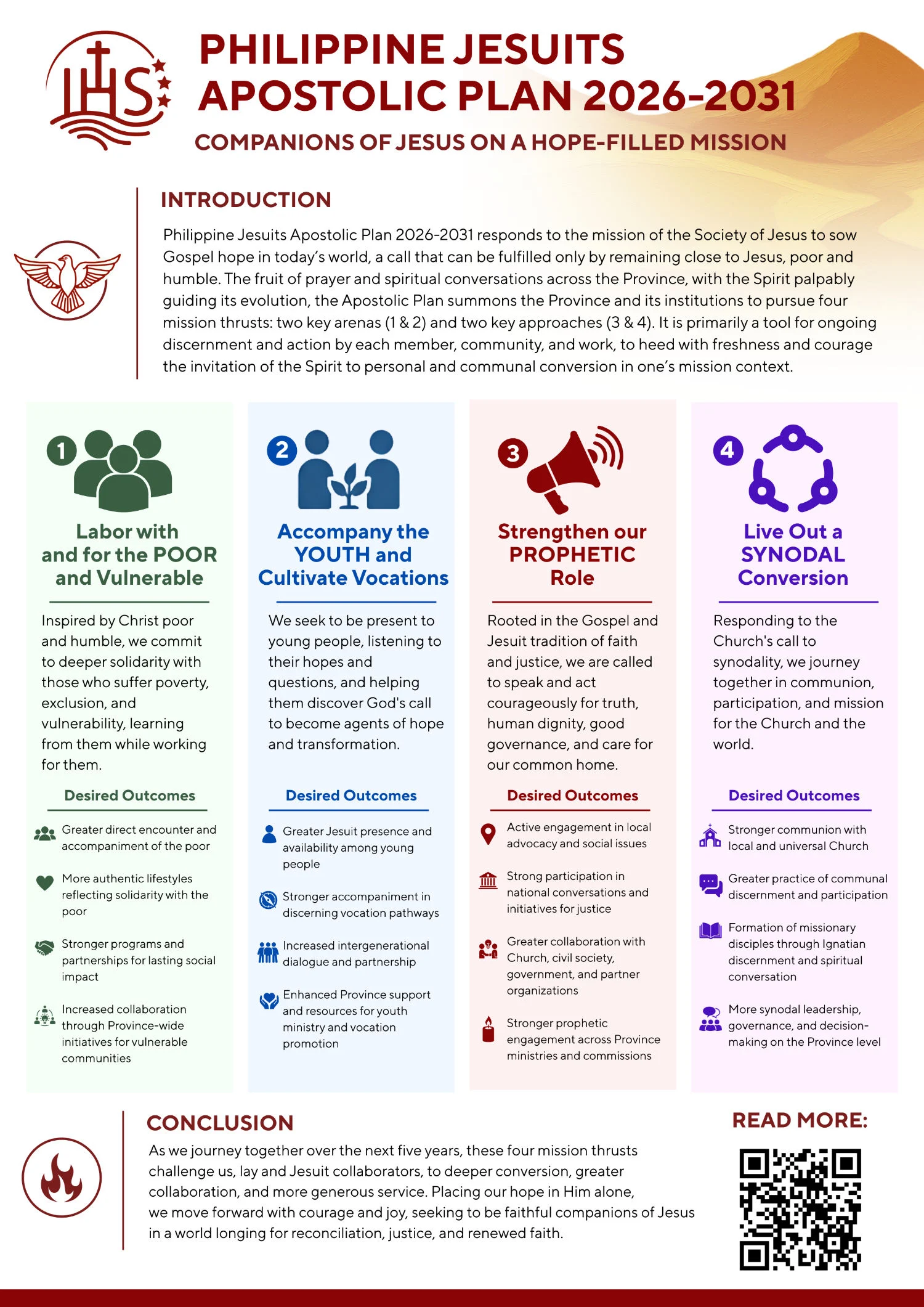
0.6.1. The PHI apostolic plan for the next five years (2026-2031) highlights four mission thrusts:
0.6.2. As the core of an apostolic plan meant to inspire each member, community, institution, and structure/body of the Province to participate in personal and communal action guided by the Spirit, the thrusts name only four of the myriad of concerns and challenges that shape our mission and occupy us today. Certainly, identifying these thrusts and not others for our apostolic plan is not meant to disengage us from those crucial concerns. On the contrary, they articulate points of convergence of the diverse contexts and concerns of our shared mission, particularly as they emerged out of the process outlined above. The first two thrusts name key arenas of our mission (poor and youth) while the other two thrusts name key approaches for fulfilling our mission (prophetic and synodal). Together, they overlap and cohere to invigorate us to go beyond simply occupying ourselves with a flurry of activities and to devote ourselves wholly to discerning and responding to the call for both personal and communal conversion which the fulfillment of Christ’s mission demands.
0.7. Desired Outcomes
0.7.1. Each thrust is further specified by four Desired Outcomes that provide contours for pursuing the thrust. A fuller description of each thrust and desired outcome follows this introduction. A preview of the thrusts and outcomes is given in the summary below:
| THRUST 1 Poor |
THRUST 2 Youth |
THRUST 3 Prophetic |
THRUST 4 Synodal |
|
|---|---|---|---|---|
|
OUTCOME 1
|
Increased direct encounter with the poor | Increased Jesuit presence and availability among the youth | Participation in local issues through advocacy activities | (Communion) Greater unity with local & universal Church |
|
OUTCOME 2
|
Authentic witness and lifestyle of identification with the poor | Stronger accompaniment in discerning vocation pathways | Participation in national issues through advocacy activities | (Participation) Practice of communal discernment in Province works and communities |
|
OUTCOME 3
|
New and sustained programs and partnerships | Increased inter-generational partnership | Engagement with partner organizations and networks | (Mission) Forming missionary disciples by sharing Ignatian discernment and spiritual conversations |
|
OUTCOME 4
|
Initiatives from Province commissions | Province-level provision of support for youth accompaniment | Strengthened prophetic engagements of Province commissions | More synodal practices in Province meetings, events, and commissions |
0.8. Monitoring and Evaluating
0.8.1. The participation of each member, community, institution, and structure/body (e.g. commission) of the Province in the implementation of the apostolic plan, guided by the Spirit, is to be the fruit of discernment. In this sense, the apostolic plan is primarily a tool for discerning how the Spirit is continually calling each of us to respond personally and communally to conversion through the key arenas and approaches that are named. To this end, the apostolic plan does not preempt the discernment by specifying particular flagship projects, centralized programs, champions or coordinators for each thrust. Instead, it enables each one to consider the invitation of the Spirit to action with regard to desired outcomes that are pertinent to one’s mission context.
0.8.2. As an aid to such ongoing discernment and action, particularly for monitoring and evaluating the implementation of the plan, each local community, institution, and structure/body of the Province is asked to report to the Curia annually (by June) for each pertinent desired outcome, first, their accomplishments (at most three) and further plans (at most three), and second, their reflections, impact, and recommendations arising out of the accomplishments. An internal midyear evaluation by each community and institution (the results of which need not be reported) would also be helpful. The following template is recommended for this exercise.
| OUTCOME | Accomplishments and Plans
What we have done, |
Reflections, Impact, Recommendations
What we have learned, |
|---|---|---|
| 1.1 | ||
| 1.2 | ||
| 1.3 | ||
| (…and so on…) | ||
0.8.3. The PHI Planning Committee will consolidate the reports and present to the MSDW in August each year for ongoing reflection, conversation, and concerted action.
1. THRUST 1: Labor with and for the POOR and vulnerable
1.1. The second Universal Apostolic Preference (UAP) “to walk with the poor, the outcasts of the world, those whose dignity has been violated, in a mission of reconciliation and justice” refocuses our mission on the timeless call of the Lord in the gospels, who leads by example. For “[o]ur identity is founded on identification with Jesus, poor and humble, and His cross. There is no other flag under which to soldier and no other leader to follow.” (Sosa, De Statu Societatis Iesu 2023, Ch 1).
1.2. Thus, this thrust amounts to a constant call for renewal in integrity of vocation, particularly in deepening our life of evangelical poverty, in choosing what Christ chose. “Acquiring the perspective of the poor is necessary to ‘preach in poverty’ as Jesus and the apostles did, as the founders of the Society of Jesus wanted, and as those who intend to announce the Good News are also invited to do today… Poverty…is not an end in itself but a step…leading to the humility characteristic of the Master’s way of life” (Sosa, “Our Vow of Poverty”, 27 Sep 2021). For this, we draw inspiration from our founding fathers. “It is critical to emphasize the continuing relevance of the real closeness of the First Companions to the poor. The poor challenge us to return constantly to what is essential to the Gospel” (GC 36, 2016, D 1, 15; also D 1, 4).
1.3. In other words, such closeness is driven not simply by what we can do for the poor, but also by what the poor can do to us. “[A]ll of us must ‘let ourselves be evangelized’ by the poor… Growing up in precarious circumstances, learning to survive in the most adverse conditions, trusting in God with the assurance that no one else takes them seriously, and helping one another in the darkest moments, the poor have learned many things that they keep hidden in their hearts… Only by relating our complaints to their sufferings and privations can we experience a reproof that can challenge us to simplify our lives” (Leo XIV, Dilexi Te 102).
1.4. In the Philippines today, the usual measure of a “poverty line” inadequately captures the precarity of the poor that strikes even those in the lower middle class. They live with precarity and vulnerability in terms of physical safety in urban areas, access to social services, stability of income sources, prospects for well-being because of weak nutrition and education, and protection from climate change disasters; such that they are “one illness away from poverty” (Leland Dela Cruz, “Perspectives on the National Situation”, MSDW, 9 Oct 2025). Sadly, they know too well how environmental degradation disproportionately affects the poor and vulnerable (Francis, Laudato Si’, 2015; Francis, Laudate Deum, 2023).
1.5. The call to appreciate the lived experience of the poor acquires particular relevance in the challenge for activists in both society and Church to engage the poor in the pursuit of social transformation, to work not only ‘for’ but also ‘with’ the poor. “Popular movements, in fact, invite us to overcome ‘the idea of social policies being a policy for the poor, but never with the poor and never of the poor” (Dilexi Te 81).
1.6. Desired Outcomes:
“[The poor] are part of our ‘family.’ They are ‘one of us’… [W]e are asked to devote time to the poor, to give them loving attention, to listen to them with interest, to stand by them in difficult moments, choosing to spend hours, weeks or years of our lives with them, and striving to transform their situations, starting from them” (Dilexi Te 104).
“It is not in the lack of many material goods that we recognize Jesus as poor and humble… He became poor in order to enrich us with his poverty. Jesus’ poverty is the fruit of his generosity, of his total gift of himself, so that in fellowship, we may all live in dignity as daughters and sons of the same Father. This evangelical poverty is what we desire when we pronounce the vow of poverty, aware that living it is only possible if we receive the grace of the Lord himself who invites us to follow him” (Sosa, “Our Vow of Poverty”).
Outcome 1.3: New and sustained PROGRAMS and PARTNERSHIPS for maximizing positive impact on vulnerable persons and communities.
“We need to be increasingly committed to resolving the structural causes of poverty… [S]ociety needs to be cured of a sickness which is weakening and frustrating it, and which can only lead to new crises. Welfare projects, which meet certain urgent needs, should be considered merely provisional responses” (Dilexi Te 94).
2. THRUST 2: Accompany the YOUTH and Cultivate Vocations
2.1. The Filipino youth are at a moment of deep social, cultural, and ecclesial transition. Many young people face economic uncertainty, family disruption, migration pressures, and a constant digital environment that can form (enhanced access and sharing of information and values, building social connections) as much as deform (pornography, addiction, misinformation, isolation). Some describe a thinning of spiritual imagination and a difficulty sustaining attention for prayer, relationships, and study. Increasingly in what some call the Fourth Industrial Revolution, Artificial Intelligence (AI) shapes how they learn, relate, imagine the future, and even how they cope with pain and loneliness (Dicastery for Communication, Towards Full Presence: A Pastoral Reflection on Engagement with Social Media, 2023; Rome Call for AI Ethics, 2020). Alongside opportunity come new pressures: algorithmic comparison, surveillance, and a widening gap between those who can keep up and those who cannot.
2.2. Ecological anxiety among Filipino youth is not a mere concept but lived amid heat, floods, storms, rising food prices, and repeated disruptions to schooling and family livelihood. It lands as a sense that the future is less dependable. Care for our common home is therefore not an “extra” topic, but part of the horizon our mission must take seriously (Francis, Laudato Si’, 2015; Francis, Laudate Deum, 2023).
2.3. The Society of Jesus and the wider Church drive us to respond to young people in their context. Pope Francis calls the Church to listen, walk humbly, and stay close to their questions and wounds. The Universal Apostolic Preferences urge us to accompany young people in the creation of a hope-filled future, to show the way to God, to walk with the excluded, and to care for our common home. To do this, we understand that our credibility flows from a coherence between life, mission, and the Jesuit way of proceeding—a concrete test of synodal practice (Francis, Christus Vivit, 2019; UAPs 2019-2029; GC 36).
2.4. While we recognize that “youth” refer primarily to Generation Z in late adolescence and young adulthood who number among those in our ministries and Jesuit communities, we refrain from treating “youth” as merely a sector, campaign, or program to manage. Rather, we affirm the apostolic posture their reality demands as a call to conversion: from activity to presence, from programs to relationships, from clericalism to synodality, from speaking to listening. Their sensitivity to authenticity and coherence, their suspicion of institutions and persons whose lived reality fail to embody their words make it crucial that our communities and works intentionally live intergenerational dialogue, availability, patience, and mutual listening.
2.5. Out of an apostolic posture and horizon shaped by the UAPs, such dialogue directs our accompaniment of the youth toward a sustained consideration and discovery of God’s personal call for each. From this fundamental approach to nurturing vocation (which “recruitment” contradicts) can emerge vocations to the Society of Jesus, as well as to mature lay, ecclesial, and civic commitments marked by freedom, depth, compassion, and integrity. In a society struggling with injustice, our accompaniment of the young—especially the poor—must be prophetic, forming conscience and engaged citizenship for the common good.
2.6. Desired Outcomes:
Jesuit communities and apostolic works cultivate recognizable, sustained, and personal presence among the young, especially the poor and those in situations of vulnerability and social exclusion. Presence is marked less by activity than by availability: willingness to be interrupted, to listen seriously, and to accompany without immediately fixing or directing, with clear safeguarding and responsible boundaries. In the hope that: youth can name at least one Jesuit or lay collaborator who takes their questions seriously; presence is sustained through regular spaces and relationships, not events alone; communities and works know when to accompany personally and when to refer responsibly.
Young people who begin to ask deeper questions about meaning, faith, service, relationships, and vocation are accompanied with intentionality and care that protect freedom and deepen trust in God’s action. When discernment becomes explicitly oriented to Jesuit life, the Vocation Promotion Team becomes the Province reference point through a warm and continuous handoff, and young people feel supported without feeling pressured.
Communities and works allow (and are aware of how) the experiences and questions of the young shape prayer, discernment, and apostolic priorities. Accompaniment becomes a space of mutual conversion where Jesuits, fellow collaborators, and young people learn to listen and speak with courage across generations and vulnerabilities, recognizing the young as active participants in the mission for the common good and civic life.
The Province provides formation, coordination, and shared resources that strengthen local responsibility rather than replace it. Provision exists to sustain Presence, deepen Pathways, and support Partnership.
3. THRUST 3: Strengthen Our PROPHETIC Role
3.1. The Church constantly exhorts all her faithful to fulfill the prophetic mission they received at baptism of proclaiming the Gospel with courage. Pope Francis urged everyone to learn from the Pentecost event. “We need the Spirit’s prompting, lest we be paralyzed by fear and excessive caution, lest we grow used to keeping within safe bounds. Let us remember that closed spaces grow musty and unhealthy. When the Apostles were tempted to let themselves be crippled by danger and threats, they joined in prayer to implore parrhesía [boldness]: ‘And now, Lord, look upon their threats, and grant to your servants to speak your word with all boldness.’ As a result, ‘when they had prayed, the place in which they were gathered together was shaken; and they were all filled with the Holy Spirit and spoke the word of God with boldness'” (Francis, Gaudete et Exsultate, 2018, 133; Acts 4:29-31).
3.2. Pope Francis warns against “an economy that kills” and a “throwaway culture” that discards the vulnerable (Francis, Evangelii Gaudium, 2013, 53). He insists that authentic evangelization includes engagement with unjust social structures (EG 176-185). He calls for ecological conversion that is both spiritual and structural, linking environmental crisis with injustice toward the poor (Francis, Laudato Si’, 2015, 48-52). Addressing Jesuits, he declares that “[c]ourage is constitutive of all apostolic action, and today, more than ever, we need courage and prophetic audacity.” So he urges the Society to remain at the frontiers—geographical, cultural, intellectual, and spiritual—discerning the signs of the times with depth and creativity (Francis, Address to GC 36, 2016).
3.3. Pope Leo XIV reaffirms the call of Pope Francis for the Society of Jesus. He calls us “to discern, innovate and trust in Christ,” to “oppose the ‘globalization of powerlessness’ with a culture of reconciliation,” to “confront ‘the dictatorship of an economy that kills,’ where the wealth of a few grows exponentially while the majority are left behind,” and “to help the world perceive…newness—to sow hope where despair seems dominant, to bring light where darkness reigns.” He counts on the Society of Jesus to continue to “read the signs of the times with spiritual depth,” to “embrace what promotes human dignity and reject what diminishes it,” and to be “agile, creative, discerning and always in mission” (Meeting of Major Superiors 2025).
3.4. General Congregation 32 declared that the “service of faith and the promotion of justice” are inseparable (GC 32, 1975, D 4). Pedro Arrupe SJ reminded Jesuits that witnessing to justice requires reading the signs of the times under the movement of the Spirit and daring to disturb complacency in the name of the Gospel (Arrupe, “Witnessing to Justice in the World,” 1973). The history of the Society also teaches that prophetic witness entails cost, including misunderstanding, marginalization, and even martyrdom (GC 35, 2008, D 2). General Congregation 36 frames the mission of the Society of Jesus as working for reconciliation and justice for the common good, especially the poor and marginalized. The Universal Apostolic Preferences direct us to engage in current and continuing global issues of poverty, exclusion, environment, and youth through critique and proclamation. Several ministries of the Society of Jesus strategically confront issues such as truth and disinformation, democracy and the threat of authoritarianism, climate emergency and environmental action. Reflecting the complexity of the issues, engagement is to be simultaneous at local, national, and global levels.
3.5. The Philippine Church through the CBCP and Church leaders has repeatedly taken on a prophetic role in envisioning a Philippine society that witnesses Gospel values and in engaging social issues through critique and proclamation. The Second Plenary Council of the Philippines calls the Church to become a “Church of the Poor,” committed to justice, participation, and transformation of unjust social structures (CBCP, 1992). CBCP pastoral statements time and again emphasized moral responsibility in governance, protection of human rights, truth-telling, and the defense of democratic institutions. For instance, in his Call for a Day of Prayer and Accountability Against Corruption responding to the flood control projects scandal, Cardinal Pablo David declared: “Let us not meet corruption with apathy or violence, but with faith, courage, and unity. Let us raise our voices in prayer, in conscience, and in peaceful action… Let us stand firm for truth, justice, and renewal. Together, let us be ‘innocent as doves, clever as serpents’, and builders of a nation where justice and honesty prevail” (CBCP, 2025).
3.6. Heeding the call of the universal and local Church and aligning with the Society of Jesus, we are inspired by the tradition of the Jesuit Philippine Province, of being prophetic in engagement with Church and society, of working for transformation of values and structures, of engaging communities, of pursuing advocacy and influencing leaders and citizens toward meaningful change. Among the urgent concerns that call for prophetic response are:
3.6.1. Social justice and the empowerment of marginalized sectors such as indigenous peoples, labor, urban poor, farmers, fisherfolk, women, and youth;
3.6.2. Nation-building and sustainable development; alleviation of poverty and inequality;
3.6.3. Peace and dialogue among religions, cultures, and ideologies;
3.6.4. Defense and stability of democracy, human rights, rule of law, and truth-telling (vs disinformation and historical distortion); strengthening of democratic institutions; good governance, transparency and accountability in delivery of public service; rejection of authoritarianism;
3.6.5. Integrity and ethics in leadership; rejection of self-entitlement and clericalism; rejection of corrupt systems and practices;
3.6.6. Safeguarding of minors and vulnerable adults; and
3.6.7. Promotion of ecological justice and the personal and communal conversion it demands.
3.7. Desired Outcomes:
4. THRUST 4: Live Out a SYNODAL Conversion
4.1. The Synod on Synodality was an extended process of renewal unprecedented in both scope and depth. On 15 Mar 2025, shortly before his death, Pope Francis initiated the three-year implementation period for the Synod, with an Ecclesial Assembly for Oct 2028 announced. Pope Francis has clearly directed the Church toward the synodal path, and away from the pitfalls of clericalism, when he describes it as “a path of spiritual renewal and structural reform that enables the Church to be more participatory and missionary so that it can walk with every man and woman, radiating the light of Christ” (Synodal Final Document, 2024, 28).
4.2. Pope Leo XIV has reaffirmed the synodal mission consistently as a Spirit-led direction for the Church. In his very first address right after his election as Pope, he proclaimed: “we want to be a synodal Church, a Church that moves forward, a Church that always seeks peace, that always seeks charity, that always seeks to be close above all to those who are suffering.” In his addresses to the synodal council, he reiterated: “Synodality is a style, an attitude that helps us to be Church, fostering authentic experiences of participation and communion.”
4.3. As an apostolic body within the Catholic Church, the Society of Jesus is thus called to participate in this synodal movement which is the “new way of being Church” for our day and age. The synod clearly identifies “conversion” as the main optic for the implementation of synodality, a conversion that leads to the strengthening of “the identity of the People of God” (Synodal Final Document 15). How do we as a Province open ourselves to this conversion?
4.4. The 71st Congregation of Procurators unequivocally frames Jesuit mission in terms of synodality: “to identify ourselves, Jesuits, as collaborators is the conversion to which we are called at this time. It is a path that leads us to find our role within the synodal Church on mission” (De Statu Societatis Iesu, 2023, Ch 3, 2). The Universal Apostolic Preferences embody synodality, as these invite us to walk together with the poor and the youth, to care for our common home, and to draw from Ignatian spirituality as a common lode of strength and inspiration.
4.5. Pope Leo challenges us Jesuits to be more active in promoting synodality. He asks us to see how religious life embodies synodality: “it may seem that part of the so-called synodal process is indeed what we have been living for centuries in chapters, congregations, assemblies.” He encourages the Society to promote synodality: “from your own charism and history as Jesuits, you have a lot to contribute simply by doing, by being who you are called to be” (Open Forum at Meeting of Major Superiors, 24 Oct 2025).
4.6. Our Province is challenged to participate more fully in the conversion called for by the Synod. As Pope Francis stated in the accompanying notes to the Synodal Final Document, “The whole Church, allowing itself to be enlightened by the Holy Spirit, was called to review its own experience and identify the steps to be taken to live communion, realize participation and promote the mission that Jesus Christ entrusted to the Church.” This conversion is incarnated in three ways: first, a conversion of relationships between the apostolic body of the Society of Jesus and the ecclesial Body of Christ (Lumen Gentium 32); second, a conversion of processes fostering greater ecclesial discernment; and third, a conversion of bonds with both the local and universal church through the “formation of missionary disciples” (Synodal Final Document 142).
4.7. Desired Outcomes:
5. CONCLUSION
When we began crafting this apostolic plan, we articulated our “hope and consolation as a Province in returning to our Galilee and encountering the Risen Christ calling us to newness in our Jesuit life and mission” (“Our Eleven Hopes in Province Planning”, MSDW Jan 2025). In fulfilling this plan, we entrust ourselves to God as we take to heart the words of Father Ignatius: “The Society was not instituted by human means; and it is not through them that it can be preserved and increased, but through the grace of the omnipotent hand of Christ our God and Lord. Therefore in him alone must be placed the hope that he will preserve and carry forward what he deigned to begin for his service and praise and for the aid of souls” (SJ Constitutions, 812). “May this plan truly be effective in re-energizing the Province, and recovering that sense of being truly missionary and sharing the hopes and joys of the Good News” (Sosa, 26 May 2026).
Annex:
OUR ELEVEN HOPES IN PROVINCE PLANNING
MSDW Jan 2025
- Hope in going beyond our immediate reactions to planning (burdened, irritated, fatigued, annoyed, anxious, ambivalent, in despair, skeptical, perceiving a lack of connection with previous plans; seeking consolation)
- Hope in acknowledging our burdens, our enormous challenges in our context (Trump, Philippine politics, truth dismissed, solutions elusive, need for big levers to counterbalance inequality embedded in capitalism, short supply of human resources and funds, dread felt palpably, past plans as add-ons, increasing pressures, internal and external issues)
- Hope in the Spirit and in being led by the Spirit (drawing hope from those we serve; from going out to the streets, to life-giving peripheries, and back to our original inspiration [Galilee]; witnessing change that blossoms from the grassroots; believing in a God of surprises who makes possible the impossible; staying calm (not anxious) and listening; embarking on a plan within God’s Eternal Plan; relying on abundant grace; making space to listen to God and to join God who continues to act)
- Hope in naming particular aspirations (collaboration, funding, listening to margins and those we serve, effecting real social change [vs ‘privatized hope’], finding big levers, crafting plans that are consoling and not burdensome, learning from past plans, inspiring slogans [e.g. ‘rowing into the deep’, ‘back to Galilee’], acknowledging our ‘soft power’)
- Hope in new Province leadership and its fresh way of proceeding
- Hope in looking at our ministries in a new way, reimagining (remembering the past and shaping the future, being sensitive to current changes, boldness and audacity and innovation, courage, freedom, Ignatian indifference)
- Hope and gratitude in entrusting our ministries to our lay partners (deepening Jesuit/lay formation in spirituality and leadership, grounded in the Spiritual Exercises)
- Hope in the planning process itself, as gift, fresh, powerfully prayerful, discerning, spiritual and synodal (the Spirit, the Risen Lord guiding us amid uncertainty, welcoming breakthroughs collectively as a Province to ‘meet him in Galilee’; simply coming together as inspiring, renewing, transforming, exciting; embracing our discomforts, fears, inconveniences, and vulnerabilities; developing a necessary sense of urgency; the process itself as grace-filled in bringing us together and renewing us, engendering more acceptance and commitment from us than before; desiring to devote sufficient time for spiritual conversations on several other topics and themes; reimagining Province structures and processes)
- Hope in new plans that inspire, energize, elicit magis and flow from past plans (ownership of previous plans, beyond compliance; celebrating past accomplishments and acknowledging ‘rolled tomb stones’; articulating and formulating priorities; trusting God who provides in our mission; humbly surrendering, which is critical to collaboration; transcending insularity, attachment, unfreedoms; acknowledging, locating, strategizing our ‘soft power’)
- Hope in deepening our commitment to the poor (defining, conversing on, evaluating our initiatives, our presence; considering new ones; attending to the youth, and others in the peripheries)
- Hope in the local Church and in discerning our unique Jesuit contributions (challenges of Pablo Virgilio Cardinal David to be quiet influencers of influencers, at the 1 Jan 2025 Province Recollection)
In summary, we witness to
Hope and Consolation
as a Province
in returning to our Galilee
and encountering the Risen Christ
calling us to Newness
in our Jesuit Life and Mission.