
Our Mission Today
In today’s increasingly complex world, we face countless opportunities alongside endless distractions. Polarization and post-truth narratives plague our societies. Without discernment, one might easily overlook the missio Dei (mission of God). This mission is not static; as the world evolves, so do challenges and opportunities. A Jesuit, through prayerful discernment, constantly seeks to know how God calls him to share in the missio Dei.
At our General Congregation (GC) 36, when Jesuits who had vowed obedience to the Pope pressed Pope Francis for marching orders, he did not comply with a list of tasks. Instead, he pointed us back to the basics: to discern the promptings of the Spirit. Rather than tell us what the mission was, he re-emphasized for us how to find it. Thus the decrees of GC 36 highlight the need for discernment—personal, communal, and institutional.
Accordingly, 16 months of discernment across all levels of the Society, including companions in mission, bore fruit in the Universal Apostolic Preferences (UAPs). Remarkably, the respective discernment of all six Jesuit conferences coincided in the UAPs without the benefit of comparing results along the way. Fr General then presented them to Pope Francis, who affirmed the UAPs as the Church’s mission entrusted to the Society from 2019 to 2029, calling them “in harmony with the apostolic priorities of the Church.” The process culminating in the UAPs aligns well with St Ignatius’ exhortation to think and feel with the Church (sentire cum ecclesia). For the Society, it was a clear moment of being led by the Spirit.
The UAPs are not merely a guide for what we should do or how we should act, but also about how God can transform us. When we show people a way to God, accompany the poor and marginalized, journey with the youth toward a hope-filled future, and care for our common home, we ourselves are changed, individually and as communities. In turn, our institutions undergo profound transformations. Our collaborative implementation of the UAPs can transform not only our own lives but, hopefully, the world as well. These preferences reflect the contemporary narrative of what it means to be “Companions in a Mission of Reconciliation and Justice” (GC 36, Decree 1).
If GC 32 in 1975 underscored faith-and-justice, GC 36 in 2016 provided a roadmap for reconciliation and justice—a reconciliation with God, with humanity, and with creation, through justice that heals and restores hope. Today, a Jesuit is committed to the UAPs, which represent our way of following Christ and joining him in a world in need of healing, justice, and hope.
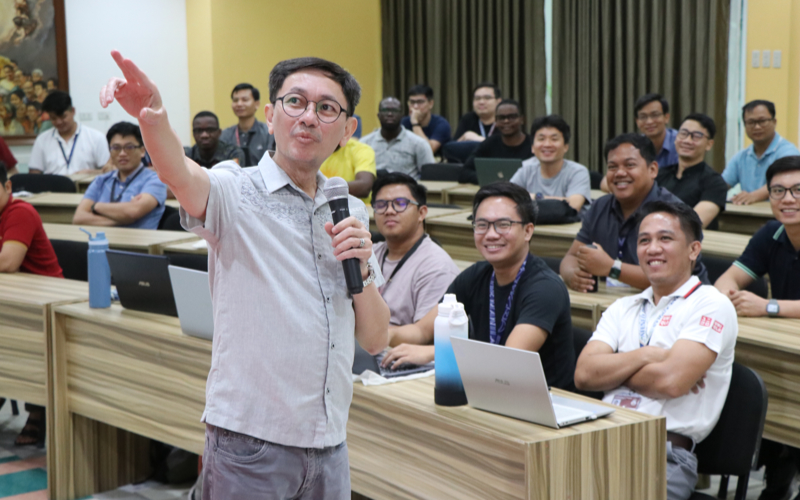
“What is it to be a companion of Jesus today? It is to engage, under the standard of the Cross, in the crucial struggle of our time: the struggle for faith and that struggle for justice which it includes.”
Decree 2: “Jesuits Today,” General Congregation 32 (1975)
Our Work in the Philippines
Jesuits have played a significant role in the history and development of the Philippines since their arrival in 1581. Their early mission was primarily focused on evangelization, education, and pastoral care, particularly in the more remote regions of the country. Over time, they established several educational institutions, including the prestigious Ateneo de Manila University, which has shaped generations of Filipino leaders.
Beyond education, Jesuits have been active in social justice, working with marginalized communities and advocacy for the poor, the indigenous, and the environment. They have been addressing societal issues such as poverty, inequality, and environmental degradation, inspired by their commitment to faith-and-justice. The Universal Apostolic Preferences (UAPs)—showing the way to God, accompanying the marginalized, caring for our common home, and engaging with the youth—animate the various Jesuit ministries in the Philippines, as Jesuits strive to contribute to a more just, compassionate, and sustainable society.
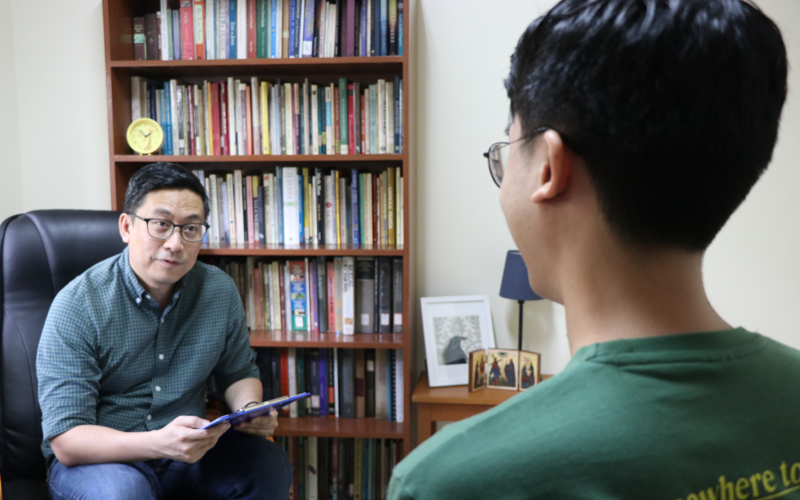
“A Jesuit, therefore, is essentially a man on a mission: a mission which he receives immediately from the Holy Father and from his own religious superiors, but ultimately from Christ himself, the one sent by the Father. It is by being sent that the Jesuit becomes a companion of Jesus.” – General Congregation 32, Decree 2
Our Works
Higher Education
Ateneo de Davao University **
Ateneo de Manila University **
Ateneo de Naga University **
Ateneo de Zamboanga University **
Xavier University-Ateneo de Cagayan **
Loyola School of Theology
** with Basic Education
Basic Education
Ateneo de Iloilo-Santa Maria Catholic School
Sacred Heart School-Ateneo de Cebu
Xavier School San Juan / Xavier School Nuvali
Loyola College of Culion
Pangantucan Community High School
Social Apostolate
Institute of Social Order
JJC Institute on Church and Social Issues
Simbahang Lingkod ng Bayan
Ugnayan at Tulong Para sa Maralitang Pamilya
Retreat Houses
Jesuit Retreat House-Cebu
Jesuit Retreat House-Malaybalay
Loyola Retreat House-Spirituality & Art Center Angono
Mirador Jesuit Villa Retreat House, Baguio
Sacred Heart Retreat House, Novaliches
Spirituality & Accompaniment
Center for Ignatian Spirituality-Philippines
Emmaus Center for Psycho-Spiritual Formation
RMT Center for Family Ministries
Seminary Formation
Socio-Pastoral
Adoracion Nocturna Filipina
Pope’s Worldwide Prayer Network (Apostleship of Prayer) / Eucharistic Youth Movement
Philippine General Hospital Chaplaincy
Philippine Jesuit Prison Service
Sacred Heart Mission Station, Kalookan
Mary the Queen Parish, San Juan
Sacred Heart Parish, Cebu
Nuestra Señora de Guadalupe Parish, Cabanglasan, Bukidnon
St. Therese of the Child Jesus Parish, Miarayon, Bukidnon
Our Lady, Mary Mediatrix of All Graces Parish, Zamboanguita, Bukidnon
Communications
Jesuit Communications
Jesuit Music Ministry
Science