
Where is hope when the world demands so much—yet gives so little room to simply be? We are witnessing a generation quietly drowning in depression—now the leading cause of disability among the youth. One in five Filipino youth have considered ending their lives, says the UP Population Institute. They grow up under relentless pressure to perform, to compare, to prove. Where is hope in a world that tells the young they’re only as good as their grades, their paychecks, their filtered faces?
Where is hope when the world itself feels like it is breaking apart beyond repair? At the end of 2024, an estimated 123 million people were forcibly displaced by persecution, conflict, violence, and ecological disaster. For many marginalized communities, climate change is not a future threat—it is already their daily reality. When the world groans, creation disintegrates, and the poor suffers even more—where is hope?
Where is hope when everyone is digitally trapped in their own truth, their own pain, their own world? Isolation is no longer a rare condition—it’s becoming the norm. A Meta-Gallup survey across 140 countries found that 57% of Filipinos feel lonely versus the global 24%. In today’s digital world, echo chambers thrive— fragmented spaces where people mostly hear what they already believe. While loneliness spreads, “my truth” reigns, and shared realities begin to erode. Where is hope when we are more connected than ever—yet more isolated, more divided, more alone?
Where is hope in this Jubilee Year of Hope?
In our desire to hold onto something, we often settle for toxic positivity—that shallow cheerfulness that fades when life gets hard. Or unbridled optimism—the denial that insists progress is inevitable if we just work harder. Or self-indulgent escapism—sentimental alternatives we seek refuge in, only to crumble in real suffering.
Dear fellow pilgrims, Christian hope is none of these.
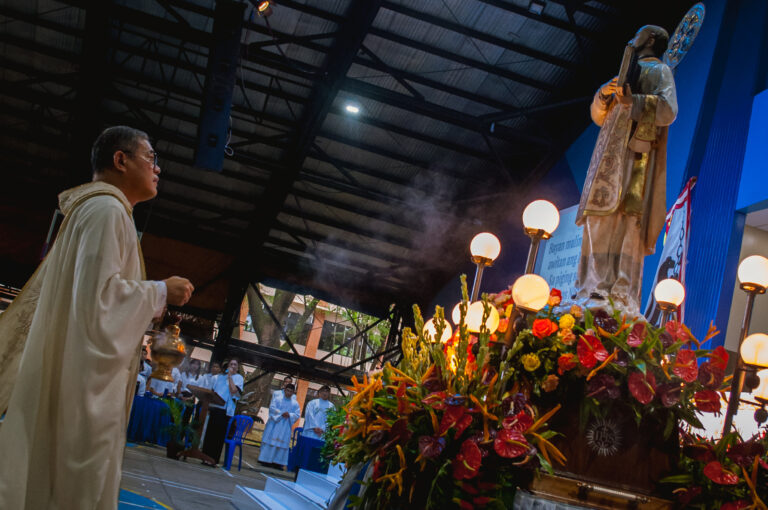
Today we gather across the Philippine Province as one Ignatian family, to remember a pilgrim who let grace transform his shattered dreams and bruised ego into a mission of hope that reached the ends of the earth.
St. Ignatius of Loyola teaches us that real hope dares to look at what is broken—and still believes God is laboring there. It is not naïve optimism. It does not deny the wounds that shape our journeys. With conviction, it stares straight into what is broken and says: Even here, God labors. Even now, God renews.
Our hope is never cheap. It is a fire that burns away illusions, a pilgrimage that demands everything. It costs us. It compels us. It co-creates community.
Today’s readings are not for tourists of faith, but for pilgrims—who dare to be transformed.
HOPE THAT COSTS. Jesus tells us bluntly: “So, therefore, none of you can become my disciple if you do not give up all your possessions.” Hope is not a fleeting feeling. Hope costs. It challenges us to live not just for survival, but for meaning, even when the world frowns at us. To choose purpose when despair tempts us to surrender. To find meaning in giving even when we feel empty.
I think of Von, who made his 30-day retreat with us. He could have built a career anywhere after graduating magna cum laude in the seminary. Instead, he volunteered at JRH. And stayed—quietly serving in the BMD. He could have moved to more lucrative work. But he cannot deny what his heart beats for. Von stayed when he could have soared because something from within calls.
Then, there’s Kim, once a Vianney seminarian on ministry year at PCHS. With his three international awards as a Paulinian teacher after, he could have chosen prestige and security. But Kim returned to PCHS eventually. Not because of convenience, but because he believes in PCHS’ vision. Kim walked the road where few would. He chooses meaning over merit, purpose over prestige.
Von and Kim are ex-seminarians. In a world where we are dictated to chase possessions, status, and success, hope becomes costly because purpose is priceless.
HOPE THAT COMPELS. Jeremiah says: “There is something like a burning fire shut up in my bones: I am weary withholding it in, and I cannot.” Jeremiah laments that the Lord “duped” him, making him a laughingstock. He tried to walk away from his mission—only to find that the God’s Word had claimed him. In a world falling apart, hope doesn’t flee. It compels. It returns. It desires bigger than oneself.
I think of Xael, an Umajamnen from Cabanglasan, where soldiers were idolized. He even pursued becoming one, but eventually shifted to be a teacher.
In one formation session, he asked: “Father, what’s the point of making us return to our communities when there are no opportunities there?” It was an honest question—hope does not pretend the ground is fertile. But Xael persevered. He passed the board exams and returned to teach in his community. Not because the ground had changed, but because he was willing to become the change, himself. Hope grows when the question doesn’t disappear—but is faced with courage and lived into, day by day.
I remember Zacara, a 4Ps beneficiary since 2009. Her family barely made ends meet. She graduated magna cum laude in Education at Ateneo de Davao. Though she completed her return service as a Kapawa scholar, she stayed on—not out of obligation, but conviction. “I enrolled in college because I had a dream to become a teacher. I am an Umayamnon. This identity pushed me to become somebody for myself, my family, and my community.” Now she mentors over a hundred high school and college leaders in the FLMFI program. Zacara stayed, not to rise alone, but to raise others.
With fellow Umajamnen youth, Xael and Zac founded the Cabanglasan Indigenous Peoples Youth Organization. CIPYO even lobbied for Indigenous youth representation in their municipality. In a world that urges the promising to leave their roots behind, hope is alive when young indigenous leaders return—to regenerate the very communities that raised them.
HOPE THAT CO-CREATES. St. Paul tells us: “Be imitators of me, as I am of Christ.” This is hope that doesn’t stay isolated. It draws others in and build each other up. It overflows into a shared mission that builds community. The love of Christ impels us—personal faith becomes communal witness, as hope kindles fire from one heart to another.
I think of Sai, a Jesuit Volunteer from Ateneo de Naga. She could have returned home and manage her family’s business after her 2-year service. Instead, she remained, serving the Indigenous ministry in Bukidnon—though it would’ve been easier to leave. Sai chose presence over privilege. She could choose comfort but that would mean losing something deeper— herself. She’d rather turn away from security to remain where love needs her most.
Then, there’s Pedro SJ, who has spent over three decades watching the forests recede, rivers shrink, people flee. He heard the groaning of creation and saw communities threatened by poverty and violence. He faced threats, ridicule, and scarce resources— yet he continues: growing trees, building schools, empowering Lumads. Because hope, when real, doesn’t retreat from what is broken. It chooses solidarity over safety.
Sai and Pedro are not from Bukidnon. They could have walked away. But they stayed— not because it was required or easy, but because the lumad’s hopes had taken root in them. They stayed not as benefactors looking in, but as companions who walk with the Indigenous Peoples in the mission of co-creating communities.
Friends, I shared the stories of Von, Kim, Zac, Xael, Pedro and Sai not because they are the only stories of hope alive in our Province. I share them because I’ve walked with them during my 8 year- Bukidnon mission, and they, along with others, kept hope alive for me when my mission felt too costly, too demanding, and even too heavy to carry alone.
Where is hope? You surely have your own Vons & Kims, Zacs and Xaels, and Sais and Pedros—your bearers of hope, quietly testifying: Hope is alive in them. But it costs us. It compels. It co-creates. Now, it calls.
In 2018, Father General visited Xavier University. I was asked to share about our Indigenous Ministry. To end the presentation, I flashed this question: “What is your message for the Indigenous Peoples, and for all the people working with and for them?”
He did not answer.
Later, during the mandatory photo shoot after being awarded my certificate, I nudged him: “Father General, what is the message that I should bring to the IPs?” He glanced at me and said: “Hope, Bros. Bring them hope.” Back then, I didn’t realize how prophetic his response would be.
Now, it’s no longer just an answer from 7 years ago—it’s a commissioning. Almost like the Call of the King come alive in real time. “I wish to overcome all the evils of the world and bring all people to the fullness of life. Will you join Me? Will you bear hope where others have grown tired?” It is no longer just for our Indigenous brethren. Not even just for those who have walked beside them!
But for us, who have received hope through the lives of our bearers of hope. This hope impels us to pass it on. It is a call to become what we have received: Bearers of hope. For Others.
Where is hope? We are where hope is.
Fellow pilgrims, together, this is our mission.
Preached by Fr. Ambrosio Flores, SJ on Feast of St Ignatius of Loyola Province Mass on 27 July 2025 at the Ateneo de Manila High School Covered Courts