
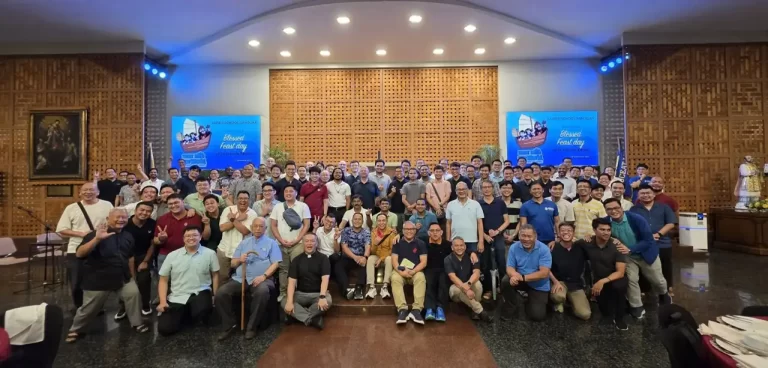
When I arrived at Xavier School last June, one of the first groups that welcomed me was KIKKOM—the Kiko Committee. “Kiko” is the Filipino nickname for Francisco, and these students oversaw this year’s celebration of St Francis Xavier’s feast. Their guiding question was simple: “What would Kiko do?” That question became the starting point for tonight’s reflection.
On this feast of St Francis Xavier, we don’t just remember a great missionary. We remember a man whose inner transformation still has something to teach us today—not only for our ministry here at Xavier School or in forming the youth, but also for the Church’s journey of synodality and our Jesuit mission.
We usually remember St Francis for the long journeys, the baptisms, the miracles. But if we look deeper, we see something even more important: a young man who allowed his big dreams to be reshaped by God. “What will your life stand for?” That is the question Ignatius once placed before him. And it is the same question Francis would place before us today—and before the young people entrusted to our care.
1.Forming the Young
Francis Xavier understood the world of high achievement and competition. He lived it. He loved it. But grace slowly reoriented him. He discovered that brilliance becomes life-giving only when it is placed at the service of God’s dream.
If he were alive today, he would look at our young people—surrounded by information, formed by algorithms, pressured to perform—and he would say: “Wisdom first. Purpose first. The pearl of great price first.”
He would admire the tools of our age, including artificial intelligence. He would see, as a man who translated the Creed into Tamil, Malay, and Japanese, that technology can open doors that once took years to push open. But he would also warn us: “Do not let knowledge outrun discernment. Do not let skill eclipse vocation.” He would recall what he once discovered in Paris: “Let your studies serve your soul, not replace it.”
And for our young who struggle with mental health, who carry interior anguish or anxiety, Francis would speak with the tenderness of someone who knew such darkness. He battled pride, loneliness, exhaustion. He learned to pray through his own limits. He would invite the young: “Do not be afraid of your struggles. Bring them into prayer. Bring them into service.”
He would not fear the complex questions our youth bring—including those around gender or identity. While his 16th-century world did not know our categories, his method remains timeless: learn the language, enter the culture, walk with respect, win hearts through love. He always began with dignity, with accompaniment, with the desire to understand before correcting. This too is our task.
2. Vocation
For Xavier, vocation meant availability. It meant letting God interrupt your plans—again and again. He resisted titles, benefices, dignities. He wanted motion, mission, the unpredictable path of love.
To young Jesuits who struggle with discouragement or disappointment in the Church, Kiko would say: “Belong because you love. Stay because Christ sends. This is the Company of love and harmony of hearts.”
He knew the Church was imperfect. He confronted abusive Christians in Goa, defended exploited converts, and challenged corrupt officials. But he never abandoned the Body of Christ. He served it more fiercely. And he would ask us: Are our hearts still bold enough to be sent? Still free enough to be interrupted? Still humble enough to belong?
3. Synodality
Some imagine Francis as only a lone missionary. But behind his courage was a profound capacity for communal discernment. He was formed in that small band of companions in Paris where decisions were made only after what the sources call a long, careful debate. And within that circle, all were equal; even the youngest voice carried weight.
This is the heart of synodality: a Church where we listen deeply, speak honestly, and discern together. But Francis adds something crucial. After the listening came obedience—joyful, mature, ecclesial obedience.
He wrote to his men constantly about humility, unity, deference to superiors, avoiding even the shadow of scandal. For him, synodality and obedience were not opposites. They were two movements of the same Spirit. He would tell us today: “Listen with humility. Discern with courage. But in the end, stay in communion.
4. Care for Our Common Home
Finally, when it comes to caring for our common home, Xavier did not have our ecological vocabulary. Nature must have been a place of hardship in his experiences and observations. Yet he would insist that care for creation is care for the poor, because environmental harm always wounds the vulnerable first. He would support any effort that relieves human suffering and strengthens justice.
In conclusion, what would Xavier ask us today?
If Francis Xavier walked into this chapel, I do not think he would begin with strategies, statistics, or structures. He would look at each of us—young or old, energized, or exhausted—and he would ask: “Where is your zeal? Where is your availability? Where are the poor you have touched? Where are the young you have lifted up? Where is the God you are helping others encounter?”
He would tell us that the mission is not over, that new shores await, that the world is hungry for Christ, and that our life—however fragile or broken—can still be poured out for something eternal.
That is what Kiko would do.
Homily on the Feast of St. Francis Xavier, preached on 3 Dec, Sacred Heart Chapel, Xavier School, San Juan City.