
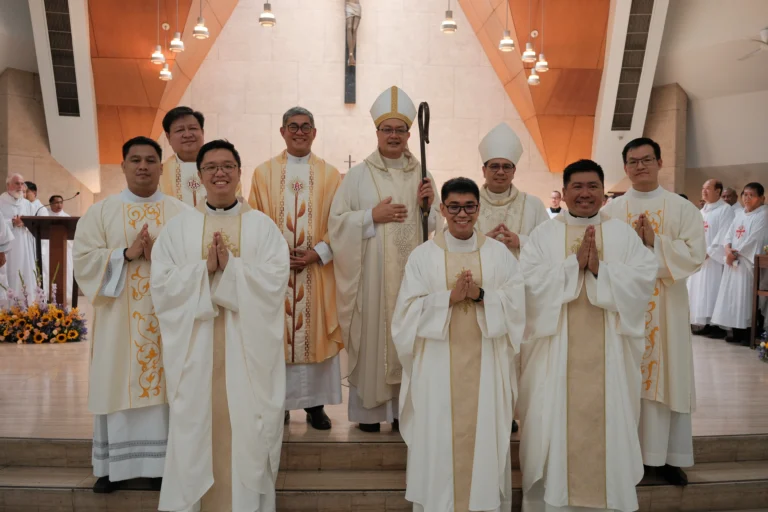
Dom, Bien, and James, allow me to begin by making one thing very clear to you. From this day forward, you are being ordained not to become substitutes for Christ, but to become his representatives. Hindi kapalit kundi kinatawan.
The distinction is important. A substitute is a replacement for someone who is absent. A representative acts in the name of the one who sends him, and who is present in him.
To understand this properly, we must always return to the foundation of our Christian vocation: we are members of the Body of Christ. Like St. Paul, we learn to say, “I live, not I, but Christ lives in me.” How can anyone represent Christ unless he first belongs to Christ? How can anyone act in his name and participate in his life and mission unless he remains in communion with him by the grace of the Spirit? As Jesus says in John, “I am the vine, you are the branches. Apart from me, you can do nothing” (Jn 15:5).
Take note: this is something I am saying not only to the three of you. It applies to every baptized Christian—lay faithful, religious, ordained ministers (deacons, priests, and bishops) alike. The vocation to represent Christ is not the monopoly of the ordained.
The moment we imagine that acting in the person of Christ belongs exclusively to us, we begin to slide into clericalism—one of the pet peeves of the late Pope Francis—your fellow Jesuit. We might start imagining ourselves as usurpers of the mission rather than as participants in the mission. We might begin acting as though we ourselves were the Messiah, the Savior, the Good Shepherd, instead of witnesses to the One who alone is all of these.
Psychologists have a name for this syndrome: Messianic Complex. It is what gives some people the gall to proclaim themselves as “Appointed Son of God”, “Owner of the Universe”, “Executive Pastor” called to save the world.
Ironically, one of the best cures for this illusion is failure. Yes, failure. Mistakes, disappointments, humiliations, and painful experiences that have a way of bringing us back to reality. They remind us that we are not angels. We are not heroes standing on pedestals. We are human beings—fragile and vulnerable, yet loved and called by God. We are sinners.
Ordination will not erase your weaknesses. The laying on of hands is not magic. It will not remove your limitations, your struggles, your temptations, or your humanity. You will remain who you are: disciples still learning to allow the Lord to lead you by the hand after a miserable failure, like Peter, the veteran who feels like a neophyte until the very end, still learning to respond with one pledge of love for every word of denial, still learning to see clearly through eyes washed by tears.
Or like Saint Paul, you may find yourselves sometimes struggling with your human frailties, perhaps begging the Lord like him, to remove your “thorn in the flesh”. You may ask him to take away a weakness, a burden, or a struggle that causes you pain. And like Paul, you are bound to hear the same answer: “My grace is sufficient for you, for in weakness, power reaches perfection.” (2Cor 12:9) The Lord does not always remove the thorn. Instead, he teaches us to rely not on our own strength but on his. In your weakness, his strength will be revealed.
In the first reading, the prophet Isaiah declares: “The Spirit of the Lord is upon me, because he has anointed me to bring good news to the poor, to heal the brokenhearted, to proclaim liberty to captives.” Who will accomplish all these things? Not you, but the Christ. He is the anointed one who heals. He is the one who liberates. He is the one who brings good news. But he continues to choose people like us. He continues to call sinners like us. He continues to work through our flawed but “magnificent humanity” to borrow from Pope Leo’s words. Never forget that.
The Spirit who descended upon Christ is the same Spirit who will be invoked upon you today. The Spirit does not replace your humanity; he inhabits it. He does not erase your personality; he places it at the service of the Gospel. Through the gift of the Holy Spirit, your lives become signs and instruments through which Christ continues his mission.
There is another word closely related to representation. friendship. No one can become an authentic representative of Christ without first becoming a friend of Christ, a companion of Jesus. For who is the shepherd of the flock? Christ alone. Who is the priest who offers the perfect sacrifice at every Eucharistic celebration? Christ alone who is the Lamb who takes away the sins of the world. Christ alone. And yet he chooses not to work alone.
We often forget that if we have faith in him as the Christ, the son of the living God, he also has faith in us as the rock on which he builds his Church. He shares with us his Spirit. He incorporates us into his Body. He allows us to participate in his life and mission through the various ministries and vocations of the members of the Church.
So as ordained presbyters, your role is to exercise leadership in such a way that Christ alone remains the real Head of the Church. You are called to shepherd in such a way that Christ alone remains the Good Shepherd of the flock. Even in leadership, you remain as representatives not substitutes, as friends and companions of the one Head, the one Priest, the one Shepherd. Your ministry of acting in the person of Christ the Head is meant to awaken and animate the rest of the Body so that every baptized person may discover his or her vocation to represent Christ in the world.
For the Church does not exist for herself. The Church exists for the life of the world. Yes, some of us might be called to serve the Church, but ministry itself is not about serving the Church. It is rather about serving society as part of a servant Church. Yes, to serve society as part of a servant Church in all realms of societal life—in politics, business, education, health care, science, information digital technology, and yes, even artificial intelligence.
Together—lay faithful, young and old, men and women, religious, deacons, priests, and bishops—we are sent to be salt of the earth and light for the world. Sent to represent the Sender. Sent to be participating participants in God’s work of creation, healing, reconciliation, and redemption. All of this happens only through Christ, with Christ, and in Christ. To him alone be all the glory and honor, all power and dominion, now and forever. Amen.
Preached on 30 May in AdMU’s Church of the Gesù, Loyola Heights, Quezon City.