
Today the Philippine Province of the Society of Jesus rejoices for the privileged gift of priesthood that our three brothers will receive of participating in the one priesthood of Jesus Christ the High Priest. But more than the Philippine Province or the Society of Jesus, the whole Church rejoices. As Vatican 2 reminds us, a priest belongs not only to a local church; rather, he shares the mission of the universal Church.
The readings carefully chosen by the ordinandi provide us a window through which we view our celebration this morning. When the prophet Isaiah says, “He has sent me to bring glad tidings to the lowly, to the poor,” we might imagine him embarking on his mission as a confident preacher or a seasoned prophet. But in truth, the Spirit often anoints people who are poor, brokenhearted, reluctant, or feel unworthy and inadequate. In the language of St Paul in our second reading, they are earthen vessels. This metaphor highlights human fragility, our dependence on God while holding the precious treasure of faith in the gospel of Jesus.
The mission of Jesus himself is handed to fragile human instruments like Melvin, the third of four siblings from Imus, Cavite. Raised by simple parents through a small egg-delivery business, Melvin took a part-time job in Jollibee during his studies. While grieving over his father’s death, he found consolation in singing religious songs with the Sacred Heart of Jesus Music Ministry. This allowed him to sense the stirring of the Spirit, leading him to hold on to a treasure that his fragile hands would not let go.
Reverend Rico is the tenth of twelve siblings. Raised by hardworking parents through farming, Rico learned that poverty and hardship is the birthplace of hope. The scholarship of +Fr Paul Brunner SJ ignited that hope. Of the three ordinandi, Rico may be the shortest, but he has had the longest formation, because initially he wanted to be a religious brother. When events turned differently, he discovered that God wanted him to be a priest in his fragility.
The treasure will also be handed to the fragile humanity and hands of Al, the fifth of seven siblings. Al’s father worked as a tor and later managed a small farm. There were days that Al would skip classes, not because he was lazy but because he wanted to help his father in the farm. Scholarship from the Sisters of Mary saved him from giving up his own schooling to give way to his sister’s education. In this fragility, God molded a resilient servant of the Lord from a working student who supported the education of his younger brother while finishing his own degree. Through hard work, Al graduated magna cum laude in Computer Science and was named STI’s National Student of the Year.
While it is true that the treasure is held by earthen vessels, by fragile human persons, in the truest sense, it is not we who hold the treasure. Rather, it is the treasure that holds us, embracing our fragility and redeeming our brokenness. It is this kind of person molded by God as shepherds who will never leave the flock. I am very inspired by the words of Ron Rolheiser OMI, “I’m convinced that God calls each of us to a vocation and to a special work here on earth more on the basis of our wounds than on the basis of our gifts. Our gifts are real and important; but they only grace others when they are shaped into a special kind of compassion by the uniqueness of our own wounds. Our unique, special wounds can help make each of us a unique, special healer.”
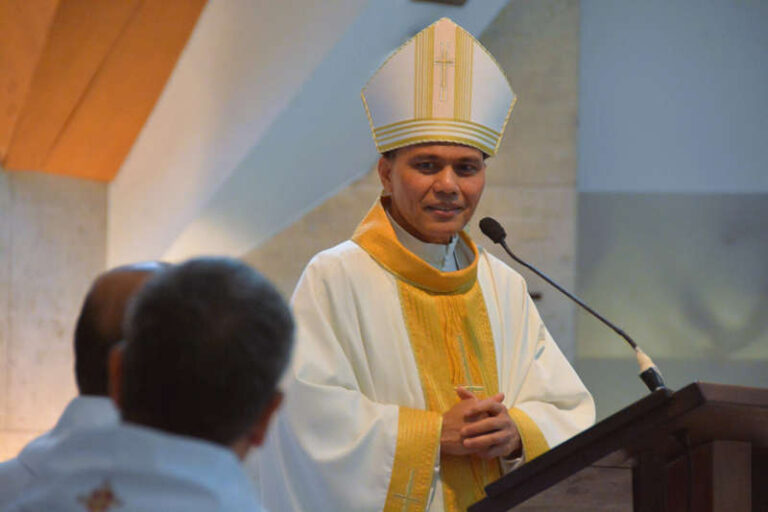
When I was a formator in St John Vianney Theological Seminary, I gave retreats to those preparing for ordination. A question often asked by ordinandi was, “Will I persevere?” On June 7, I will celebrate 32 years as a priest and seven years as a bishop. What has sustained me through these years is neither the busy-ness of ministry nor the appreciation of people nor even the consolation of success. What has truly sustained me are three things which I owe to St Ignatius and my Jesuit formators and professors: solitude, silence, and the examen.
Many of you may know that I am a cancer survivor. I was diagnosed with cancer when I was appointed third Bishop of the Diocese of Tandag in Surigao del Sur. While I would never wish suffering on anyone, I must say that those months of treatment, radiation, chemotherapy and surgery became unexpectedly sacred to me. During treatment, especially radiation, I was utterly alone in a room while technicians worked in an adjacent room behind protective walls. I lay there still and silent for about 20 minutes each session.
During those 20 minutes day after day, I did my examen, reviewing my day, sensing God’s presence, asking for grace. What I found in those moments was not absence but deep presence. I was not alone. I was never alone. The sterile hospital room with beeping machines and flickering lights became a sanctuary for me. The silence wasn’t empty; it was filled with God. I felt a kind of oneness with One who was intimately close to me. The time of physical vulnerability became one of the most sacred periods of my life.
My dear brothers, you are to be ordained. More than the great joys of ministry, what will sustain you is the interior life, not social media, not the crowds, not the many demands of your mission. It is the daily return to God in solitude, in silence, in the examen that will ground you, purify your intentions, and remind you that your priesthood is not about what you do, but about who you are in the eyes of the One who called you by name despite your fragility. The Ignatian magis is not about more activities, programs and projects. The Ignatian magis is more of God, His will and His greater glory.
So, I say to you today, welcome the silence. Do not run from solitude. Embrace the examen, not just as a spiritual exercise, but as a special moment of encounter, a place of intimacy with God who loves you more than you can imagine. At the end of my treatment, when I was permitted by my doctor to go back to Tandag, I went to see the Nuncio. At the end of our conversation, he asked me “Bishop Raul, what is cancer for you?” Spontaneously I answered, “Your Excellency, for me cancer is the tightest embrace I have ever received from God.”
Our fragility becomes good news to people who are searching for God when we allow the hand of God to touch our wounds, so that our wounds become an instrument for the healing of others. Let us end with this beautiful prayer that is so familiar to us, that has shaped our lives over the years. Take, Lord, and receive all my liberty, my memory, my understanding, and my entire will. All I have and call my own, you have given to me. To you, Lord, I return it. Everything is yours, even my illness, my brokenness. Do with it what you will. Give me only your love and your grace. That is enough for me. Amen.