
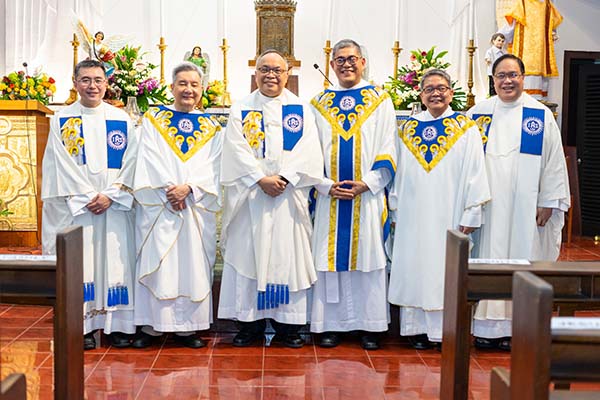
Jonjee Sumpaico entered Sacred Heart Novitiate on 30 May 1995. Two years later, he pronounced First Vows. Jesuit First Vows are perpetual. After only two years in the novitiate, a Jesuit already promises vows that say forever. In 1997, Jonjee vowed to the Divine Majesty, “perpetual poverty, chastity, and obedience in the Society of Jesus.” And every year since then, Jonjee has repeated the vows to remind himself of what he already made to the Lord.
If the First Vows were already perpetual, what does it mean then to take Final Vows in the Society? It would seem to make little sense to take “final” vows when the ones which were taken 27 years ago, and repeated yearly, are perpetual. How much more final can you get than perpetual? … than forever? There is no religious order except the Society of Jesus which takes perpetual vows so early and final vows so late!
In his essay on Final Vows, the Jesuit theologian Michael J Buckley explains this conundrum [“Final Vows: Culmination of an Ignatian ‘Election”, National Jesuit News (April 1981), 8 & 10; extensively and freely quoted in this homily]. Buckley elucidates that to understand the meaning of Jesuit Final Vows, it is necessary to place them within the general structure of an Ignatian election, the way described by St Ignatius in which one moves toward finding and giving one’s life over to the will of God.
There is the initial offer of a choice to God our Lord, an offering that is made according to a time for making an election and which is then presented before the Lord. What the dynamic of the election looks for after the moment of offering is the subsequent confirmation by God. Election develops over time between two major events: the time of human offering and the period of confirmation by God.
Offering and Confirmation. The vows of the Society of Jesus follow a similar pattern. The First Vows of a Jesuit are an offering, following upon an election, made in perpetuity. This offering is contingent upon the subsequent confirmation by the Lord, worked through a human being’s personal religious history over the next 20 years or so. Final Vows are the confirmation of the offering.
Up until Final Vows, the Jesuit lives in a period of probation, testing whether the first offering of his life to God in the Jesuit way is accepted and confirmed by Divine Providence. Over the past 27 years, Jonjee has experienced in some depth the fulfillment and the disappointments of his First Vows.
Over the years, Jonjee has known weakness, self-doubt, frustrated expectations. But also, optimism that has yielded much more to hope, a hope in what he does not see.
As Jonjee comes to Final Vows, he knows, as only extended day by day experience can teach, what it will mean for him to live a life of fidelity in the poverty, chastity, and obedience of the Society of Jesus. He knows, as only living in various communities can instill, who the Society of Jesus is, the flesh-and-blood brothers with whom he will spend his life.
27 years later, it is a different Jonjee whom the Society calls to Final Vows. Yet over the immense changes of those years, the happiness and the struggles through which he has moved, his initial offering has remained – deepened, differently modulated, but persistent. The confirmation of God runs through this history and is embodied in his knowing choice of the Jesuits as his brothers and the Jesuit way of life as his path to God.
These years have been spent in various communities, at the various works and missions of the Society – Loyola House of Studies, Sacred Heart School–Ateneo de Cebu, Bilibid Prison Service, Xavier University–Ateneo de Cagayan, University of San Francisco, Ateneo de Manila. And the Society – concrete, flawed, intense, needing the mercy of God – recognizes in Jonjee the persistent presence of its charism, the constellation of graces that it calls vocation. The Society finds in Jonjee, a brother, possessed by a shared passion for mission.
If the Society witnesses that the initial offering of the Jesuit is confirmed by his religious experience and history, then the Society calls him to pronounce his Final Vows. By granting Final Vows, the Society witnesses that the initial offering of so many years ago has been accepted and confirmed by God. Final Vows are more an act of God confirming the initial offering than a new offering.
First Vows are made only to God and no human person is addressed. They are an offering to God to live and to die as a Jesuit. In his First Vows, Jonjee did not just make three vows of poverty, chastity, and obedience. He also made a fourth promise, “and I promise that I shall enter that same Society in order to lead my entire life in it.”
The offering of the novice during First Vows is important and an enormous gift of God and he promises to enter the Society when the Society calls him. During Final Vows, the Society definitively calls the Jesuit. The fourth promise of entering the Society is fulfilled. The confirmation of Final Vows is more the action of God, taking up what was given so many years before and asserting that it is of God.
In God binding him, the vows set Jonjee free (CN 143.2):
- Free, by the vow of poverty, to share the life of the poor and to use whatever resources he may have not for his own security and comfort, but for service
- Free, by the vow of chastity, to be a man for others, in friendship and communion with all, but especially with those who share his mission of service
- Free, by the vow of obedience, to respond to the call of Christ as made known to him by those whom the Spirit has placed over the Church and to follow the lead of his superiors
Final Vows are commitments made not only to God but to the Society. Final Vows, unlike the First, are accepted by the Society, as the Jesuit “vows into the hands of the one who admits him (Cons 533)” – in today’s ceremony, Fr Provincial Xave Olin. Final Vows are as serious and solemn a confirmation of religious and personal choice of a way of life as the Church can give. By receiving Jonjee’s Final Vows, the Society today attests that his initial offering 27 years ago has been accepted and confirmed by God and that he is now fully incorporated into … fully embraced by … the Society of Jesus.
Jonjee and the Society have lived a common history together, and the steadiness of Jonjee’s desire has been matched by this common recognition of the vocation of his life. Jonjee is among those whom Ignatius soberly describes as “those who have been tested in the Society sufficiently and for a time long enough so that both parties may know whether their remaining in it is conducive to the greater service and glory of God our Lord” (Cons 510).
Fr Jonjee chose the Feast of the Holy Guardian Angels as the day to pronounce his Final Vows. He also chose to make his vows in this beautiful Chapel of the Holy Guardian Angels of the Ateneo Grade School. This is the very Grade School which nourished the seed of his vocation during his elementary years.
It is fitting then, that we close our reflections on the two main characteristics of angels. Contemplation and Ministry sum up the life of an angel. Angels exhibit an openness to God (contemplation) and to do God’s will (ministry). The angel is one who stands always in contemplation before the throne of God, and at the same time is ready to go anywhere God may wish to send him. Angels show a willingness to be in God’s presence and to go anywhere and to do anything at His command. With a singlemindedness, the angel is totally oriented toward God and His service. [Joseph F Conwell, SJ, “Living and Dying in the Society of Jesus or Endeavoring to Imitate Angelic Purity”, Studies in the Spirituality of Jesuits (May 1980, Vol 12, No 3), 8-10].
Alam naman nating lahat, hindi naman anghel si Jonjee! Still, our prayer for him as he takes his Final Vows is that he will grow more and more in becoming so absorbed in God and so ready to do God’s will … a contemplative in action … a true son of Ignatius.
Holy Guardian Angels, … pray for Jonjee … pray for us.
[By Fr Roberto C Yap SJ, 2 Oct 2024]