
In 2002, Timor-Leste won its independence from Indonesia. With the smoke and rubble still fresh after decades of struggle for independence, two Filipino Jesuits were sent there: Fr Samuel “Sammy” Dizon and Fr Martin Antonio “Bong” Abad Santos. They headed straight to the mountainous region of Railaco, Ermera, in Western Timor-Leste, approximately 27 kilometers from the capital city of Dili.
The locals remember how the two Filipino missionaries went about upon arriving, as if there was no time to spare. Without stopping over in Dili to greet their Jesuit brothers, they went directly from the airport to their mission area in Railaco, an administrative post with a vibrant and thriving Catholic community in dire need of a priest. From that point on, Fr Bong started his medical and feeding mission for the community in the far-flung mountain villages in Ermera, while Fr Sammy established the parochial school adjacent to the parish church. Both served as pastors for the mission chapel.
In June 2023, I was privileged to be sent by my formators to Railaco for a two-week immersion to join and observe the mission of the Filipino Jesuit missionaries there. I vividly recall going through the zigzagging roads leading to Railaco, how I almost tumbled at the back of the old truck that picked me up from the airport. I can only imagine what the road must have been like in 2002—if there was any—when Frs Bong and Sammy first arrived at Railaco.
Fr Sammy, now 90 years old, is retired and residing at the Jesuit Health and Wellness Center in Quezon City, where he prays for the Church and the Society. Fr Bong is still in Railaco, now joined by Fr Erik John “EJ” Gerilla, the current parish priest of Nossa Senhora do Fatima Parish. Fr EJ arrived in Timor-Leste in 2014. With them in community are five other Jesuits: Fr Hyoe Murayama who is from Japan and the director of the parochial school; Bro Thaddeus Tha who is from Vietnam; Fr Roberto Madeira Encarnação and Fr Domingos Emmanuel Morerira who are local to Timor-Leste and assigned to assist in the pastoral works of the parish; and Sch Nelson Marques who is also from Timor-Leste and a regent assigned to teach at the parochial school.
In my two weeks in Railaco, Fr EJ was my direct supervisor and made sure that I had the opportunity to witness many activities in the mission area. I joined a convoy of parishioners for a six-hour road trip to Baucau to witness the first Mass of a newly ordained Jesuit priest in his hometown. I taught English to a handful of students in the parochial school, which was quite challenging since English is the fourth language they learn. I also ran a three-day workshop on Laudato Si’, which aimed to inspire the youth leaders of the parish community to care for the environment. However, what I found most remarkable and astonishing was living with the two Filipino missionaries. Their exemplification of availability, mission, and love for the priesthood was exactly what a young Jesuit like me needed to witness firsthand.
“Confession first, medicine later.”
When I arrived at the Aeroporto Internacional Presidente Nicolau Lobato, I was greeted by two ladies and a Jesuit wearing a cheeky grin and khaki cargo shorts. “Welcome to East Timor! Ang inet! Kumain ka na?” said Fr Bong. I had met him once when I was in the novitiate, seen him on vocation promotion posters, and heard countless stories about his work in Timor-Leste. The two ladies were Ms Ellie, a French nurse, and Dr Maria Ha, an Australian medical doctor. Both were volunteers working with Fr Bong.
As a young Jesuit, I was impressed by numerous stories of our Filipino missionary Jesuits. Among them were Fr Totet Banaynal in Cambodia, Fr Jody Magtoto in Japan, and the young priests in Bukidnon. These stories showed how Jesuits were sent where there was greater need. Fr Bong’s story was one of them: a medical doctor, the grandson of Filipino World War II hero Jose Abad Santos, sent to Timor-Leste almost 20 years ago, still working there, even receiving the Sergio Vieira de Mello Award for the promotion of Human Rights in 2020 from the President of Timor-Leste.
One afternoon, while reading a book in my room, I heard a loud knock on my door. It was Fr Bong who said, “Let’s go! Nag-bonamine ka na?” He wanted me to be ready for the long ride through zigzagging roads high in the mountains. As I hopped into one of his trucks, I noticed that another truck was loaded with boxes, which a young Timorese lady was busy checking. Apparently, every time Fr Bong went on a medical trip, known as the “mobile clinic,” he brought with him a rolling pharmacy. The young lady was a volunteer pharmacist.
Fr Bong initiated the mobile clinic in 2004 to ensure that those in the mission areas and remote villages further away could avail of medical assistance. “I have been doing this for a long time now. When I was a novice, I offered medical help and consultation in Sapang Palay, Bulacan. I did the same in Zamboanguita, Bukidnon, as a young parish priest,” said Fr Bong while he was driving.
As we passed through isolated villages, I noticed that people knew the sound of Fr Bong’s truck. Children at a distance ran towards the “road”. As Fr Bong’s trucks passed, they flashed big smiles and waved while shouting “Bom dia, amu!” which is “Good morning, Father” in Tetum. One child even shouted, “I love you, amu!” Fr Bong laughed. Not a surprise since Fr Bong had been doing this even before those children or even their parents were born. The team visited different villages, turning chapels into field clinics. They made sure each community was visited twice a month. People appreciated Fr Bong for his goodness and love. To them, he was a smiling missionary who devoted his life to the healing and welfare of the Timorese people.
After a little headbanging in the truck and some sharp turns, not to mention the death-defying feat of crossing a bridge newly (and lightly) constructed out of wood and mud by the locals to shorten the trip, we arrived at a small chapel perched on top of a lonely hill. In the distance, one could see clearly Mount Ramelau, Timor-Leste’s highest peak; all around were coffee plants, the locals’ primary source of income. As I got off the truck, kids ran towards Fr Bong. On the horizon, more people were walking towards the chapel. When the other truck opened, I realized it was indeed a complete pharmacy. The chance to see the medical team in action excited especially that part of me that wanted to be a medical doctor before I joined the Jesuits.
I eagerly asked Fr Bong how he went about giving free medical consultation and medicine. He smiled and with a wink said, “Confession first, then Mass. Medicine later…” He put on his alb and purple stole and began to walk away from me. “Then lunch after. Hehehe!” he shouted as he entered the chapel. He heard the confessions of around 20 penitents. The rest of the congregation of around 70 people was sitting on the pews and the floor. Ms Ellie could see I was taking it all in. “This is what we do every day,” she said. “A holistic kind of healing. First we listen to the soul, then offer spiritual nourishment, before we heal the body… He’s a priest before a medical doctor. A healthy lunch comes after everything.”
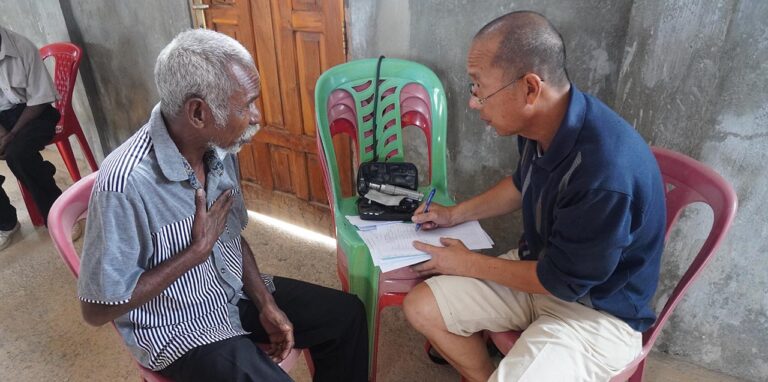
After confessions, the Mass was celebrated with beautiful singing. Once this was over, the chapel suddenly transformed into a clinic complete with someone taking care of registration and two nurses taking vital signs of people. Fr Bong had his own station with his medical equipment on a monobloc-chair-turned-table where he wrote his prescriptions and reports. The mobile clinic operated for about two hours. Congregants became patients. Families, children, and the elderly queued to consult Fr Bong or Dr Maria. Many of them left without needing a prescription. Those who got one headed to the Toyota-Landcruiser-turned-pharmacy, where the young Timorese lady handed out medicine.
Occasionally, I drew near to observe how Fr Bong worked. He asked questions in Tetum typical of a doctor. On one occasion, instead of writing his prescription for the patient, he drew symbols. I think I saw what appeared to be a sun and two small circles. Apparently, the old lady could not read, so Fr Bong found an alternative way to indicate for her when and how much medicine to take.
When the last patient had left the chapel, I asked Fr Bong what illnesses were common among the people. He replied, “Often they have respiratory infections, heart ailments, ear and eye infections… but nothing too serious. We often given them maintenance medicine or things to prevent the worsening of their illnesses. But many of them do not have illnesses… Maybe they just want an assurance that everything is alright…”
That last line struck me. Here is a Jesuit missionary with his team, miles away from home, heading every day in his old truck to the remote mountainous villages of Timor-Leste, equipped with priesthood and medical training, offering medical assistance after celebrating the wholeness and reconciliation that Christ offers. The residents are miles away from the nearest hospital or health center, but thanks to Fr Bong and his team, a convoy of trucks would regularly visit their chapel and offer an assurance that everything is alright, because God has not forgotten them. Indeed, though far from the reach of government healthcare, they are certainly close to the heart and hands of holy mother Church. “Jesus said to them in reply, ‘Those who are healthy do not need a physician, but the sick do’” (Luke 5:31).
“What! Cute?!”
Since 2005, three years after he arrived with Fr Sammy, Fr Bong has been running a feeding program for malnourished children around Railaco, particularly those in far-flung villages. I had the good fortune of joining the team of Christina, Nora, and Mario in one of their feeding trips. Fr Bong and his medical team seldom joined as they were occupied with the mobile clinic.
Hours before our departure, I could smell what the children would be having for lunch: rice porridge containing loads of chicken meat and crushed hard boiled eggs, with vitamin-rich milk to go along with it. The team always took pains to prepare vitamin- and protein-fortified meals to fill nutritional gaps in the children’s daily diet. Later, I saw for myself how important this was for the beneficiaries who seemed shorter and smaller than normal. In fact, I mistook one child for a four-year-old when she was seven.
The mountains near Railaco actually looked fertile to me. There seemed to be an abundance of fruits and vegetables. I often saw pigs, goats, and chickens near houses. So I wondered why children here were malnourished. Fr Bong explained, “It takes a while to grow vegetables and to raise animals. Many of the adults are out planting or harvesting coffee. The children often eat cassava, sweet potatoes, a few vegetables; that’s it! Add junk food, instant noodles, and what do you get? Children who feel full but have no nutrition! They do not grow! That’s why we need to augment their protein and vitamin intake.”
As the truck of the feeding team made its way near the villages, I saw children walk towards the road while holding out empty bowls and cups. Mario, who was driving the truck, occasionally stopped to let the children and parents hop on and ride until we reached an open area for food distribution, where more children were already waiting. Our truck stopped at three open areas during a trip that started at 10.00AM and ended at 2.00PM, providing meals for around 100 children altogether. This was their daily routine. Thus, one team is for the mobile clinic while another team is for the feeding program.
I was given the happy task of entertaining the children while they were queuing for their meal. Many of them could not speak English, so I used exaggerated facial expressions and hand gestures to communicate, and I think they worked perfectly well. Except with this little boy who seemed to know just one English phrase, “How are you?” and for whom it meant, “What is your name?” “Where are you from?” or even, “Why are you so fat?”
But I was inspired by the children, particularly their care for each other. Many of them came as siblings. An older child would drag along two or three other younger siblings. After getting their share, the older ones always gave away some of their own chicken meat or chunks of egg to their siblings. I witnessed this act of generosity consistently, as if it was perfectly natural for the children to share what they had with their siblings. If only adults had such generosity, the world would be a much better place.
I was also inspired by how genuinely the children smiled. I was pretty sure it was not their first time to get free food from Fr Bong’s program, yet they seemed perpetually grateful. Cristina confirmed that they were not new to the program. “We had just fed them two days ago. In fact, their parents were also fed when they were children.” She added while pointing to some teenagers who were watching from a distance, “The young boys there were fed too when they were younger.”
“But they seem very happy and excited to see you,” I replied. Cristina laughed and told me (with a slight rolling of her eyes), “Frater, children want free food and good food; besides, they like the attention. We are here… We notice them!”
People do appreciate and deserve attention, the kind that all humans need by virtue of their dignity and basic needs. Such attention assures people that they are not forgotten… that they are special. Individuals and communities pushed to the margins of society or to “existential” margins often feel pangs of despair from being neglected. They feel disenfranchised, invalidated, and simply forgotten. The feeding program, more than simply providing nutritious food, is a physical reminder to these people that they are noticed, they are worth cooking food for, they are worth visiting, they are worth more than a thousand sparrows (cf. Matthew 10:31). I believe this explains the wide smiles of the children, without discounting the appeal of good food, of course!
We arrived back at Railaco parish just moments after the mobile clinic had returned from their own trip. The ladies and volunteers were busy unloading the mobile pharmacy into the storage rooms. Fr Bong was supervising everything. He saw our truck arrive, waited for me to get off, and asked, “How was it? How were the children?”
“Wonderful experience, Father! The children were cute and…” Fr Bong cut me off, his eyes were wide with surprise, and he blurted out, “What?! Cute?! That’s how you describe them?” I feared that I might have angered him. He went on, “The children are malnourished. They are hungry! That’s why we need to feed them! …But they’re also cute. Hehehe!” He began to smile and pat me on the back. “Let’s go inside. Send me some pictures. I will show them to the donors of our program,” he said.
What an unforgettable experience I had! Though sometimes I wonder: what difference would a single meal make? After a nutritious lunch, the children go back to their homes, likely back to their usual meal of a bag of junk food or fried cassava. Malnourishment is not unique to Timor-Leste; we too have it in the Philippines. It is a symptom of complex problems of infrastructure, agriculture, government neglect, and simply the lack of healthy options in the market. Reflecting on my experiences of various feeding programs—Kalinga Center in Tayuman, Manila, San Ignacio Care for the Poor in Cagayan de Oro City, and now in Railaco, Timor-Leste—I ask, “Can one meal really solve the problem?”
And yet, while one meal might seem like a drop in the bucket, it was nevertheless a meal given in the name of love and fraternal care. It was a meal prepared, cooked, distributed, and consumed all in the name of Christ. Though that single meal did not guarantee a solution to malnutrition, it was a concrete reminder that people do care. A single meal for a hungry person may not address the world’s hunger problem, but it relieves the hunger of that person at that precise moment. It attends to the hunger of one of the least among us. It is an act of charity that, no matter how small, does not go unnoticed, since “you did it to Me” (cf. Matthew 25: 40).