
“Compassion is not a relationship between the healer and the wounded. It’s a relationship between equals. Only when we know our own darkness well can we be present with the darkness of others. Compassion becomes real when we recognize our shared humanity.” —Pema Chodron
In psychotherapy and spiritual formation, there can be a subtle illusion that the relationship flows in one direction. The therapist helps, and the client is helped. The formator imparts wisdom, and the formand learns and grows. However, the longer I do this work, the more I realize that the dynamic is not as unidimensional as it appears. To truly embody compassion, I must embrace the fundamental truth of helping: to give is to receive, and one can give only inasmuch as one receives.
Compassion as a Relationship Between Equals
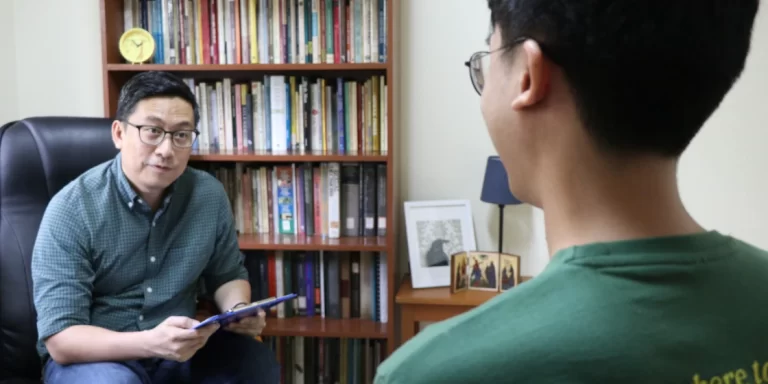
In the helping profession, especially when starting out, it’s easy to approach the work with a sense of responsibility to “fix” or “show the way.” With years of training and experience, it’s tempting to assume the role of an “expert” who has all the answers. However, in the work of accompaniment, the real fruit lies not in expertise but in compassion.
Compassion is not condescension. It is not about offering help from a place of strength. It’s about meeting someone where they are and sharing in their full humanity. What enables me to do this is the recognition that I, too, have been in that vulnerable place. I carry my own wounds, fears, and uncertainties. This makes the work less about providing a solution and more about mutual journeying. The person sitting across from me is not merely a recipient of help but a partner in our shared growth.
Being Present to Their Struggles—and My Own
As I sit with clients who struggle with stress, anxiety, grief, or compulsion, I often find my own inner challenges reflected back to me. Their struggles remind me of my own—not necessarily in form but in essence. Moments of resonance occur when their pain touches upon wounds I carry, and their questions about life and meaning echo my own. These reflections can be uncomfortable, but they are deeply important. Working with others invites me to confront my own unresolved wounds. I am reminded that I am not exempt from the very struggles I help others navigate. This reflection is humbling and unsettling as it reveals parts of myself I might otherwise keep hidden. However, it also reminds me that we are all in need of healing.
Over time, I’ve come to see clients and directees not as people to “fix,” but as fellow travelers, co-pilgrims. Their vulnerability gives me permission to acknowledge my vulnerability, and their courage to face their struggles strengthens my own. In this mutuality, there is a certain joy that arises from knowing we are not alone. The shared nature of our struggles deepens the connection and makes the difficult moments not only bearable but transformative.
Creating Inner Space through Compassion
Compassion is not simply an emotion or an attitude; it is the foundation of all healing relationships. When I approach a client or spiritual directee with compassion, I am not just offering support—I am opening myself to transformation as well. Compassion recognizes that we are all interconnected. While I may have tools and insights to offer, I am equally in need of the very things I give. This insight is rooted in my own experience of those who have held space for my struggles—spiritual directors, therapists, mentors, and dear friends who have helped me in my own journey.
This shared power of compassion breaks down the divide between therapist and client or between formation guide and seeker. It creates a space where we can both be fully present, human, and open to growth. Some of the most profound moments in my work arise not from my expertise but from sitting with someone in silence, bearing witness to their pain and being present to mine.
Compassion, while often involving difficulty and pain, is also a source of unexpected joy. There is something profoundly life-giving about being present to someone’s suffering and realizing that we are both, in that moment, fully human. The joy in these connections is quiet and subtle—it does not come from fixing or solving but from witnessing courage and resilience. It is the joy of sitting with someone and creating a sacred space where pain can be held gently and ultimately be transformed. In doing so, we too are both being transformed. In these moments, compassion flows both ways. There is a quiet joy in knowing that, in our shared suffering, we are walking together toward something deeper.
A Reciprocal Journey of Healing
The longer I walk this path, the more I realize that accompaniment is a reciprocal journey. I do not hold all the answers, nor am I expected to. The people I work with bring their own wisdom, strengths, and capacity for healing. My role is to walk alongside them, providing space for clarity and healing—not as an expert but as a fellow human, learning, growing, and healing. They are the true experts of their stories.
This reciprocity keeps me grounded in humility. To see myself as the sole “giver” of healing would ignore the ways I, too, am being healed through this work. Every person I meet teaches me something new about compassion, vulnerability, and what it means to be alive. In helping them, I help myself.
What brings me the greatest joy is not the satisfaction of helping someone “solve” their problems but the shared journey of growth. There is a deep sense of delight in witnessing someone rediscover their resilience, just as I, in turn, rediscover mine. This joy is not loud or obvious—it emerges in subtle shifts, in quiet moments of understanding and connection.
The Jesuit Fr. Greg Boyle often speaks of “radical kinship” as a way to describe this work of creating space for others. He stated, “You want to be as spacious as you can be, that you can have room for stuff. And love is all there is, and love is all you are. And you want people to recognize the truth of who they are—that they’re exactly what God had in mind when God made them.
Alice Miller, who’s the late, great child psychologist, talked about how we’re all called to be enlightened witnesses—people who, through your kindness, tenderness, and focused, attentive love, return people to themselves. And in the process, you’re returned to yourself.”
Ultimately, the work of accompaniment is not about fixing others. It is about joining people in the sacred, messy, and beautiful process of being human. In this space, we help each other, and we are helped in return. We grow together in ways we couldn’t have anticipated when we first began the journey. While the path is not always easy, it is rich with moments of connection, grace, and joy. This is the privilege of the work: to be part of someone’s journey as they come home to themselves. And in doing so, I, too, am being returned to myself.
Fr. Jordan Orbe, SJ is the Executive Director of Emmaus Center for Psychospiritual Formation and Accompaniment s