
Emmaus Center for Psycho-spiritual Formation and Accompaniment is a Jesuit ministry founded by the late Fr. Venancio “Benny” Calpotura, SJ, and two lay female psychologists, the late Ma. Teresa Nietes and Eva Galvey, in November 1981. Father Benny envisioned a center that would equip formators in their work of formation by accompanying them on the path to human maturity which later on leads to interior freedom.
Using the psycho-spiritual approach of doing human formation through the years, the center has made programs available to those who may not be religious, clergy, or consecrated formators, but do ministry work and are in the helping profession.
Now in its 43rd year, Emmaus continues to exist for those who are called and ministered to form other people—this time more specific—formators who accompany young people.
Why cater to youth formators?
When asked how it all began, Fr. Jordan Orbe, SJ, executive director of the Emmaus Center, shared that accompanying the youth is one of the Universal Apostolic Preferences of the Society of Jesus (https://www.jesuits.global/uap/). He noted that the initiative also responds to the urgent need to understand the realities young people face in a post-COVID world, particularly the generational gaps and mental health challenges intensified by rapid change and uncertainty. Given Emmaus Center’s expertise in forming formators, it was a natural step to extend support to those who accompany the youth.
In the article “Accompanying the Youth: Human, Not Just Spiritual” written by Bien Emmanuel Cruz, SJ, he says, “We often hear in our religious circles that now more than ever, the Church must listen to the youth and accompany them.”
BUT are we truly listening and truly accompanying them? What does it mean to accompany them?
In the presentation given by Father Jordan on the first day of the workshop, the word accompaniment was nuanced and later on clarified to be “journeying with” which means walking alongside others, not so much as superiors, but as companions and guides. The value of providing an empowering presence as a companion is also highlighted, which means being fully there for the young person in a way that is positive, non-judgmental, safe, affirming, hope-instilling, and empowering. It thus creates space for authenticity and growth. Moreover, accompaniment’s clear intention is to foster self-awareness, inner freedom, and deeper connection—with oneself, with others, and with the Divine.
In a nutshell, accompanying young people focuses on the person, growth, collaboration, and a shared journey.
Emmaus’ Workshop “Accompanying Young People: Psycho-Spiritual Perspectives”
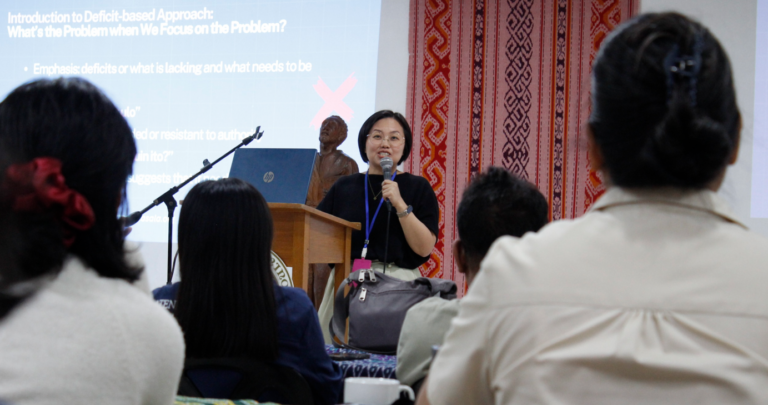
While Emmaus does not have direct programs for young people, we have “extended a hand” to them through the three-day workshop “Accompanying Young People: Psycho-spiritual Perspectives” which was designed for formators, campus ministers, guidance counselors, mental health practitioners, and leaders who are journeying with youth and young adults.
Emmaus has always grounded itself in the realities each person goes through, whether they are religious, clergy, or lay. That’s why this workshop explores the unique challenges and opportunities of accompanying young people today. Drawing from both psychological insights and spiritual wisdom, it offers practical tools for understanding their inner world, supporting growth, and guiding them with empathy, clarity, and hope.
Through this program, youth formators are able to (i) understand the context of young people by looking into their realities, issues, and struggles, (ii) learn ways of accompanying with care through mindful and attuned presence and the strengths-based approach, and (iii) ground themselves by forming from within a holistic view of youth wellbeing, tapping on spirituality as a resource, and making space for the person of the companion.
Its first run was in Cebu Center for Ignatian Spirituality Jesuit Retreat House last July 8-10, 2024 with 70 participants. As a new workshop, the team behind it didn’t have high expectations in terms of registration, but was later on surprised that many youth formators coming from different backgrounds and places in the Philippines wanted to be part of it. Clearly, there was a clamor for a workshop for youth formators that provides psycho-spiritual perspectives.
To address the need of those in Metro Manila, Emmaus had the 2nd run of this program in Manresa Retreat House, Quezon City on March 20-22, 2025 with 75 participants. This was followed by a requested run by the Office of the AVP for Ignatian Spirituality Formation (ISF) of the Ateneo de Manila University in Faber Hall last May 14-16, 2025 with 47 participants.
This workshop is a space for youth formators to not just listen to input, but to also reflect on one’s inner journey as companions to young people, share with a dyad partner, ask questions through Q&A portions, group discussions, and a group practicum.
Accompanying Young People The Emmaus Way
As part of the team of this workshop, I find myself not just a facilitator but also a learner and a co-journeyer with my fellow youth formators. I myself am being formed and accompanied, humbly accepting where I am in my journey of being a companion to young people, what I should start doing, stop doing, and continue doing, and what I look forward to as I practice what I teach.
While reflecting on the pressing need to equip youth formators today using the psycho-spiritual approach, I cannot help but go back to the Emmaus story in the Gospel of Luke.
- Just like how Jesus met the disciples on the road while they were conversing and debating, we are invited to meet and encounter young people where they are in this modern and digital age: in social media, in their areas of interests, and in the topics they truly care about.
- Just like how Jesus asked “What sort of things?,” we are invited to engage in authentic conversations (without any hidden agenda), and be fully present to listen to what they have to say, honoring them as experts of their story, and giving them opportunities to express themselves—in verbal, written, and many other creative ways.
- Just like how Jesus received the disciples with their disappointment, disillusionment, and sadness, we are invited to receive their raw emotions (joy, sadness, fear, disgust, anxiety, envy, embarrassment, ennui, etc.) and validate them in a developmental stage that is both promising and challenging.
- Just like how Jesus gave the impression that he was going on farther, we are invited to allow them to navigate life on their own while also being available for them when they need companions and say “stay with us.”
Hopefully, by creating and holding sacred spaces where they will feel seen, heard, loved, and empowered, curiosity begins—curiosity that opens their eyes and makes them recognize the risen Christ and say “Were not our hearts burning [within us] while he spoke to us on the way?”
Raine Eguico is the assistant programs officer of Emmaus Center for Psycho-Spiritual Formation and Accompaniment, a Jesuit ministry that fosters psycho-spiritual integration towards healing and wholeness through formation programs and accompaniment services. She is a coordinator of formation courses for formators (religious, clergy, lay) and a facilitator of psycho-spiritual recollections, retreats, and workshops for young people and lay groups.
She holds a bachelor’s degree in Speech Communication, a Masters’ in Religious Studies and a Master’s of Education, major in Marriage and Family. She is a licensed professional teacher who taught Christian Living Education and Humanities and Social Sciences subjects in an all-girls senior high school for two years. She was also a lay missionary for young people for about eight years.