
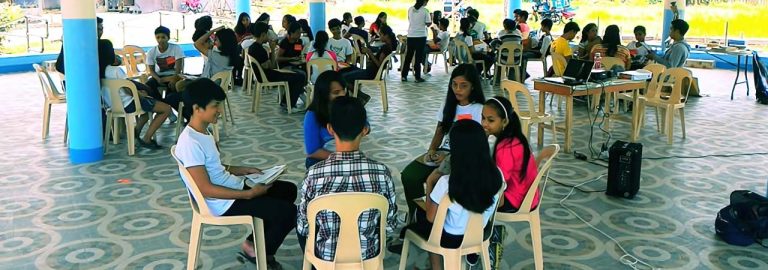
Jesuits: Their Spirituality and the Transformation of Society
Disturbances and Callings
I used to believe in God until I felt the church didn’t. After hearing too many homilies that attempted to justify disasters and tragedies as divinely ordained, I became an atheist in my first year at Ateneo. The rituals, the talk of heaven, and the afterlife that provided me with security and a sense of belonging became hollowed and empty. I could not embrace a way of life disconnected from the hard question of pain and suffering that was so absurdly blatant in the country I lived in. I wrestled with these questions in the same way Job lamented his suffering. What answers does the Church have for the evil we see around us? What can our faith say to someone who is hurting and in despair? Where is God’s love in this reality?
The latter part of my Ateneo education introduced me to the social vision of the Church, liberation theology, and Ignatian Spirituality. I felt a stirring inside, as if embers that had grown quiet were lit. I resonated deeply with the language of Ignatian Spirituality that put emphasis ion engaging with the world, and animating our faith through the pursuit of social justice, peace, and the integral development of every human being. I was attracted to the idea of genuine witnessing, of “draw[ing] people to Christ not by loudly discrediting what they believe, by telling them how wrong they are and how right we are, but by showing them a light that is so lovely that they want with all their hearts to know the source of it.”[1] As I heard testimonies and stories of Ateneans who, inspired by the Gospel, gave their lives to the service of the nation and our countrymen, I found myself desiring to be like them. The door leading me back to God began to open.
Finding God in all Things
The catechism I grew up with divided the sacred from the secular, the holy from the “unholy”. It gave me such relief that Ignatian spirituality recognizes divine presence in every aspect of existence, and invites people to engage with the world rather than withdraw.
I’ve often heard that the Church was only about the salvation of souls, but it became clearer to me that integral to the mission of “helping souls” is responding to the needs of persons – body, mind and spirit. The work of making the world a better place for everyone, most especially the poor is a core concern of the Church, contrary to what I’ve come to see and believe.
Jesuit Spirituality sees God in every moment, every struggle, and every face. It is a world-affirming spirituality that understands God as intimately involved in the world; not distant nor detached, but present in time and space, always near us.
Responding with Love and Courage
It was late at night in October 2015. Our boat, locally called a bote, floated quietly over the waters of a river. The motor had broken down and we had been waiting for over two hours for rescue. The air filled with laughter as we joked about the situation we found ourselves in. This was only my third month in this Jesuit Social Apostolate, Simbahang Lingkod ng Bayan. In that boat, I found myself asking, albeit in a joking way – how did I end up in this ministry?
We were in Arteche, Eastern Samar, on our way to a barangay to conduct political formation programs, and disaster preparation workshops. It was a place never visited by politicians, and usually forgotten in times of disaster. We were going to the peripheries, in response to the call of the Gospel. Earlier on I was told that the water was contaminated and I could get amoebiasis. Thirty minutes into the boat ride, phone signals went flat.
I think I found God there. I’m just not sure if it was because of panic or faith, or both.
In 1975, during the General Congregation 32, Fr. Pedro Arrupe, SJ, then General of the Jesuits worldwide, declared that “the mission of the Society of Jesus today is the service of faith, of which the promotion of justice is an absolute requirement. For reconciliation with God demands the reconciliation of people with one another.” At its heart, Ignatian Spirituality embraces the work of social transformation.
Jesuits boldly responded to this call. The mission was further animated by the wave of renewal that came from Vatican II reforms, leading to the birth of social institutions that attempted to concretize the love of God into genuine service of the poor. Jesuits led these social apostolates. They wrote rigorous political and social analysis to understand the causes of oppression and structural sin. They empowered grassroot communities and collectivized them into action. Their energies were spent attempting to dismantle structures of injustice.
Through the many social apostolates of the Jesuits in the Philippines, a spectrum of issues was responded to – agrarian reform, indigenous people’s concerns, housing, living wages and labor issues, human rights abuses, environmental sustainability, and many more.
These institutes continue this good work today, led now by individuals who draw inspiration from Jesuits and their spirituality. Lay collaborators work closely with Jesuits on this shared social mission. They also responded to the stirrings in their hearts, answered the promptings of the Holy Spirit and turned from richness and gains, to be at the service of the poor; “men and women completely convinced that love of God which does not issue in justice for others is a farce[2]”.
Stubborn Hope
Back in the early years of the Duterte administration, amidst all the extrajudicial killings, the excessive use of violence and fear, and threats to our country’s democratic institutions, I found myself grasping in the dark for an end to the madness that was unfolding before us. I attended forums where wailing mothers shared stories of how they lost their husbands and sons to the police and vigilantes. I was in meetings with civil society leaders discussing the dangers of how legal processes have been weaponized to silence opposition and harass media outlets. It was a difficult time. And for those of us who worked for social transformation, it felt like the country was regressing. Jump forward to the 2022 elections, and to the shock of many, the Filipino people elected the son of a dictator that the country removed from power in a peaceful revolution in 1986.
It was the end of another one of our civic education workshops, Kuwentuhang Bayan. Our team, was busy packing up and taking down the materials that littered the conference hall of Cardinal Sin Center. One was on a stool removing the tarp illegally taped on the ceiling, others were hunting down every precious pen and marker for future use.
A sister in her crisp and startling white habit exclaimed: “Ito ang kulit nito e! Ang daming email na si-nend sa’kin.”. Sr. Eva, one of our participants, wearing a big smile, refers to one of our SLB team members. She wasn’t supposed to be at the event but decided last minute to attend. She came to the workshop discouraged by the economic and political situation of the country. But by the end of the workshop, she found herself inspired to write civic formation modules that would help shape the youth entrusted to her care. “Salamat! Nabuhayan ulit ako. Ito talaga ‘yung kinailangan ko. Salamat talaga ha.”
Social transformation feels like a David and Goliath story. The temptation to give in to despair constantly looms. But in recent years, I have been reminded of what it means to be stubborn about choosing hope no matter how hopeless things may seem.
Just like Sister Eva, I find myself at these events celebrating my fortune to be surrounded by people who pursue the same mission and speak the same language of hope. For those of us in the Jesuit social apostolates, the gift of Ignatian Spirituality continues to anchor us, and allows us to persevere. The companionship makes the journey less lonely and, more importantly, less impossible. It is, I imagine, the same companionship that gave consolation to St. Ignatius and the first companions.
We choose to be persistent in hope not because of what we can do but because of our God who labors with us. The companionship is not only about us but about the One who called us to this mission together. Because of this we can continue to move forward.
We act, because in faith, we know there is always hope.
[1] L’Engle, M., & Chase, C. F. (2001). Madeleine L’Engle herself: Reflections on a writing life. Shaw Books.
[2] Pedro Arrupe, 1973, “Men for Others” – https://jesuitportal.bc.edu/research/documents/1973_arrupemenforothers/
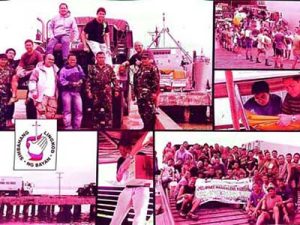
SLB’s Engagement with Disaster Relief
|
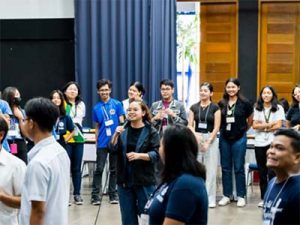
Kuwentuhang Bayan Session with Ateneo de Naga University
|
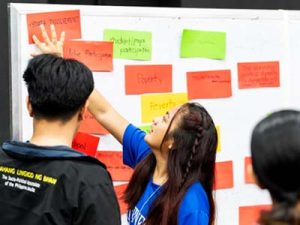
Kuwentuhang Bayan Session with Ateneo de Naga University
|
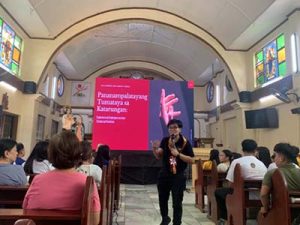
Session on Catholic Social Teaching with San Lorenzo Ruiz Parish-Aniban, Bacoor Cavite
|
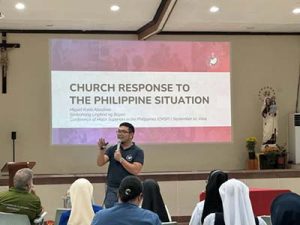
Church Response Panel Discussion with the Conference of Major Superiors in the Philippines
|

Kuwentuhang Bayan Session with Ateneo de Davao University
|
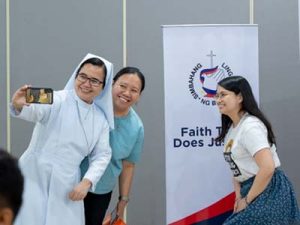
SLB 38th Anniversary Celebration
|