
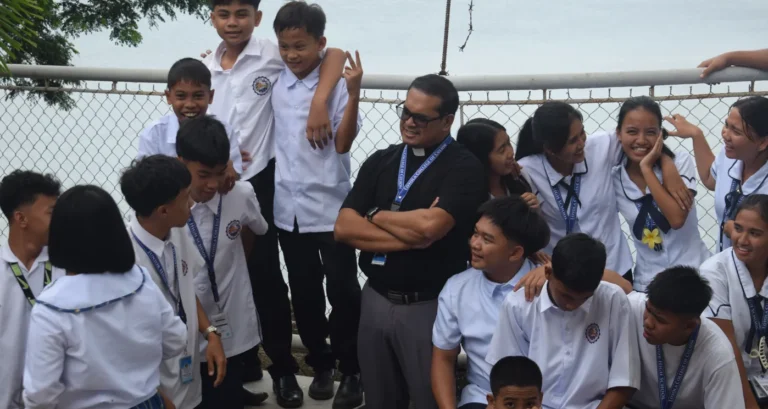
Not many people know that nestled on the beautiful island of Culion in the north of Palawan is a small Jesuit school that has quietly stood for 90 years: The Loyola College of Culion (LCC).
I am an alumnus of LCC, back when it still offered college courses. Older generations might remember it as St. Ignatius Academy. There was a time when children could begin their pre-school here and continue all the way to college. Most professionals you meet in Culion— teachers, local government workers, medical professionals—were formed by LCC. Today, we only offer junior and senior high school.
We don’t have the luxuries of bigger Jesuit schools. No projectors or televisions in every classroom. No tall buildings or a well-stocked library. But we do have a beautiful view of the sea seen through the old wooden panels of our classroom windows. And we have the same heart and trademark of Jesuit education. We strive to form men and women for others. In the spirit of cura personalis, we care deeply for the young people in our small island community—most of them scholars, and many of these scholars are Tagbanwa.
For the past seven years, I have served as LCC’s Indigenous Peoples (IP) Coordinator. I have witnessed how the school transformed the lives of the Tagbanwa, and how, in turn, our indigenous community has transformed the school.
The Tagbanwa are the ancestral owners of many islands in Palawan. They are one of 110 ethno-linguistic tribes in the country, each with their own rich culture and tradition. Yet our indigenous peoples remain among the most marginalized, poor, and disadvantaged. For the Tagbanwa, being scattered across smaller islands makes it even harder to access basic services and resources, particularly healthcare and education.
I have seen these struggles firsthand. In college, LCC had immersion programs where we lived with IP communities. That was my first exposure, and what I saw stirred in me a desire to learn more and to help. I accepted invitations from Jesuit Volunteers to visit other island communities. What began as casual volunteering became a regular engagement with Cartwheel, an NGO focused on culturally relevant education for IPs.
I started as an adult literacy volunteer. I taught older tribe members how to read and write. For us, these are basic skills. For them, these are shields—protection against manipulation. Against greedy and corrupt individuals who often take advantage, having them thumbprint documents they can’t read, only to find out later they have unknowingly given away their land or fishing grounds.
Eventually, I was hired by Cartwheel and assigned to a community. I remember sitting on a bench outside our staff house one night, beside Lilia Diaz, a fellow volunteer and a Bayaning Pilipino awardee. We were looking at the stars twinkling so brightly in the clear Palawan sky, wishing and hoping for a better pathway for Tagbanwa children to access quality education. Back then, no scholarship program existed for IPs in Culion. Today, I find myself on the other side of that dream—now serving as LCC’s IP Coordinator, overseeing scholarships, IP student formation, and managing the IP dorm.
I am living proof that LCC’s impact on indigenous education began even before the IP programs were built. The Jesuit formation carved in us, non-IP students, a space to care for people around us who are marginalized and vulnerable. Culion is a small community. But even in small communities, it is easy to get lost in our own comforts. LCC helped direct our gaze outward, to those who need our attention, and taught us to respond with compassion.
Today, most of our IP scholars are the first in their families to pursue formal education. We currently have 65 scholars. What began with students from three IP communities, has now grown to include scholars from 20 communities within Culion and 5 communities more from other municipalities. But gaining community trust wasn’t easy. Just because a scholarship is offered doesn’t mean people believe they deserve it.
We can hand someone a toolbox with instructions to build a chair, but if they don’t believe they can build it, they won’t even open the box. Years of discrimination and abuse made the Tagbanwa distrust the system, and worse, themselves.
Lor* was like that. He was bright but didn’t want to continue his studies. I invited him to apply to LCC for Senior High School. He said he needed to work for his family. His parents, however, wanted him to finish school. I sensed the hesitation wasn’t really about work. Eventually, he admitted that he was anxious and scared—that he would not fit in a private school, that it might be too difficult, too different, and that he might just fail in LCC.
What we have learned from our IP scholars is that inclusion isn’t just about creating access for those who would otherwise be excluded. It’s not just a strategy or a program.n It’s a commitment to truly seeing those on the margins and making room for them. It’s about relational belonging. But good intentions are not enough. Intentions need structures. And structures must be grounded in culture and context.
Through the years, the Jesuits and LCC have reached outward to IP families and communities, assuring them that their children would be nurtured with respect for their heritage. At the same time, we looked inward, working to build a school environment that provides reliable care so that our IP learners develop a stronger sense of security and trust. There are regular formation sessions and tutorials. Our IP scholars are supported academically and even in extracurriculars. Many have become student leaders—in clubs, classrooms, and student government. LCC believed in them, and it has been an honor to witness them begin to believe in themselves.
And while they have changed, they have also changed us. Our IP learners have helped LCC grow. Their stories, needs, and insights have shaped our practices and made us a better school.
It’s always a joyful moment when I see Tagbanwa parents and grandparents visit the school for the signing of the scholarship agreement. They arrive in plain clothes, sometimes barefoot. Faces sunburned and weary from boat or land travel, yet always smiling. I welcome them into the IP Dormitory, which a tribal elder once called, “Bahay Pag-asa”—a House of Hope. For them, it is more than just a building. It is a visible sign of their hope for their children, a reminder that they are welcome and accepted at LCC.
Things have changed since the early days of the IP Ministry. Because of their experience at LCC, the Tagbanwa now know they have the right to quality education. They now claim it. They defend it. Lor enrolled and graduated with us. He did well. He went on to college in Puerto Princesa and is now in his final year. There are still setbacks—students who drop out, others who stop their schooling. But our work in LCC is shaped by Ignatian spirituality, which refuses to leave the most vulnerable behind. The greater mission is in rallying the wider community to transform the systems that keep our indigenous youth from truly thriving.
At Loyola College of Culion, the journey with our indigenous learners is not a story of charity but of solidarity. Not of outreach but of accompaniment. It is a journey of pagtubo—of growth, not just for our students, but for our whole community. Truly, LCC is not just a school on an island. It is Bahay Pag-asa. Where the Tagbanwa are not just included, but embraced. And where Jesuit education continues, quietly but powerfully, to shape a more just and compassionate world— beginning on our island, rooted in our communities, and lived out through our learners.
*not his real name.
–
Kathlea Jay Roxas is the coordinator of the Indigenous Peoples Ministry in Culion and dorm mother of the St. Francis Xavier IP Dormitory, which houses about 35 high school IP students and supervises 30 more in various boarding houses. Although she is not a member of the Tagbanwa, Culion’s indigenous community, she is deeply respected by both elders and community members for her steady service and commitment. Her involvement with the IP ministry began while she was a college student at Loyola College of Culion, joining a Cartwheel Foundation volunteer visit to IP communities. After completing her AB Literature degree, she volunteered to teach in the Adult Capability Program and Early Childhood Education in the island communities of Alulad, Cagait, and Chindonan. From her early work as a literacy teacher helping adults write their names and understand their rights, she has steadily grown into a trusted advocate, mentor, and companion for Culion’s indigenous youth and families.