
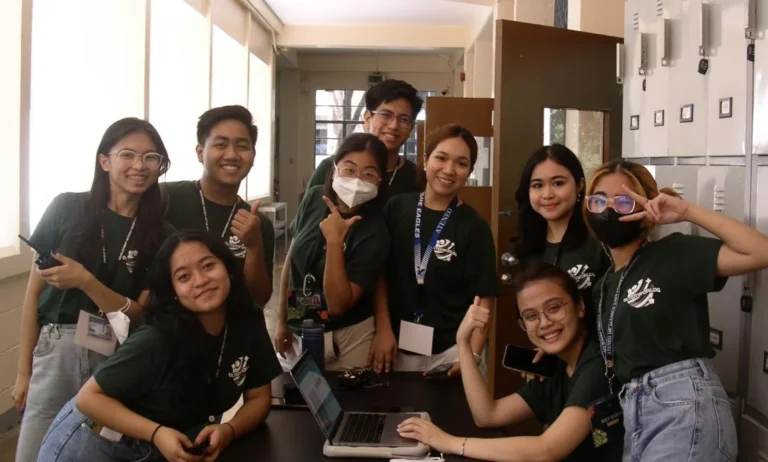
Even though I’m not always seen as the “student leader” or “youth leader” now, it took a while to accept that label. Throughout high school, I wasn’t the type to run for student council. I simply enjoyed leading class projects or rallying our section to victory during school fairs and Buwan ng Wika. I often ended up as the one who spoke up to teachers about impossible deadlines or voiced out class concerns. I also found joy in directing and training new members in our high school theater org—less about the spotlight, more about bringing others into their own.
Although I wasn’t holding formal leadership positions, my junior high school in St. Bridget still recognized me with a leadership award during graduation. That was a turning point. I realized that leadership doesn’t always mean a title—it can mean showing up with care, passion, and commitment. It can mean stepping up, not to be seen but for the good of others.
Finding the Vocation of Student Leadership
Coming into Ateneo for college, I never imagined myself leading the Office of Placement and Career Services (OPCS) in junior year, and especially not the Council of Organizations of the Ateneo – Manila (COA-M) in senior year.
Like most bright-eyed freshmen, I joined orgs to meet people, try new things, and explore my interests. Eventually, I learned to find a home in these communities, to foster these found families, and to work in the service of our sectors and advocacies. Over time, I began to see the gaps in how we can make these homes stronger, these families bigger, and these services delivered better.
The possibility of innovation has always been my driver. I found myself thinking: what if we did this better? And while we can suggest change as members, we are able to truly drive it as leaders. That desire to improve—to imagine, build, and commit—nudged me into leadership.
But it wasn’t an easy decision. I remember asking a friend to help me discern which org to commit to going into junior year. He asked, “Where would you be happiest? And in order, goes orgs A, B, C, and D. Funnily enough, I choose C and D. They were the more difficult ones—not where I’d be happiest, but where I saw the most room for growth, the most need, and the most potential for transformation.
As I’ve learned through our senior course, Discerning Life Questions (DLQ 10), a vocation isn’t just what you want to do—it’s what you’re called to do. I never dreamed of being in these leadership positions, but in hindsight, I was being led toward them. In the Ignatian tradition, vocation emerges at the intersection of desire, giftedness, and mission. And leading these orgs, as difficult as it was, felt like saying yes and working towards something, not out of ambition but out of service.
Servant Leadership & Serving from Behind
One of the biggest internal hurdles I faced was my aversion to being “in front.” In my orgs, I’ve always found joy in doing things with others, not over others. I loved scouting divisoria for prop materials, creating those DIY paper cutting decorations, putting up those tall tarpaulins, preparing the participant name tags, or even answering all those messenger and email queries. I lived for those unexpected errands, the typo-ed certificates, the forgotten tokens—and of course, the late-night egresses, cleaning up, blasting music and celebrating the successful project that has been.
In many ways, I have always preferred to work behind the scenes. In theater, I found deep joy in being backstage, helping others find their footing in the spotlight. In orgs, I thrived in laying foundations, structuring delegation, and creating those spaces for individuals to shine. Even literally on field trips, I liked to stay at the back, quietly checking if everyone was accounted for.
And somewhere along the way, I learned that this, too, is leadership. Whoever said a leader must always be in front? There’s something powerful about standing behind, pushing others forward, and ensuring no one gets left behind. In practice, it’s leadership that listens, accompanies, and uplifts. This I learned was servant leadership.
The Power of Community
What truly makes the Ateneo org community as vibrant and transformative as it is, is the deep sense of shared purpose. COA-M has been privileged to help nurture this through collaboration, shared practices, and spaces for accompaniment. We grow not by competing but by building one another up.
One of the best expressions of this was the EDSA Commemoration, a collaboration across various student groups that worked almost entirely behind the scenes. Organizations shared their bulletin boards and digital platforms to promote the walkout. The student council coordinated with different schools, emailing professors to inform them of the activity. A simple anonymous Facebook event quietly gained traction as students saw their peers joining.
On the day itself, Sanggunian officers walked from classroom to classroom, inviting students to join the walkout. They then enjoined the community to leave their mark on the handprint mural. The Blue Babble Battalion’s noise barrage echoed throughout campus, the Ateneo College Glee Club’s voice drew others in, and the College Ministry Group led us in song. It was a patchwork of different efforts woven into something collective, reflective, and powerful.
That is the power of community, a shared movement. In the Ignatian tradition, we speak of magis—doing more for the greater good we are called toward. And we are able to best reach the greater good not alone, but as a community that draws strength from one another.
For the Youth and Our Formators
The work of students would never be possible without the formators who walk alongside us. Their presence may not always be visible, but they are constant. They encourage us to reflect, to discern, and to listen deeply. In moments of doubt or difficulty, it was often their quiet assurance or guiding questions that helped me find my way again.
To our formators: thank you for your trust, your mentorship, and the space you give us to grow, fail, and try again.
And to my fellow youth: may we never lose that bold and restless spirit that insists that things can change, and we can help change them. May we keep asking difficult questions, imagining better ways, and committing to act. Let us lead not for titles, but in service of others. Let us lead not to be at the front, but to make sure everyone comes along and no one is left behind.
Leadership is not a spotlight but a path of accompaniment. And in our shared pursuit of justice, care, and meaning, may we keep walking together—with love, with purpose, and always with hope.
Kayla is a recent AB Development Studies graduate. She was an active member of the ADMU Org Community having taken up 10 Officer Board Positions and 65 project roles across 8 organizations.
Notably, she served as the President of the Placement Office Student Arm, Co-Chairperson of the Seniors Alliance and the President of the Council of Organizations of the Ateneo – Manila (COA-M). Currently, she is the Nation Network Coordinator of SDSN Youth Philippines.
Her formation in the Ateneo’s org community, learned passion for service, and exposure to Ignatian Leadership guides her current roles in contributing to national development by empowering the youth to facilitate sustainable solutions.