
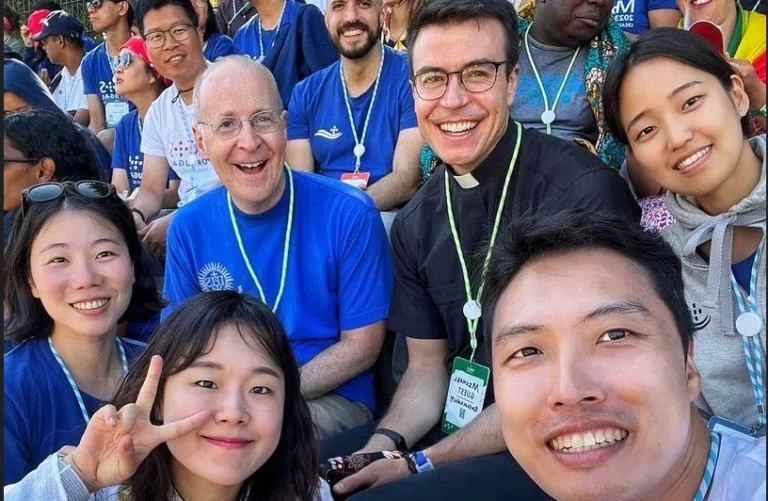
Young people today often present confident, curated versions of themselves online, while experiencing unprecedented rates of anxiety and loneliness. Many have been “sacramentalized” but not evangelized, having received the sacraments of initiation but never having truly encountered Jesus Christ.
As Pope Francis observed in Evangelii Gaudium, “So many of our brothers and sisters are living without the strength, light, and consolation born of friendship with Jesus Christ, without a community of faith to support them, without meaning and a goal in life.”
Those engaged in youth ministry today must face these challenging realities and respond in a manner that connects with the youth.
Young people spend a significant portion of their lives online. They will continue to engage with digital media whether the Church is present or not. The question is whether we will meet them there with authentic witness, genuine care, and the life-giving message of the Gospel.
The Imperative for Digital Engagement
Using social media is not a replacement for an embodied, sacramental community, nor is it necessarily the most fruitful avenue for preparing the way of the Lord. Still, Christians cannot ignore the world of media, particularly when it may be one of the very few avenues by which to reach many who do not know Jesus Christ.
Pope Francis emphasized the need for a pastoral strategy that “would actually reach everyone without exception or exclusion.” He stressed that “the joy of the Gospel is for all people,” but a significant number of young people are not finding that joy. If the Church is truly going to reach everyone, digital technology offers one of the few ways of connecting with many who would not otherwise step inside a church door.
Just as Saint Paul became “all things to all people,” the Church needs to take advantage of all possible paths that could bear fruit. Most people already possess the technology to produce content that could potentially go viral. The stakes are too high to remain on the sidelines.
Unlike traditional one-way broadcasting, social media creates space for relationship-building, dialogue, and authentic encounter. When someone shares content that resonates, comments thoughtfully, or engages in meaningful conversation, they create opportunities for the Gospel to take root.
Strategic Approaches to Digital Youth Ministry
There are important considerations to keep in mind.
1. Listen Before You Speak
Pope Francis emphasized that evangelizers must “take on the smell of the sheep” and “keep their ear to the people to discover what it is that the faithful need to hear.” Digital media offer rich opportunities for this kind of listening.
People often express themselves more freely online, providing feedback that those in ministry might never otherwise receive. Young people who might never go to church—and thus people Church leaders are far less likely to hear from—can send messages, leave comments, and share their real thoughts and struggles. The question is whether the Church will take advantage of such opportunities to truly listen.
2. Ignite Desire
The Church’s challenges run deeper than young people not attending Mass. Many have never had their religious imagination opened or their desire for God ignited. There’s a need to start further back. New media have a role to play in this work.
Rather than sitting on the sidelines while brands and influencers use media to appeal to baser desires, evangelizers can use these same tools to cultivate longing for what is true, good, and beautiful.
Video content proves particularly powerful for this work. It can show rather than simply tell. Podcasting is another promising medium that can facilitate substantive conversation.
3. Practice Digital Hospitality
Using digital media effectively for ministry requires maintaining an attractive online presence—keeping one’s “front door” open through websites and active social media engagement.
Just as consumers read reviews before visiting restaurants, people check things out online before making commitments in the physical world. Getting one’s digital house ready for guests can facilitate connections that transform visitors into friends and followers.
4. Propose, Don’t Impose
Pope John Paul II emphasized that the Church proposes rather than imposes, addressing people with full respect for their freedom. Popes Benedict XVI and Francis noted that the Church grows by attraction, not coercion. Online, there’s simply no other option. People online don’t owe us their attention.
Just as Jesus didn’t demand total dedication from the beginning but invited people to “come and see,” contemporary evangelizers must show why someone would want to take a metaphorical walk with them. The Church isn’t selling a product, but it must still attract in order to facilitate encounters with a Person.
The Indispensable Role of the Laity
Priests and religious have a role to play in using social media for ministry, but lay people are the primary digital evangelizers.
Peer-to-peer sharing shapes social media culture. Lay people sharing meaningful content within their networks can reach people the clergy might never encounter.
Pope Benedict noted that young people have “an almost spontaneous affinity for the new means of communication.” They are the natural leaders in evangelizing what has been called the “digital continent.” The most effective evangelizer of the youth is another young person.
Realistic Expectations and Perseverance
Pope Francis famously stated in Evangelii Gaudium how he prefers “a Church which is bruised, hurting, and dirty because it has been out on the streets.” He extended the metaphor to include the digital highway. One trying to evangelize online has an up-close look at what can be a toxic digital environment.
Trolls exist. Negative comments are common. Even more challenging than criticism is silence. Most online content is largely ignored. YouTube hosts more than two billion active users, but the vast majority of videos never reach 1,000 views.
While online witnesses may not face the martyrdom experienced by missionaries throughout history, there are many opportunities for self-sacrifice in digital ministry. Success requires patience, authenticity, and a willingness to “die to self” when efforts generate little immediate response.
A Personal Journey in Digital Ministry
In 2017, I started the “One-Minute Homily,” recognizing the shift toward video content and the crucial importance of brevity online. Rather than creating something entirely new, I built on work I was already doing—preparing weekly homilies—but adapted the format for digital culture.
The key insight is that you don’t necessarily need to start something entirely new—you might be able to build upon work you’re already doing, adapting it for digital integration and online culture.
Later, I began the “One-Minute Jesuit” series, hoping to reach the religiously indifferent. While most of my followers are practicing Christians, I hope to create content they feel comfortable sharing with their less religious friends. There is a need to bridge the gap between the engaged and the indifferent.
The Urgent Call
The most effective missionaries have always adapted their methods to reach people where they are. Today, young people—and not-so-young people—are online. Social media cannot replace the sacraments, but for a generation shaped by digital technology, it may be one of the few ways to begin the conversation that leads to greater Church participation.
In a world where so many live “without the strength, light and consolation born of friendship with Jesus Christ,” the time for digital engagement is now. The harvest is ready, but the workers are few. Fortunately, the tools for reaching every corner of the digital vineyard are already in our hands.
——————
Fr. Michael Rossmann, SJ is a Jesuit priest at Loyola University Chicago. He serves in campus ministry, teaches theology, and is the superior of Arrupe House. Father Rossmann earned a doctorate in missiology from the Pontifical Gregorian University in Rome and has graduate degrees from Loyola University Chicago and Boston College. He started the “One-Minute Homily” and “One-Minute Jesuit” video series and posts a weekly video reflection at amdg.substack.com. Father Rossmann is the author of The Freedom of Missing Out and Online Pre-Evangelization.