
Like the shepherds in the Gospel who went in haste to Bethlehem to pay homage to the newborn Savior, we come with joy and hope before the Eternal Lord of all things. Following the Spiritual Exercises, “we raise our minds and think how our Lord is looking at us… Then we will make an act of reverence or humility” (SpEx 75). Staying in this same scene of utter deprivation, we consider how the Lord has chosen to “be born in the greatest poverty; and that after so many hardships of hunger, thirst, heat, cold, injuries, and insults, he may die on the cross! And all this for us!” (116)
Part One.
For our reflection tonight, let us consider three invitations. First, we are invited to see how the Lord has been present to us in the past year. In the Lord’s presence, we recall the year, perhaps with a sigh. 2025 had its share of difficult upsetting events: the revelation of massive corruption in government, shameless leaders-turned-thieves who have betrayed our people, the guilty still unpunished, national anger waning. We had stronger, more destructive typhoons and floods, more people poor and hungry, more people suffering from mental and emotional health problems, many of them in our own personal circles, a significant number of them young. There is yet no end in sight to the violence and displacement in Gaza, Myanmar, Ukraine, Sudan. Migrants and refugees continue to endure suffering and persecution in some places.
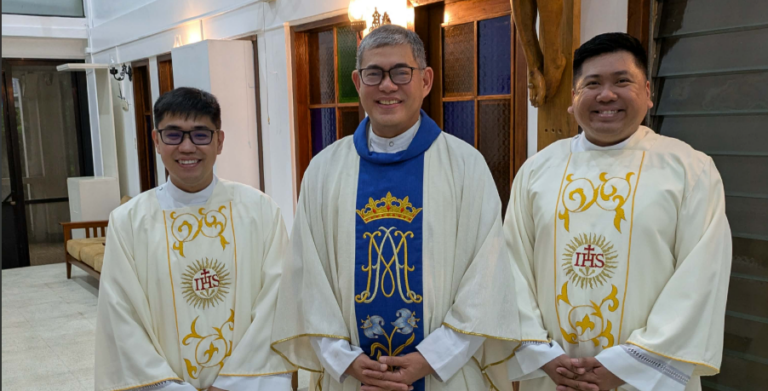
But there are also many things in 2025 that make us smile. Our young people are more aware of sociopolitical issues and have become actively engaged, mobilizing community action and speaking out strongly. More lay people are involved in political and Church affairs, taking lead roles (and Churchmen do not always have to organize and lead as in times past). Synodality is slowly taking root, developing a culture of discernment, participation and shared leadership in communities. And Jesuit vocations are growing, thanks be to God: seven new novices last August, up from four the previous year. Three were ordained priests, and three deacons. Novitiate numbers remain steady in other younger units of the Society like VIE, ETR, MYN. While some smaller regions/provinces are unifying, two new provinces were erected recently.
Indeed, “The LORD has blessed us and kept us! The LORD let his face shine upon us, and was gracious to us! The LORD looked upon us kindly and gave us peace!” (Num 6:24-26) God blessed us in His mercy! (Ps 67) We know from our own experience that where darkness pervades, light shines brightest; where we are at our weakest, we feel God’s power most intensely.
Part Two.
As we journey into the new year of our life-mission, we are invited to accompany and serve the poor and the vulnerable. The Lord identifies himself with the poor and embraces the poor from the beginning as we see in our gospel today from Luke. Not only does he take on human flesh and is born to ordinary parents in poor conditions, but he also attends to the lowly and the outcast. The shepherds, numbered among the lowest class in society, are given the privilege of being the newborn Child’s first visitors, of seeing His face shine upon them. The Lord draws them from afar, desires to be close to them, welcomes them, gives them the gift of encounter.
We must find ways as individual Jesuits and as communities to seek and serve those on the margins, wherever we are. A fruit of the spiritual conversations of the Meeting of Superiors and Directors of Work last October is this important reminder: the poor and vulnerable are subjects and agents of our shared journey, not simply objects of our ministry and recipients of charity. We have to know them and be familiar with their lives and stories so we can truly walk with them. We have to grow in friendship with them, and understand who, where and how they are. They, too, can teach us many things in our life in the Lord, even challenge us to “live more simply with less” (GC36 d1 n6).
I remember the experience of a Muslim student in one of our universities. Even with a scholarship grant, his family finances were not enough. At times he came for class hungry as he could not afford lunch, so he would just drink from the water fountain on campus. Now a lawyer and a lay partner in the university, he would smile each time he saw the water fountain that tided him over his hunger. It was good that the university learned of his problem and gave him a meal grant on top of the scholarship. It’s reassuring to know that in our schools, we have ways to know and support those in great need so no one goes to class hungry.
How can we deepen our commitment to the poor and vulnerable? In our regular pastoral commitments, do we have space for the poor—celebrating Masses in a poor community, or giving the Exercises to disadvantaged communities? Even in our effort to promote vocations for Ours, Fr General reminded us at our Meeting of Major Superiors (MMS) about the importance of working with the poor: “We need to ask Jesus to call many to join this least Society, to be pilgrims with us in the service of Christ’s mission, to carry the cross of Jesus with him, to lighten the burdens of so many people today who are wounded and suffering, sick, poor, excluded” (MMS, Oct 2025, emphasis added).
Part Three.
We are invited to stay close to Jesus, to remain focused on Jesus who calls us to labor with him in his saving and reconciling work. In the events leading to the Nativity and following, Mary’s witness is an important reminder. Her life-choices center around Jesus. Her life-mission is about serving and accompanying the Savior.
That recent MMS in Rome opened with a retreat with Fr General. Among his prayer points was: “Whatever the challenge, we want Jesus to be at the center. How do we keep Jesus at the center of our mission?” Pope Leo affirmed this desire in our subsequent audience with him, as he reiterated our mission to the frontiers: “Remain close to Jesus… No frontier will be beyond your reach if you walk with Christ.” We are servants of the Mission of Christ entrusted to the Church. We have Jesus to lead us in these frontiers. Let each day be an opportunity to come closer to Jesus, the center of our life-mission, whose Name the Society Society bears, and under whose banner we vow to serve.
Mary stands as a guide and witness to all. “And Mary kept all these things, reflecting on them in her heart” (Lk 2:19). Following her example, we are to treasure and nurture our inner life, committing ourselves more deeply to prayer and our life in the Spirit. At Cana when she pleads with her Son to turn water into wine, the words she speaks to the servants can very well be the constant reminder of a Mother to each of her Jesuit sons: “Do whatever Jesus tells you” (Jn 2:5).
On the Solemnity of Mary, Mother of God, let this be our prayer: Mary, Mother of God, mother of our eternal King and universal Lord, and mother of our least Society, in whose motherly presence we all promised to be chaste, poor and obedient like Jesus, place us with your Son and help us to stay close to Christ, poor and humble.
Homily preached on 1 Jan in the Oratory of St. Ignatius, Loyola House of Studies, Loyola Heights, QC, for the Province New Year Celebration.