
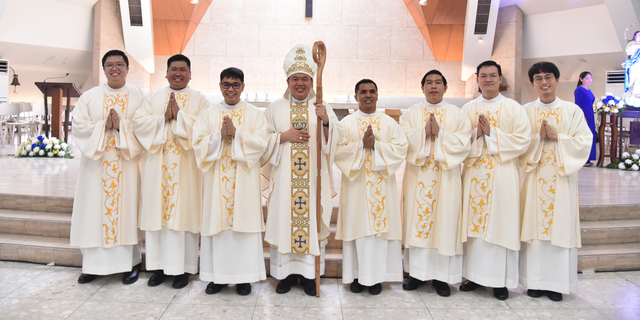
Excerpts from the Homily at the Ordination Mass
Most Rev. Elias L. Ayuban Jr., CMF, DD
(Bishop of Cubao)
About 30 years ago, in November 1995, I was ordained a deacon by your Jesuit confrere, Bp Francisco Claver SJ. The deacons who served at that Mass were my Jesuit classmates, Frs Manny Uy, Manol Montesclaros, and Rene Oliveros. Interestingly, the dalmatics they wore then are the very ones being worn by our deacons in today’s Mass… Who could have imagined that three decades later I would return the favor as the new bishop of Cubao by ordaining seven Jesuits as deacons?
I can sum up my homily by saying and addressing directly our ordinandi: Love Jesus by loving the poor; wash their feet as the path to holiness, and be servants of the Word.
Dilexi Te (I have loved you), the first Apostolic Exhortation of Pope Leo, came out the other day. It’s very timely for this ordination because the first theme that I would like to share with our ordinandi is that God loves the poor. As deacons, you are called to love the poor and to be their friends. As Pope Francis used to emphasize, the poor are not only recipients of our charitable works; they are our true evangelizers.
In his address to the Secretariat for Social Justice and Ecology of the Society of Jesus on 7 November 2019, Pope Francis said, “The poor are privileged teachers of knowledge of God. Their fragility, their simplicity exposes egos, false securities, pretentions, and lead us into the experience of God’s closeness and tenderness.”
In the Diocese of Cubao, we have created a new ministry, the Ministry for Justice and Peace and Integrity of Creation and for the Urban Poor. We have a group of religious institutes catering to the needs of street dwellers especially during typhoons and inclement weather. We are so happy because one congregation offered their place as a safe place where street dwellers can sleep, eat and bathe. I would like to invite more congregations to engage in this ministry to the street dwellers.
When I was in Rome, I befriended a street dweller. Elena was in her early 70s at that time. She was a beggar from Poland. Almost every morning when I went to work, I would meet her and we would talk. One day she told me, “Fr Ely, yesterday I was so happy, because for the first time I felt I belonged to the Church.”
She said that she and around 200 other beggars around the basilica were asked to wear their best clothes and were ushered by Swiss guards to the Vatican Museum for a private tour. No other tourists were around. It was a special day for them. For the first time, she witnessed how beautiful the museum was.
They were ushered into the Sistine Chapel, where lo and behold, Pope Francis was waiting for them. The Pope said to these street dwellers, “This place also belongs to you.” And Pope Francis continued, “I will spend time with you and I will eat with you.” Amazing how a singular experience of closeness to a pastor of the church brings people closer to God!
Do not get me wrong. We love everyone. We love the rich and the poor alike. But if ever you are invited by two friends, one rich and one poor, and your time does not allow you to accept both invitations, I advise you, my dear deacons, to accommodate the invitation of the poor one.
Why? Because your rich friend most likely has other priest friends, but your poor friend probably has only you as a priest friend. He or she cannot repay you. But the Lord promises you’ll be repaid in the resurrection of the righteous.
The message about the poor is not simply about befriending the poor, but also about becoming poor ourselves. I would like to appropriate these words from the book of Revelation that have become the title of the new apostolic exhortation. I have loved you. You have but little power yet I have loved you. In the first reading, Jeremiah feels very poor, very inadequate with little power. Maybe at one point or another in our vocational journey we have asked ourselves, “How can I be a witness when I am so inadequate, so flawed?” Loving the poor is very demanding.
But don’t worry, because as I learned from my theology, an authentic indicator of a true calling is the feeling of inadequacy, of unworthiness. So like in the first reading, the Lord says, “Do not say I am too young or I am so inadequate. To whomever I send you, you shall go. Whatever I command you, you shall speak.”
Second, wash the feet of others. That is the pathway to holiness. We do not become saints by washing our own feet, by self-care. We can only be saints by washing the feet of others.
In your invitation to this ordination, you used the image of washing of the feet because it is the icon of the diaconate, of what it means to serve in the manner of Christ. Interestingly, we always portray the Last Supper as table fellowship. But in today’s gospel from John, the last supper is portrayed by the washing of the feet.
To be a deacon is to kneel where Christ kneels at the feet of others with a towel around one’s waist and love in one’s heart. The towel and basin are not merely symbols of humility. They are instruments of communion. Through them, the Lord shows us that authority in the church is not exercised from above, but from below, in service, in compassion, and in tenderness.
But holiness, my dear friends, is not a solitary journey. It is a communal path. As religious, your distinctive gift to the church is to witness to that holiness together. You are not sent as isolated individuals but as members of a religious community and of the community you are called to serve. We are called not simply to become holy individuals. We are called to build holy communities. We are called not to become individual prophets but to build up prophetic communities.
Lastly, you will be ordained deacons to become servants of the Word, not its proprietors or owners. St Augustine teaches that it is not enough to hear and proclaim the Word. We must love it. When we truly love the Word, we become the Word ourselves. This is holiness by contamination. When we truly love the Word, something marvelous happens. We become what we love. I hope and pray, my dear brother deacons, that the gospel you preach will not be mere sound that passes away, but a living power that abides, shaping your mind, purifying your heart, and guiding your hands and feet in service.
When you preach, let the Holy Spirit speak to you through the Word, as well as through the saints and the learned who studied scriptures. Sound exegesis tempered with your faith experiences make a good sermon. The Holy Spirit who inspires you when you give the homily is the same spirit who tells you to go to the library, open the commentaries, read stories of the saints. As I learned at LST, good pastoral ministry is rooted in sound theology, and sound theology in turn gives rise to authentic pastoral practice.
So my dear ordinandi, love Jesus by loving the poor. Wash their feet as the pathway to holiness. But do it as a community or in the name of the community of Jesuits. And be servants of the Word, not owners or proprietors.
Preached on 11 October in AdMU’s Church of the Gesù, Loyola Heights, Quezon City.